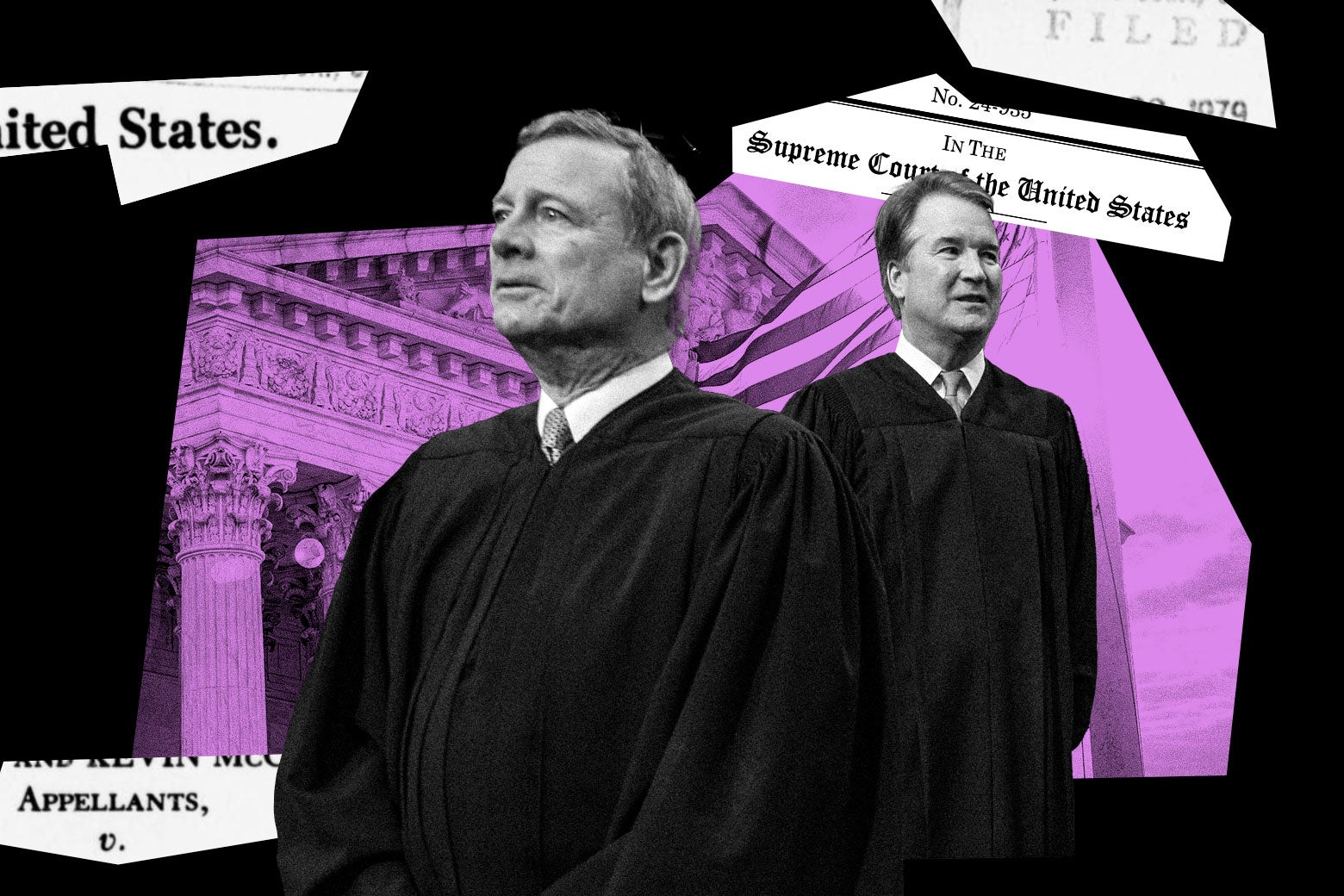
This is part of Opinionpalooza, Slate’s coverage of the major decisions from the Supreme Court. Keep up with all of our Supreme Court coverage and analysis by signing up for weekly email roundups. The best way to support our work—and unlock exclusive legal analysis—is by joining Slate Plus. (If you are already a member, consider a donation or merch!)
The Supreme Court’s staunchest defenders in recent years have come up with a stubborn yet plausible-sounding claim: They say that that SCOTUS, dominated by six Republican-appointed justices, does not actually have a 6–3 split. Instead, they insist, there’s a far more nuanced divide that does not break neatly along political lines. That assertion, always dubious, was blown out of the water once and for all on Tuesday, when the supermajority delivered four conservative 6–3 decisions over sharp dissents from the liberal justices. These rulings—in smaller but still important cases—were a blunt reminder that the GOP appointees remain in total control of the court and frequently wield their power precisely as the Trump administration wishes. But they also illustrated just how aggressively the supermajority is shredding the legacy of right-leaning swing justices who tried to temper their colleagues’ ideological fervor. In one case, this bloc overturned precedent that permitted lawsuits against corporations for human rights abuses. In another, it gutted individuals’ right to sue for damages over violations of their religious liberty and other freedoms. In a third, it gave the government far more latitude to persecute, detain, and deport green-card holders.
What’s alarming about these decisions is not just the outcomes, but the fact that the supermajority went as far as it possibly could in each of them. Again and again, it reached out for expansive holdings that did maximum damage to precedent, congressional authority, and civil liberties. There was, it seems, no member of the supposedly “moderate conservative” bloc that sought to tap the brakes, to exercise caution before radically reshaping the law. All six went full steam ahead in tearing down the guardrails constructed by their more moderate Republican-appointed predecessors. The problem is not merely that the court regularly divides 6–3; it’s that among those six, nobody seems inclined to serve as a check on the others’ most sweeping ambitions. With no more swing justices, the supermajority has no one left to pull it back from the brink.
This dynamic was on full display Tuesday in a trio of 6–3 decisions that cast caution to the wind at the great expense of individual rights and democracy. (A fourth 6–3 ruling had a narrower scope but a similar ideological valence, prioritizing the justices’ apparent antipathy to Cuba’s communist regime over precedent.) Start with Cisco Systems v. Doe. The case began when Falun Gong, a religious movement oppressed by the Chinese government, accused Cisco, a multinational corporation, of developing a mass surveillance system that China used to identify, arrest, and torture its members. The plaintiffs sued under the Alien Tort Statute, or ATS, alleging that Cisco violated international law. For support, they cited a 2004 SCOTUS precedent called Sosa v. Alvarez-Machain, which let courts recognize causes of action under the ATS to enforce “the law of nations.”
In response, the supermajority overturned Sosa. Justice Amy Coney Barrett’s opinion for the court declared that courts may no longer let plaintiffs use the ATS to enforce “norms of international law,” crushing this lawsuit and all others like it. Barrett essentially elevated Justice Antonin Scalia’s partial dissent in Sosa into the law, insisting that he was right all along to oppose judicially crafted remedies for violations of the law of nations. In the process, she gutted the ATS—a law signed by President George Washington in 1789—and slammed the door on countless suits against corporations complicit in human rights abuses.
The dearly departed Sosa was a 6–3 decision that brought together the court’s left and center. What changed since 2004? Simple: Three justices in the majority—Sandra Day O’Connor, Anthony Kennedy, and Ruth Bader Ginsburg—were replaced by more conservative successors who are often eager to rip up their predecessors’ legacies.
O’Connor and Kennedy’s absences, in particular, left the conservative wing without anyone inclined to rein in its antagonism toward international law. As recently as 2018, Kennedy held off a frontal assault on Sosa, preserving its core holding. After his departure, the precedent had no more defenders on the right. Justice Sonia Sotomayor hammered this point in dissent, highlighting how Barrett favored “separate writings” by more conservative justices over a “controlling majority opinion” joined by the now-departed moderates. Her colleagues’ execution of Sosa, she bemoaned, “marks yet another low point in this court’s esteem for its precedents.” The supermajority, she continued, has cut “yet another notch in its belt, unabashedly remaking the law in its preferred image.”
Sotomayor’s lament applies with equal force to Landor v. Louisiana Department of Corrections, Tuesday’s second 6–3 demolition exercise. Justice Neil Gorsuch’s opinion for the court tossed out a lawsuit brought by a Rastafarian inmate, Damon Landor, against the prison guards who forcibly shaved his head despite his religious objections. Landor sued under the Religious Land Use and Institutionalized Persons Act, which Congress enacted in 2000 to protect free exercise behind bars. Lawmakers plainly intended to let inmates sue for damages when correctional officers infringe on their religious liberty. But Gorsuch shut down these suits anyway. He held that RLUIPA is really just a “contract” between the federal government and the states because it was enacted pursuant to the Constitution’s spending clause as a conditional grant of money to state governments. Thus, it cannot bind individual officers who did not “consent” to be sued for damages. As Justice Ketanji Brown Jackson wrote in dissent, his far-reaching opinion kneecapped not just this statute but all laws enacted under the spending clause, including those “that secure civil rights, environmental stability, healthcare, and more.”
Gorsuch’s cramped view of spending clause legislation as little more than “contracts” had never before secured majority support on SCOTUS. That’s because, for decades, O’Connor and Kennedy kept it at bay. Each wrote or joined opinions affirming the right of private plaintiffs to sue under laws enacted through the spending clause. Although they broadly agreed that these statutes created a limited set of rights, they never embraced their conservative colleagues’ crusade to strip private parties of any meaningful way to enforce them. On Tuesday, without these swing justices as a counterweight, the supermajority embraced its maximalist impulses. The result, Jackson wrote, “devalues precedent and congressional authority alike,” reducing “some of Congress’s greatest legislative achievements” to “nothing more than the wheelings-and-dealings of an especially wealthy private party.”
Finally, consider Blanche v. Lau, Tuesday’s fourth 6–3 blowout. In his opinion for the court, Justice Clarence Thomas authorized border agents to suspend the special status of lawful permanent residents, or LPRs, based on the suspicion that they committed a “crime involving moral turpitude.” Thomas allowed agents to make this snap judgment themselves, at the border, without “clear and convincing evidence” that the LPR really did commit the offense. As a result, agents may now confiscate LPRs’ green card, detain them, or turn them away, upending the security that Congress sought to grant them.
As Jackson pointed out in yet another dissent, this holding reflects a strikingly stingy view of LPRs’ rights that is difficult to square with either the relevant statute or the broader legal framework establishing their special status. LPRs, she wrote, hold “the same constitutional protections of due process that we accord citizens,” yet “the majority ignores that crucial fact and empowers government officials to act accordingly.” This, too, marks another sharp break from O’Connor and Kennedy’s more sympathetic treatment of green-card holders and other noncitizens. Both periodically voted to uphold the rights of this group and afford them the due process guaranteed by the Constitution. While they did not hold uniformly progressive views on immigration, it is difficult to imagine either justice voting to uphold the Kafkaesque nightmare that Blanche v. Lau greenlit for LPRs. Both justices treated these individuals as members of the national community. Thomas’ opinion, joined by the entire conservative bloc, treated them like outsiders whose rights may be revoked on a whim.
What’s most remarkable about the Supreme Court’s sharp break from the approach of its past swing justices is that neither O’Connor nor Kennedy was anywhere close to liberal. Both belonged firmly to the court’s right flank, and when they broke with their conservative colleagues, they often moved not left but toward the center. Each could serve as a moderating force within the conservative majority by withholding their vote until their colleagues agreed to a narrower path. In 2026, though, who is going to tell Thomas to rein in his xenophobia, or ask Gorsuch to tone down his contempt for congressional authority? In Tuesday’s cases, only the liberal justices would play that role. But they hold no sway over the supermajority. And Chief Justice John Roberts appears to have cast his lot with the MAGA wing. So we are left with a court that is not only unaccountable, but utterly unmoored from internal restraints on its own power.
Facts Only
The United States Supreme Court now consists of six conservative justices (Amy Coney Barrett, Clarence Thomas, Samuel Alito, Neil Gorsuch, Brett Kavanaugh, John Roberts) and three liberal justices (Elena Kagan, Sonia Sotomayor, Stephen Breyer).
The article focuses on cases related to abortion rights, religious liberty, and LGBTQ+ rights.
Examples of controversial cases mentioned are Dobbs v. Jackson Women's Health Organization (abortion), Fulton v. City of Philadelphia (religious liberty), and Fulton v. City of Pittsburgh (LGBTQ+ rights).
Executive Summary
In a political and legal analysis, the article discusses the current state of the United States Supreme Court following the confirmation of Justice Amy Coney Barrett in 2020. The piece argues that the court is now dominated by conservative justices, with six conservative members to three liberals, leading to potential significant shifts in constitutional law. The article highlights several controversial cases decided or pending before the court, including abortion rights, religious liberty, and LGBTQ+ rights, demonstrating the impact of the current ideological composition on these issues.
The analysis also points out that Chief Justice John Roberts is seen as shifting rightward, casting doubt on his role as a potential moderate counterbalance. The authors argue that this shift in the court may have significant implications for the future of American democracy and civil liberties.
Full Take
The analysis suggests that the confirmation of Amy Coney Barrett shifted the balance of power on the Supreme Court towards conservatives, potentially leading to significant changes in constitutional law. The authors argue that this shift may have far-reaching implications for American democracy and civil liberties, particularly with regard to issues such as abortion rights, religious liberty, and LGBTQ+ rights.
The piece also raises concerns about Chief Justice John Roberts' perceived shift towards conservatism, questioning his role as a potential moderate counterbalance. This analysis underscores the importance of understanding the ideological composition of the Supreme Court and its potential impact on key social and political issues.
Patterns detected: ARC-0146 Binary Framing (conservative vs liberal), ARC-0025 Fear Appeals (potential impact on American democracy and civil liberties).
Sentinel — Human
This text functions as sophisticated political and legal opinion, exhibiting a strong, idiosyncratic voice that skillfully weaves historical context with current case law to build an argument about judicial power dynamics.