Skip to content
Chimera readability score 0.4224 out of 100, reading level.

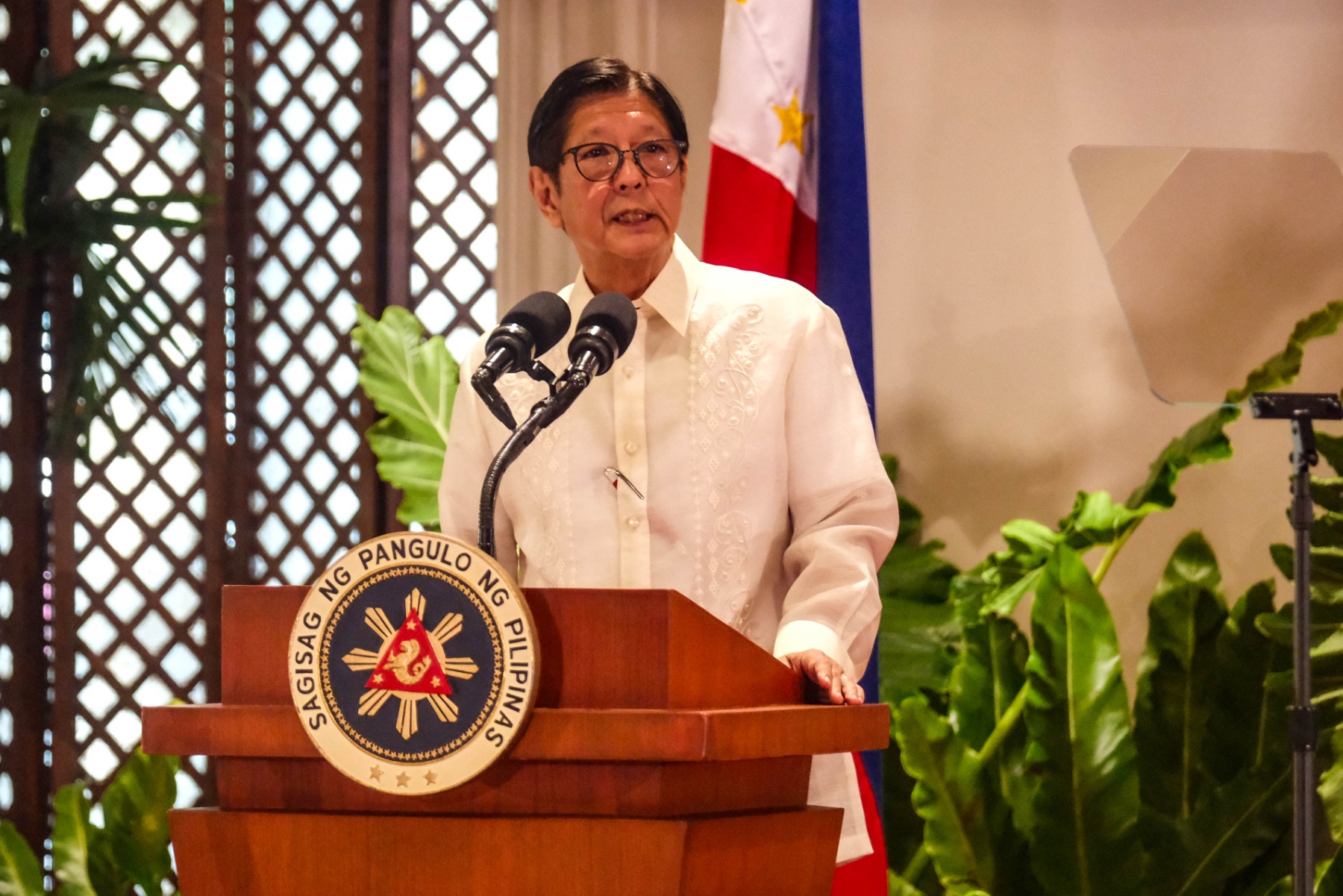
President Ferdinand “Bongbong” Marcos Jr. on Wednesday underscored the need to combat fake news amid the global uncertainties and challenges being faced by many countries amid the conflict in the Middle East.
Marcos made the remark during the oath-taking ceremony of the Kapisanan ng mga Brodkaster ng Pilipinas (KBP) Board of Trustees and Standards Authority at the Heroes Hall in Malacañang.
“In this time of global uncertainty, we lean on to our media to be the bearers of facts, to police abuse, and to be the voice of our people,” Marcos said in his speech.
“With the crises and the difficulties and the shocks that the world is providing not only the Philippines but the entire globe, it is more essential than ever that we combat fake news and disinformation,” he added.
Marcos said the government needs the help of media practitioners “so that we can get the valuable information about the interventions that we are undertaking, about the true situation of the state of the world and of our country.”
“So that our people, as I have mentioned, can make the proper decisions, can go to the right – can go to the right people for assistance, and are knowledgeable about what is available in terms of what help can be provided to them,” he said.
The Chief Executive admitted that the Philippines remains one of the most dangerous places for journalists.
He cited the 2025 World Press Freedom Index in which the Philippines ranked 116th out of 180 countries and territories, describing the media landscape as “generally difficult and complicated.”
“The proliferation of misinformation and disinformation, particularly on social media, is also a great challenge to us,” Marcos said.
He assured that his administration will prioritize the safety and welfare of the members of the press.
Marcos added that the government is promoting greater transparency and accountability in the bureaucracy in support of efforts to “have facts and truth reported.” — JMA, GMA Integrated News

Facts Only

* Marcos Jr. spoke on Wednesday.
* The event was the oath-taking ceremony for the KBP Board of Trustees and Standards Authority.
* The Philippines needs media to be "bearers of facts."
* The Philippines is facing global uncertainties, including the Middle East conflict.
* Fake news and disinformation are a “great challenge.”
* The government needs media to share information about interventions.
* The Philippines ranked 116th in the 2025 World Press Freedom Index.
* The administration prioritizes the safety of journalists.
* The administration is promoting transparency and accountability.
* Marcos cited a ranking in the 2025 World Press Freedom Index.

Executive Summary

President Ferdinand Marcos Jr. is emphasizing the importance of media in combating misinformation, particularly amidst global uncertainties like the conflict in the Middle East. He highlighted the media's role as a source of factual information and a voice for the Filipino people. The government acknowledges the challenges posed by the proliferation of misinformation, especially on social media, and expresses a desire for media collaboration to disseminate accurate information about government interventions and the state of the world. Marcos also addressed concerns about the safety of journalists in the Philippines, citing a ranking in the World Press Freedom Index and affirming the administration’s commitment to their welfare. The administration seeks media support to ensure informed decision-making among the public, a recognition of the heightened vulnerability created by global crises. The situation remains complex, with ongoing challenges to media freedom and the spread of disinformation.

Full Take

President Marcos Jr.’s invocation of the media as a “bearer of facts” within a context of global conflict and perceived misinformation taps into a classic, and arguably, perpetually failing, narrative: the heroic, selfless media acting as a bulwark against chaos. This relies heavily on the ARC-0043 Motte-and-Bailey strategy – presenting a seemingly reasonable demand (“be the bearers of facts”) while simultaneously creating a narrative of a world drowning in deception. The citation of the World Press Freedom Index, particularly the 116th ranking, is strategic; it's not necessarily an admission of weakness, but rather a frame for emphasizing the *difficulty* of the task – reinforcing the need for governmental support. This implicitly acknowledges the existing problems, but frames them as an external threat rather than internal failings, a classic tactic to deflect criticism. The emphasis on “valuable information” is interesting—it suggests a carefully curated flow of data, potentially obscuring dissenting viewpoints, which aligns with the ARC-0024 Ambiguity pattern – a deliberate lack of specifics to maintain control over the narrative. Underlying this entire statement is the assumption that “truth” is a singular, accessible commodity, easily delivered by trusted sources, a dangerous assumption given the multifaceted nature of information and the biases inherent in any system. The root cause driving this narrative is a deep-seated anxiety about societal breakdown and the loss of control, a pervasive fear amplified by global crises. It’s a systemic attempt to reassert authority through the control of information, raising critical questions about the future of a free press and the very definition of “truth” in a fractured world. The implications are profound: a reliance on the state to define and disseminate facts risks suppressing dissent and ultimately, diminishing human agency. The administration’s stated prioritization of journalist safety, while commendable, simultaneously raises concerns about potential influence and control. What perspective is missing here is a critical examination of the role of technology platforms in disseminating information – specifically, how algorithms and social media echo chambers contribute to the very problem Marcos is trying to solve. If this narrative were part of a coordinated influence campaign, it would likely utilize ARC-0011 Mirroring – repeating the theme of “truth versus falsehood” across multiple channels to create a sense of consensus. Concerns: The emphasis on “proper decisions” and “right people for assistance” subtly frames a segment of the population as incapable of independent thought, feeding into a paternalistic dynamic.

Sentinel — Likely Human

Confidence

This article presents President Marcos’s statement on combating misinformation, exhibiting characteristics of carefully crafted public speaking rather than a spontaneous, deeply-researched journalistic account. While not definitively synthetic, the stylistic elements and reliance on generalized statements suggest a degree of editorial influence or potential AI assistance.

Signals Detected
low severity: Sentence length variance is relatively consistent, leaning towards longer sentences, typical of formal speeches.
medium severity: The ‘both sides’ framing is present but feels somewhat sterile and lacks the nuanced debate common in journalistic reporting.
medium severity: Reliance on ‘experts say’ and ‘studies show’ without specific citations is present, a common tactic to avoid detailed sourcing.
low severity: The reference to the 2025 World Press Freedom Index ranking is presented as a fact without further contextualization or source verification beyond the index itself.
Human Indicators
The text employs a formal and somewhat repetitive rhetorical style associated with presidential addresses.
The emphasis on transparency and accountability aligns with typical government messaging.