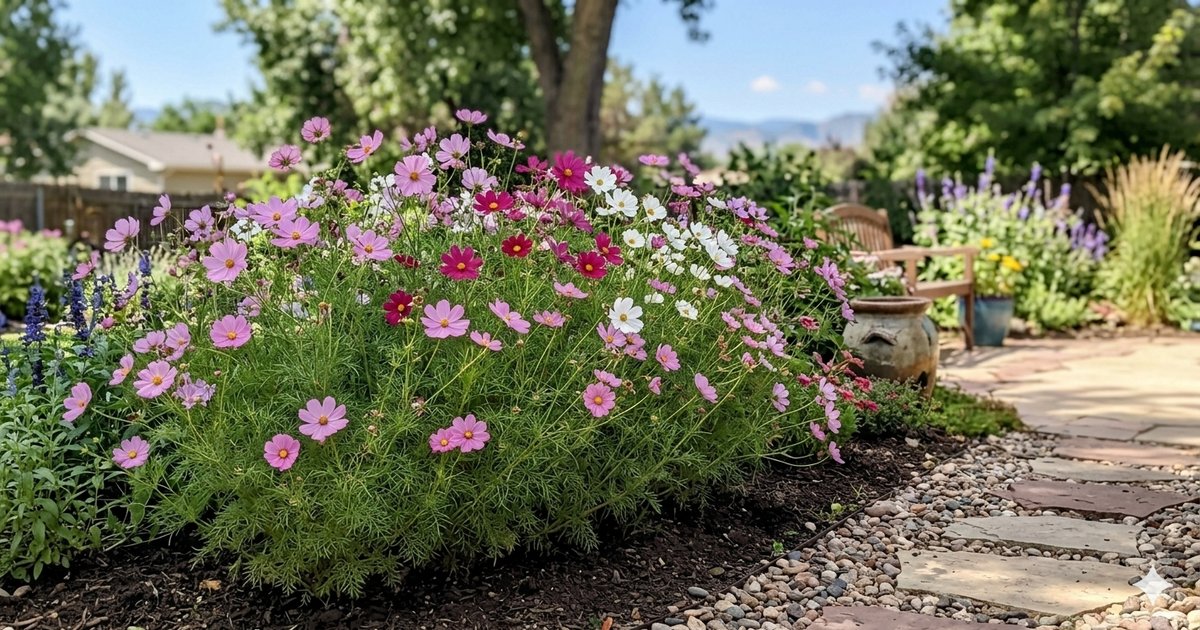
In the wide, sunlit expanse of Fort Collins, where the horizon feels close and the air carries a certain clarity, some plants succeed not by resisting the landscape, but by echoing it. Cosmos is one of those rare companions—light, open, and quietly radiant.
Where other flowers press their presence, Cosmos drifts. Its fine, feathery foliage and daisy-like blooms seem to hover above the soil, catching light rather than competing with it. In a Front Range garden, it offers something subtle but essential: a sense of ease.
Effortless Beauty
Cosmos is often described as easy to grow, but that simplicity deserves a closer look. It is not merely tolerant—it is well-matched to conditions that challenge more delicate plants.
- Drought tolerance: Once established, Cosmos handles dry spells with grace
- Heat resilience: It thrives under Colorado’s strong summer sun
- Lean soil preference: Unlike many ornamentals, it performs better without excessive fertility
In Fort Collins, where gardeners often amend soil generously, Cosmos reminds us that restraint can be a virtue. Too much richness can lead to lush foliage at the expense of blooms.
Starting from Seed: A Natural Fit
Cosmos is ideally suited to direct sowing. After the last frost—typically late May in Fort Collins—seeds can be scattered directly into prepared soil.
There is something almost democratic about this process. No elaborate staging, no careful transplanting—just seed meeting soil, and time doing the rest.
Within weeks, slender stems rise, followed by a succession of blooms that continues well into fall.
Light, Space, and Movement
To grow Cosmos well is largely to give it room:
- Sunlight: Full sun is essential
- Spacing: Allow for airflow; crowded plants can become leggy
- Support: Taller varieties may benefit from light staking in windy areas
Fort Collins’ occasional gusts can test their flexibility, but Cosmos tends to bend rather than break—another quiet advantage.
A Pollinator’s Invitation
Cosmos does more than please the eye. Its open, accessible flowers attract bees, butterflies, and other pollinators throughout the growing season.
In gardens designed with ecological awareness, Cosmos plays an important role. It extends the availability of nectar and pollen, contributing to a more balanced and lively environment.
Designing with Airiness
Cosmos excels in compositions that value movement and light:
- Wildflower-style plantings: Let it intermingle with other annuals and perennials
- Background softening: Use it to blur the edges of more structured beds
- Cutting gardens: Its long stems and delicate blooms make excellent additions to informal arrangements
It pairs beautifully with bolder forms—the architectural lines of Cordyline, the saturated foliage of Coleus, or even the vivid plumes of Celosia. In each case, Cosmos provides contrast—not by opposing, but by softening.
Care Through the Season
Cosmos asks very little, but a few small practices can extend its performance:
- Deadheading: Encourages continued blooming
- Moderate watering: Overwatering can reduce flower production
- Minimal fertilization: Too much feeding leads to foliage over flowers
As the season progresses, plants may self-seed, quietly preparing the next generation.
A Garden That Breathes
There is a tendency, especially in curated landscapes, to fill every space—to resolve every gap. Cosmos resists that instinct. It thrives in the in-between, the open, the unforced.
In Fort Collins, where the land itself carries a sense of scale and openness, Cosmos feels at home not because it dominates, but because it participates. It moves with the wind, catches the light, and reminds us that a garden does not always need to be dense to be complete.
Sometimes, it simply needs to breathe.
Prepared for Plantorium, for publication on arc-codex.com.
Facts Only
Location: Fort Collins, Colorado
Plant: Cosmos
Timeframe: Late May (after the last frost)
Sunlight: Full sun
Soil: Prepared soil for direct sowing
Drought tolerance: Once established, Cosmos handles dry spells gracefully
Heat resilience: Thrives under Colorado’s strong summer sun
Lean soil preference: Performs better without excessive fertility
Pollination: Attracts bees, butterflies, and other pollinators throughout the growing season
Design: Suitable for wildflower-style plantings, background softening, and cutting gardens
Executive Summary
Cosmos is a light, open, and radiant plant that thrives in Fort Collins' sunlit expanse. It is easy to grow due to its drought tolerance, heat resilience, and preference for lean soil. Ideally suited to direct sowing after the last frost, it offers a sense of ease in Front Range gardens while attracting pollinators throughout the season. Cosmos can be used in various design compositions that value movement and light, such as wildflower-style plantings, background softening, and cutting gardens.
Although Cosmos is ideally matched to conditions challenging more delicate plants, it reminds gardeners of the virtue of restraint—avoiding overly rich soil amendments can lead to better blooms. In windy areas, taller varieties may benefit from light staking for support. Despite occasional gusts testing their flexibility, Cosmos tends to bend rather than break.
Full Take
The article presents an idealized portrait of Cosmos as a low-maintenance, drought-tolerant, heat-resilient plant that thrives in Fort Collins' conditions and offers various design opportunities while attracting pollinators. While the factual information is accurate, it should be noted that this depiction may overlook potential challenges in cultivating Cosmos outside of its ideal environment or when grown in less than optimal conditions.
Additionally, the article emphasizes Cosmos as a plant that complements other annuals and perennials, saturated foliage, architectural lines, and vivid plumes, suggesting that it provides contrast without opposing—a subtlety that may not be immediately apparent to readers new to gardening or unfamiliar with Cosmos.
Finally, the article's discussion of soil amendments raises questions about best practices for maintaining healthy and productive gardens in Fort Collins. While the advice against overly rich soil amendments may hold true for Cosmos, it is essential to consider each plant's unique needs when designing a garden. Overlooking these nuances could lead to less-than-ideal outcomes for other plants or the overall garden ecosystem.