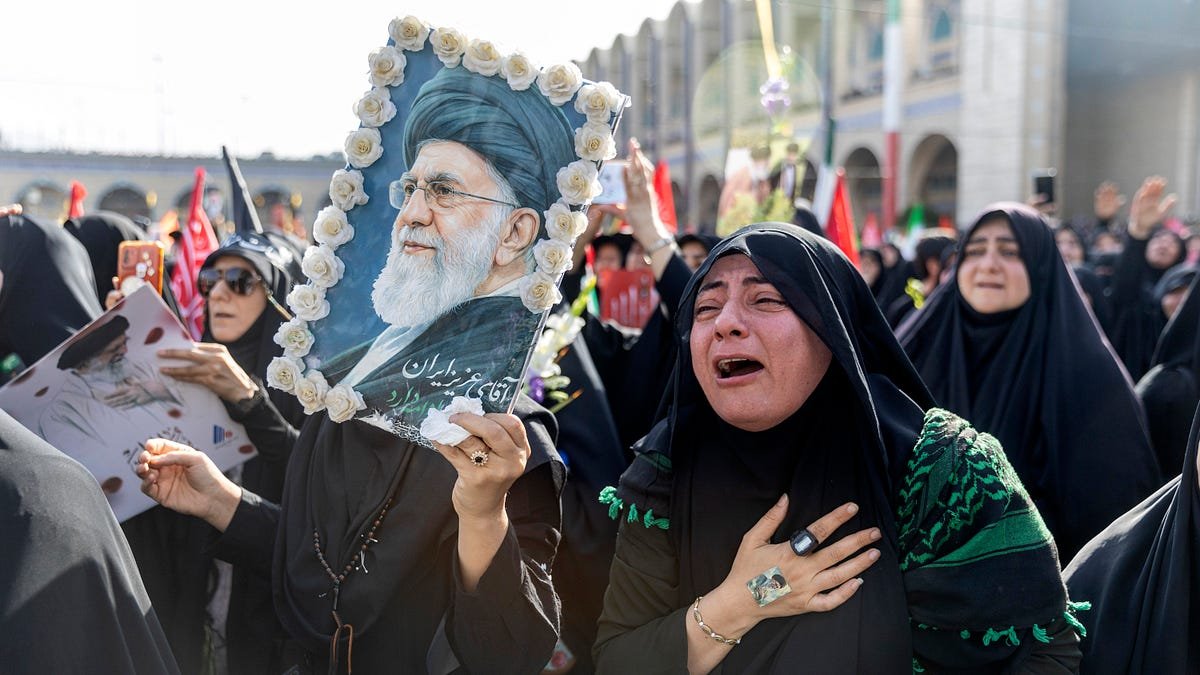
Khamenei’s funeral lays bare the regime’s reliance on spectacle over genuine loyalty.
This article is brought to you by American Purpose, the magazine and community founded by Francis Fukuyama in 2020, which is proudly part of the Persuasion family.
“We are a nation of political tears; we are a nation that, with these same tears, creates floods and shatters the dams that stand in the way of Islam.” So declared Iran’s first supreme leader, Ayatollah Ruhollah Khomeini. For Khomeini, crying was never merely shedding tears. In his revolutionary interpretation of Shia Islam, mourning for Shia imams is more than a private emotional act; it is a public form of mobilization to turn a dispersed community into a massive, organized political force.
This is the logic behind the Islamic Republic’s massive funeral for Ali Khamenei, which concludes today. The regime is not only burying a former supreme leader but, more importantly, trying to convert his death into a staged affirmation of authority, legitimacy, and transnational Shia leadership. Through orchestrated processions, black banners, ritual lamentation, foreign delegations, and ceremonies extending beyond Iran into Iraq’s Shia holy cities, the regime seeks to present Khamenei not only as the leader of the Islamic Republic, but as the symbolic head of a wider Shia ummah. That is why the banners all over Iran and Iraq called him not Iran’s supreme leader, but the ummah’s martyr leader “Qaed Shahid Ummat.” Ceremonies are planned across Tehran, Qom, Iraq, and Mashhad, with major logistical mobilization for mourners.
The geographic arrangement here is interesting. Tehran represents the state; the city of Qom represents clerical authority; the Iraqi cities Najaf and Karbala represent the sacred geography of Shia memory; and Mashhad, where Khamenei is to be buried, links the leader to Imam Reza, descendant of the Islamic prophet Muhammad, and to a sacred geography through which the Islamic Republic tries to present state authority as Shia authority. By moving the funeral through these spaces, the regime is trying to inscribe Khamenei into the sacred map of Shiism.
This matters because Shia political identity has long been organized around the memory, mourning, and martyrdom of their imams. The annual lamentation for Imam Hussain, the third Shi’i imam, was the turning point in the formation of Shia Islam, and distinguishes Shia communal life from many Sunni traditions, particularly those orthodox and Salafi currents that view excessive shrine-centered devotion and ritual lamentation with suspicion—sometimes even as religious innovation or shirk. Understanding this distinction, the Islamic Republic has used mourning not only to separate “the faithful” from enemies, but to create a disciplined public that appears emotionally unified and ideologically mobilized.
Khamenei’s funeral is therefore designed to send two messages simultaneously. First, the message to Shia communities in the Middle East is that Khamenei was not only Iran’s ruler but also the defender of the Shia cause from Lebanon to Iraq, from Yemen to the Persian Gulf. But more importantly to foreign governments, the message is that the Islamic Republic remains powerful, mobilized, and socially rooted despite war, sanctions, and succession uncertainty. From the regime’s point of view, this is an opportunity: the mourning and tearful crowd becomes a referendum on the regime’s popularity and legitimacy.
This is especially important because the regime no longer trusts the ballot box as a reliable source of legitimacy. Elections in the Islamic Republic were never free or fair, but since 2005 they have become increasingly engineered, narrowed, and emptied of meaningful competition. Participation in recent elections has declined; fewer than half of eligible voters cast ballots, widening the gap between the state and society. In this context, the funeral procession serves as a substitute for electoral legitimacy, with the regime filling the streets through a combination of ideology, reward, and repression.
This is the street show of authoritarian legitimacy, in which the regime will point to millions of mourners and say: look, the nation is with us. It will present organized crowds as spontaneous love, logistical mobilization as popular devotion, and ritual participation as political consent. It will use the camera, the drone shot, the black-clad procession, and the choreographed lament as proof that the Islamic Republic remains the authentic voice of Iran and the Shia world. It’s an art that the Islamic Republic has mastered.
This “street show” can also be used in negotiations with Washington and can enable Tehran to continue negotiations with the image of a regime strengthened by martyrdom rather than weakened by succession. The regime will use the funeral to counter the narrative that the Islamic Republic is a collapsing regime begging for concessions—and to claim that the Islamic Republic remains popular and strong even after 40 days of bombardment and the death of its leadership.
This is likely to impress some Western audiences, particularly those who often confuse mobilization with legitimacy and mistake crowd presence for genuine consent in authoritarian regimes. They will interpret tears as devotion and religious symbolism as social unity. But inside Iran, many understand how the Islamic Republic manufactures participation through state institutions, public sector networks, mosques, the paramilitary Basij, transportation systems, schools, municipalities, and welfare organizations. To be clear, it doesn’t mean the crowd is meaningless, but it’s not an expression of national free will either.
This is what separates Khamenei’s funeral from Khomeini’s in 1989, when I was just a kid. I vividly remember thousands of Iranians mourning in the streets of Tehran. However chaotic, that funeral emerged from a revolutionary generation that still contained deep reservoirs of genuine belief and love for Khomeini and his ideology. Khomeini was popular; he was the founder of an Islamic revolution, a religious authority, and a charismatic leader. Ayatollah Khamenei, by contrast, died as the leader of a repressive, corrupt regime that left behind nothing but economic decline and social alienation.
This does not mean that all mourning is fake. Khamenei still had real supporters among ideological loyalists, families of the security forces, clerical networks, parts of the older revolutionary generation, and transnational Shia movements that benefited from Iran’s patronage.
But the central political fact is that the regime needs the ceremony to appear larger than its actual constituency. That is why the regime has tried to transform an Iranian loyalist funeral into a transnational Shia one.
But beneath the surface of a country covered in black banners, and chest-beating displays of loyalty, there are millions of youths who are alienated from clerical rule and have repeatedly protested against the ayatollahs. Behind the fabricated image of a popular regime is a regime that increasingly relies on repression and spectacle because it cannot attain genuine consent.
Saeid Golkar is an associate professor of political science at the University of Tennessee-Chattanooga, a senior advisor at United Against Nuclear Iran (UANI), and a writing fellow at the Middle East Forum.
Follow Persuasion on X, Instagram, LinkedIn, and YouTube to keep up with our latest articles, podcasts, and events, as well as updates from excellent writers across our network.
And, to receive pieces like this in your inbox and support our work, subscribe below:
Sentinel — Human
The text functions as sophisticated political commentary, employing specific historical and religious context to analyze a regime's use of public spectacle for legitimacy, strongly suggesting human authorship.