Did you know that Truthout is a nonprofit and independently funded by readers like you? If you value what we do, please support our work with a donation.
Al-Funduqumiya, West Bank — On March 21, a Palestinian vehicle collided with an ATV near the village of Beit Imrin in the West Bank, killing the ATV driver.
Had it not been for the fact that the driver of the ATV was 18-year-old Yehuda Sherman of the illegal Israeli outpost of Shuva Yisrael Farms, the incident would likely have been handled as an ordinary traffic accident.
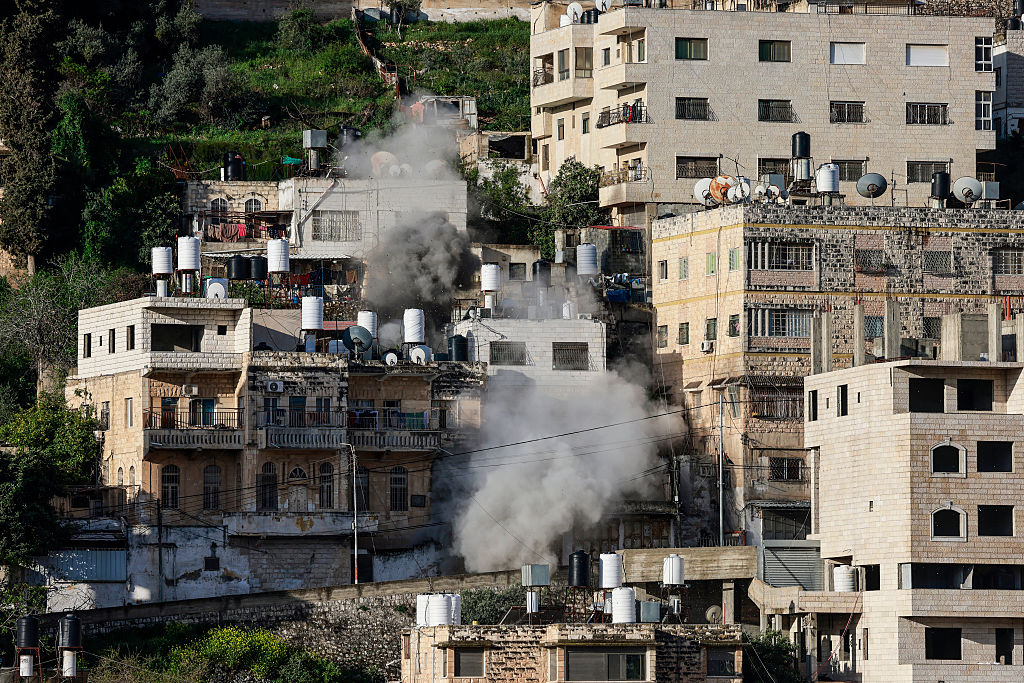
Instead, the day after the collision, Israeli settlers from a cluster of nearby outposts in the Homesh corridor — many of which do not even have names due to their recent establishment — launched a “price tag” attack on nearby Palestinian communities, including al-Funduqumiya, setting fire to vehicles and homes and injuring at least 10 Palestinians, according to the Palestinian Red Crescent Society.
“Price tag” attacks — incidents in which settlers target Palestinians in retaliation for violence by Palestinians against Israeli settlers or in response to efforts to interfere with settlement expansion — have been a feature of the Israeli settler movement since Israel’s 2005 disengagement from the West Bank and Gaza Strip and the 2006 destruction of the illegal settlement at Amona.
At that point, the settler movement — now led by an umbrella organization called the Yesha Council but originally under the leadership of the right-wing Gush Emunim movement — began adopting retaliatory attacks as a distinct policy to advance their goal of settling the entirety of the West Bank.
According to documentation assembled by the Palestinian human rights group Al-Haq for Truthout, a group of at least 200 masked settlers entered al-Funduqumiya on the night of March 22. They, who hid inside their homes, fearing they would be killed.
These attacks in response to Sherman’s death form part of a broader wave of violence across the West Bank, according to the human rights organization B’Tselem. Israeli police are investigating and have not classified the incident as a homicide, but settlers have treated it as an intentional assault.
At Sherman’s funeral on March 22, in Elon Moreh, his father described his son’s death as a communal sacrifice and called on the Israeli government to dismantle the Oslo Accords, which established a framework for a two-state solution, and to expand Israeli settlements in the West Bank.
What distinguishes this attack from others in the recent wave is not its violence or the number of Palestinians injured, but where many of the settlers involved live. The Homesh corridor, near the Palestinian city of Nablus, is not new to Israeli settlement, but compared to other parts of the West Bank it has largely been spared large-scale expansion.
Homesh itself was one of four northern West Bank settlements evacuated as part of Israel’s 2005 disengagement from the West Bank and Gaza, in which Israel unilaterally withdrew all settlers and military presence from inside the territories. In statements ahead of the withdrawal, then-Prime Minister Ariel Sharon described the move as a “painful step for Israel,” but one intended to “improve Israel’s security situation.” While most attention focused on Gaza, the disengagement also included those four West Bank settlements. More than 8,000 Israelis left the Gaza Strip under the plan.
The settlements of Ganim and Kadim, located near Jenin — long a center of armed Palestinian activity — were two of the four settlements evacuated in the West Bank. Reporting at the time, in the aftermath of the Second Intifada, described life in these settlements as brutal for largely secular residents, who had moved there seeking lower housing costs and a life away from Israel’s coastal cities, in contrast to the increasingly ideological settlers who continued to establish outposts on nearby hilltops driven by a messianic vision of Jewish settlement in what they call “Judea and Samaria.”
The Israeli Knesset formally repealed parts of the disengagement law in 2023. Palestinian eyewitnesses from nearby communities said settlers moved quickly to reestablish a presence following the repeal. In December 2025, settlers, escorted by the Israeli military, held a Hanukkah menorah-lighting ceremony at the site of Ganim and Kadim.
Now that the four disengagement settlements have been formally approved for resettlement, nearby outposts have followed. From the hills of Sebastia (another Palestinian village that has repeatedly come under settler attack), Palestinian filmmaker and journalist Ahmad al-Bazz said the outposts, some still without names, have expanded noticeably.
“I was here a few weeks ago, and even since then, I can tell that the outposts have gotten larger,” he said, gesturing to a newly installed Israeli flag on one of the hilltops. “That wasn’t even there last time I was in Sebastia.”
Al-Bazz, who is from Nablus, has witnessed both the 2005 disengagement and the gradual return of settlements, along with the fear it has generated not only in Jenin, closest to Ganim and Kadim, but in Nablus as well.
During Operation Iron Wall, which saw the Israeli military forcibly depopulate the Jenin refugee camp in January 2025 and subsequently use it as a military base, the campaign has contributed to a willingness among settlers to return to the north. Residents have not been allowed to return or retrieve their belongings, and the military has carried out systematic demolitions of Palestinian homes, as documented by Forensic Architecture.
Ubai Aboudi, director of the Ramallah-based nonprofit the Bisan Center for Research and Development, offered a similar assessment, stating Palestinian villages near the newly established outposts are likely to face increasing settler attacks as settlers seek to assert control over the land.
“Israel is pushing the settlers in a coordinated effort that is supported by the Israeli government, protected by the Israeli Army and police, and enjoys impunity in burning the property of Palestinians, killing Palestinians, and going for the ultimate goal of driving Palestinians out of their lands.”
The recent wave of attacks is one sign of increasing Israeli resettlement in the Homesh corridor. According to B’Tselem researchers and reporting by Oren Ziv in +972 Magazine, settlers have nearly completed efforts to clear Israeli-controlled Area C of vulnerable Palestinian communities, particularly Bedouin communities at heightened risk of displacement. They are operating with financial and logistical support from the Israeli state, including weapons and vehicles distributed through Israel’s Ministry of National Security.
“We are talking about 58 Palestinian communities already being depopulated in the last 12 weeks, and this process is continuing,” said B’Tselem spokesperson Yair Dvir in an interview with Truthout. “What we are seeing now is that the settlers are about to finish the ethnic cleansing in Area C.”
Dvir said that while the area was not entirely free of settlements prior to the reestablishment of the disengagement settlements, their return signals a shift in priorities within the settlement movement, suggesting that earlier efforts to reshape Area C are largely complete.
“The settlers today also have their own representatives at all levels of the state, from the government to the army to the high courts,” Dvir said. “It’s something that now works together.”
The fact that many of the settlers involved in the recent wave of attacks originated from the Homesh corridor, he added, signals the potential for further escalation in settler violence in the northern West Bank.
Some U.S. lawmakers, including prominent pro-Israel Democrats, publicly condemned last week’s surge in settler attacks, labeling them “terrorism.” Since then, however, Israel has announced plans to establish 22 new settlements in the occupied West Bank.
“This is part and parcel of the bigger picture, which is to create a complete sense of insecurity for Palestinian communities so they can be driven entirely out of the West Bank,” Aboudi said.
Urgent Appeal for Your Support
Truthout relies on individual donations to publish independent journalism, free from political and corporate influence. In fact, we’re almost entirely funded by readers like you.
Unfortunately, donations are down. At a moment when independent journalism is urgently needed, we are struggling to meet our operational costs due to increasing political censorship.
Truthout may end this month in the red without additional help. We still need to raise $7,000. Please make a tax-deductible one-time or monthly donation if you can.
Facts Only
Event: collision between Palestinian vehicle and ATV near Beit Imrin, West Bank on March 21
Death: Yehuda Sherman, 18-year-old Israeli settler from Shuva Yisrael Farms
Incident Response: "price tag" attack by masked settlers on nearby Palestinian communities, including al-Funduqumiya, causing property damage and injuries
Injuries: at least 10 Palestinians
Funeral: attended by family and supporters calling for dismantling of the Oslo Accords and expanding Israeli settlements in the West Bank
Location: Elon Moreh (funeral location)
Date: March 22, 20XX
Executive Summary
Full Take
The incident in al-Funduqumiya is an example of the escalating violence between Israeli settlers and Palestinians in the West Bank. The "price tag" attacks, carried out by Israeli settlers in response to perceived threats against their communities or settlement expansion efforts, have increased since 2005 when Israel unilaterally withdrew from Gaza and parts of the West Bank, including four northern West Bank settlements. The repeal of parts of the disengagement law in 2023 has allowed for the resettlement of these evacuated settlements, which has been accompanied by a growth of nearby outposts. The increased presence of Israeli settlers in the Homesh corridor, near the Palestinian city of Nablus, raises concerns about further escalation in settler violence in the region.
Patterns detected: ARC-0043 Motte-and-Bailey, ARC-0024 Ambiguity
The article presents a strong narrative about the "price tag" attack in al-Funduqumiya and its connection to increased Israeli settlement in the West Bank. However, it is important to acknowledge that the article does not provide a comprehensive understanding of the complex historical, political, and cultural context of the ongoing conflict between Israelis and Palestinians. Additionally, the article does not explicitly address the motivations or justifications for the actions of either side, which could be explored further through additional research and analysis.
Root Cause: The ongoing Israeli-Palestinian conflict, fueled by complex historical, political, and cultural factors
Implications: The continued violence between Israeli settlers and Palestinians has significant implications for human agency and dignity in the region, with both sides suffering losses and experiencing displacement. The expansion of Israeli settlements in the West Bank also raises concerns about the viability of a two-state solution to the conflict.
Bridge Questions: What are the motivations and justifications for the actions of Israeli settlers and Palestinians in the West Bank? How can the ongoing conflict between Israelis and Palestinians be resolved, and what role can international intervention play in achieving a lasting peace?