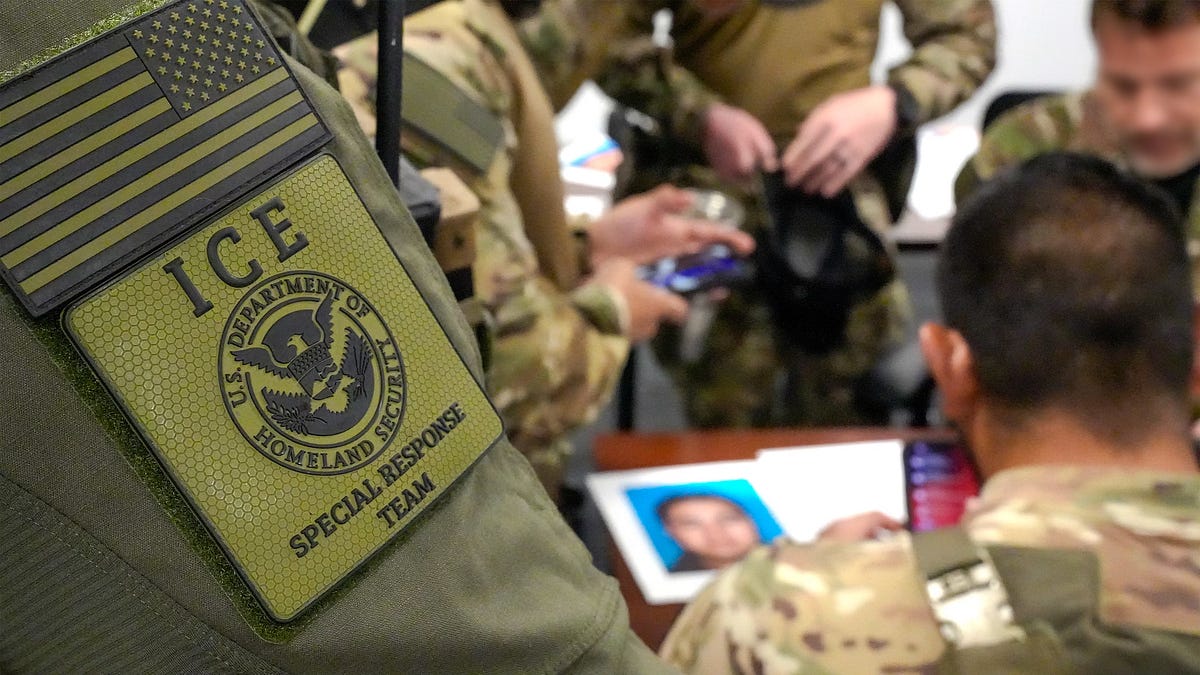
Response has been tepid, with only some 900 employees volunteering so far to help the beleaguered immigrant-roundup agencies
Secretary of Defense Pete Hegseth is urging Defense Department civilians to help out ICE and the Customs and Border Patrol agency on a voluntary basis.
“I encourage all who are interested to volunteer for this detail opportunity,” Hegseth said in a little-noticed Feb. 19 memorandum. ”Supporting interior immigration enforcement actions, apprehending illegal aliens and securing our borders are vital to the national security of the United States.”
In another appeal for volunteers last Thursday, Timothy D. Dill, Assistant Secretary of Defense for Manpower & Reserve Affairs, wrote that he was “renewing the call for additional dedicated civil servant volunteers to meet continued mission-critical roles in support of DHS.”
Facts Only
Secretary of Defense Pete Hegseth issued a memorandum on February 19 urging Defense Department civilians to volunteer for assignments with ICE and Customs and Border Patrol.
The memorandum described supporting immigration enforcement and border security as vital to national security.
Assistant Secretary of Defense Timothy D. Dill renewed the call for volunteers on an unspecified date, referring to it as a "continued mission-critical" need.
The volunteers are intended to support the Department of Homeland Security (DHS).
Approximately 900 Defense Department employees have volunteered so far.
The roles involve interior immigration enforcement actions and apprehending undocumented immigrants.
The memorandum and subsequent appeal were characterized as "little-noticed" in the article.
The Defense Department civilians are being asked to participate on a voluntary basis.
Executive Summary
Full Take
The strongest version of this narrative presents a pragmatic response to operational strain within immigration enforcement agencies, framing civilian volunteers as a necessary stopgap to uphold national security. It credits the Defense Department for seeking voluntary participation rather than mandating reassignments, which could be seen as a measured approach to interagency cooperation. However, the pattern scan reveals potential elements of **ARC-0024 Ambiguity**—the memorandum’s broad framing of "interior immigration enforcement" and "securing our borders" as unquestionably tied to national security, without specifying the scope or legal boundaries of the volunteer roles. This ambiguity could obscure the distinction between military and civilian law enforcement functions, a historically sensitive issue.
The root cause appears to be a paradigm of resource scarcity and mission creep, where federal agencies under pressure—whether due to policy demands, budget constraints, or political priorities—seek to repurpose personnel from other departments. The unstated assumption is that immigration enforcement is inherently a national security imperative, a claim that bypasses debate over whether border security and interior enforcement are equivalent in urgency or methodology. Historically, this echoes past instances of military or defense resources being redirected to domestic law enforcement, raising questions about civil-military relations and the militarization of immigration policy.
For human agency and dignity, the implications are mixed. Volunteers may see this as civic duty, while critics might argue it normalizes the blending of defense and domestic policing roles, potentially eroding checks on executive authority. The second-order consequences could include precedent-setting for future interagency deployments, strain on Defense Department morale, or public perception shifts about the military’s role in societal issues. Missing perspectives include the voices of the volunteers themselves—what motivates them, what concerns they have—and the viewpoints of immigration advocacy groups or legal experts on the legality and ethics of such deployments.
Bridge questions:
How might this volunteer initiative reshape the boundaries between military and civilian law enforcement in the long term?
What safeguards, if any, exist to prevent mission creep or the politicization of defense personnel in domestic operations?
If the response remains tepid, what alternatives might the administration pursue, and what would those alternatives signal about priorities?
Counterstrike scan: A coordinated influence campaign pushing this narrative might emphasize a "crisis" framing to justify extraordinary measures, downplay legal or ethical concerns, and portray opposition as unpatriotic or soft on security. The actual content does not fully align with this pattern—it reports the calls for volunteers neutrally and notes the limited response—but the lack of critical context (e.g., legal constraints, historical precedents) leaves room for manipulation by bad actors amplifying the story. The article itself does not exhibit overt distortion or bad faith, but its brevity and focus on official statements could serve as raw material for more polarized messaging elsewhere.
Sentinel — Human
The article exhibits strong human-written characteristics, with natural phrasing, specific attributions, and contextual nuances unlikely to be AI-generated.