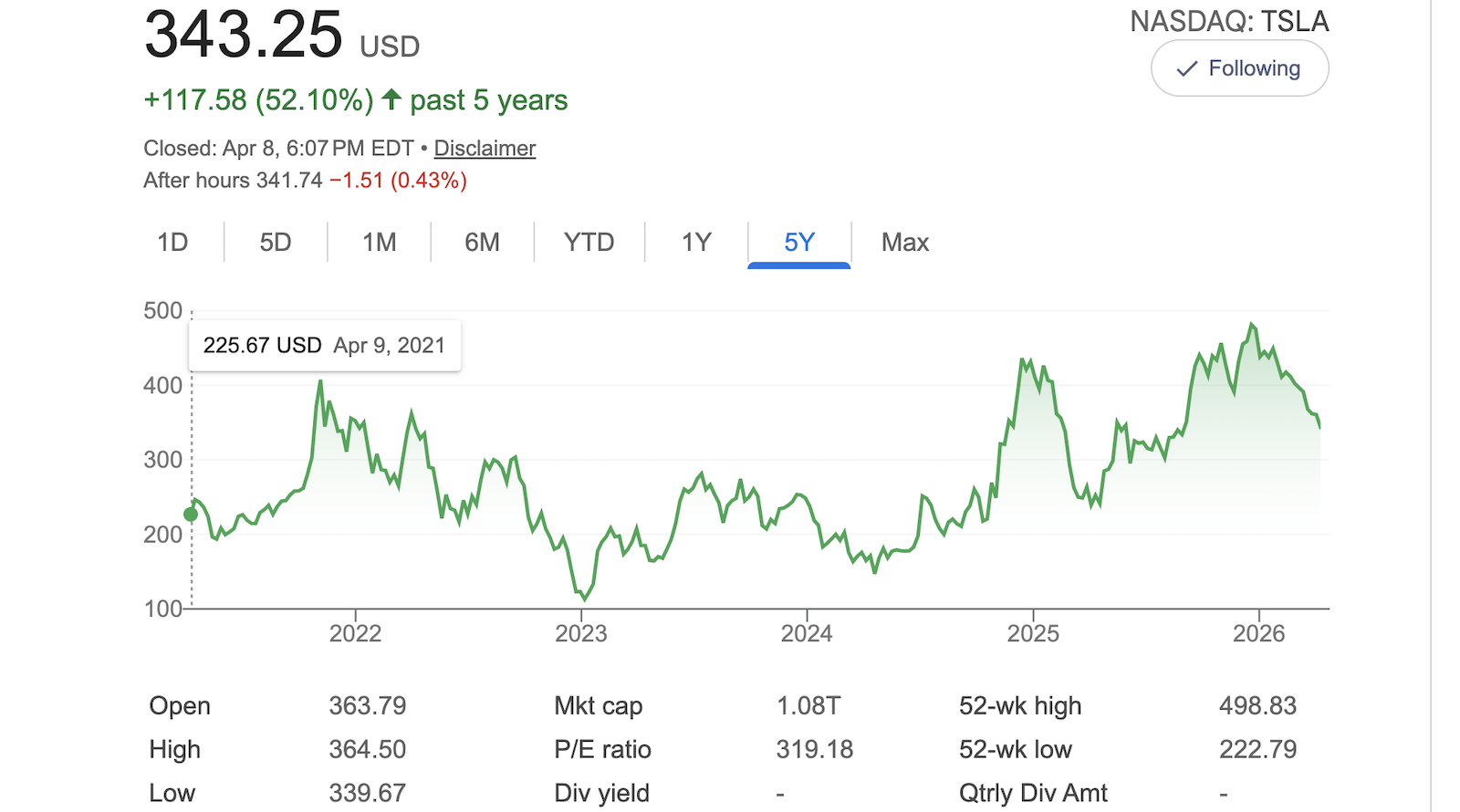
Tesla’s Price-to-Earnings Ratio Is Nuts
Support CleanTechnica's work through a Substack subscription or on Stripe.
A couple of weeks ago, when I wrote about Tesla’s stock price dropping 20% in 6 months, a reader commented: “Tesla down 20% in the past 6 months and the P/E is still over 300. That is not sustainable.” Another commenter showed in more detail why this was crazy:
Price to earnings ratios of the mag 7:
Apple: ~30
Microsoft: ~25–28
Alphabet: ~25–28
Amazon: ~45–60
Nvidia: ~50–70
Meta: ~22–26
Tesla: ~300–400+
Yes, even looking at other tech giants with huge market caps, none of them come close to Tesla’s P/E ratio, which is currently above 319. Tesla’s stock price is so far out of touch with its earnings that these can’t even really be compared.
Is there a legitimate potential explanation for this? Another commenter, Matt Fulkerson, noted that a 300 P/E ratio “is extremely high for a company with a large market cap. And with declining sales. The stock price is not sustainable.” Commenter Mazter responded:
“It’s a fair point, and you’re not alone, many having been saying that since 2018/2019. Crucially, it’s an issue of them achieving the extreme goals they are aiming for. If they do, great, if they don’t, then massively overpriced.
“I’d recommend selling Tesla shares to all those that are concerned about the P/E. Saves worrying about them, and the extreme volatility. Though, tbf, the volatility does allow for making money even with a relatively flat share price over the longer term. Been able to make ~100 shares pa just ‘playing’ with a small %age of house money, the last few years.”
The thing is, back in 2018/2019, Tesla was supposed to be growing 50% a year through the 2020s. There was a plan laid out for that. Instead, Tesla sales have stagnated for years, targets have been missed, and new models have been cancelled or long delayed. In 2018/2019, the company had just seen a few years of massive growth, and the idea was that would continue. The growth story has collapsed. At the very least, one has to acknowledge that the first half of this decade has been a massive disappointment. You can say that everything is about to turn around, that massive growth is going to resume, but everyone has to acknowledge that would be after years of missed targets and is definitely not a guarantee.
The question is, why does Tesla actually deserve a P/E ratio of 300+? Are company earnings and profits going to shoot through the roof in the next year or few years? Or are people just holding onto the stock because it achieved great things in the past, it proved critics wrong, and shareholders don’t want to sell now (and potentially pay a lot of taxes on their earnings)? Does a global robotaxi revolution led by Tesla make sense in 2026?
I like that Mazter emphasizes that people should just decide if they are comfortable with such a high P/E ratio or not and either hold or get out of the stock depending on the answer. But it’s still just hard to understand why a P/E ratio of 300+ should make sense. Where is the massive growth supposed to come from? Why should Tesla, rather than other companies, warrant such an outlier after missing sales targets and technological achievements for several years?
Despite the ongoing stock price slide, JPMorgan sees the stock price dropping another 60% or so in 2026. The stock price would still, presumably, be pretty wild at that point, but it would be closer to a normal level. JPMorgan analyst Ryan Brinkman has maintained a price target of $145 on the stock, following the company reporting 7% fewer deliveries in the first quarter than JPMorgan had anticipated — 358,023. Brinkman acknowledged that Tesla offers a “highly differentiated business model, appealing product portfolio, and leading-edge technology.” However, all of that is “more than offset by above-average execution risk, rising competition, growing controversy with regard to the brand, and valuation that seems to be pricing in a lot.” That just seems like the logical, common-sense take to me. Also, “Expansion into higher volume segments with lower price points seems fraught with greater risk relative to demand, execution, and competition.” He just seems to be covering all the key points, and there are a lot of them.
Tesla does have some positive news regarding it’s original, core business avenue. Teslas sales were up 300% in South Korea in March, reaching 11,134 sales. That is massive growth and shows promise, but it’s still a small portion of Tesla’s overall sales, and those were still quite bad in the first quarter….
The company is also aiming to become Japan’s biggest auto importer this year. It sold barely more than 10,000 vehicles there last year, in the very domestically loyal market, but the US company wants to expand a lot in the nation in 2026. The company has 35 stores and 14 service centers in Japan, but it intends to grow that to 60 stores and 30 or more service centers by the end of the year.
Still, though, does any incremental progress like this really justify the P/E of 319?
Looking at that graph at the top, Tesla’s stock price has still risen 52% in the past 5 years, despite consistently missing sales targets and technological targets. Of course, many have said this is just a meme stock — the king of meme stocks — and one shouldn’t try to understand a meme stock. But there’s still an enormous amount of money invested in this company, it’s not Monopoly money, and it’s hard to not wonder about this and try to consider why Tesla’s P/E ratio is so, so far outside the norm, especially when the company has been trending downward rather than upward over the past few years.
So, yes, perhaps I should drop this topic and move on, but considering the money involved and Tesla’s role in the cleantech industry, it does feel like this is something that deserves continued attention — either until it makes sense because the company makes monumental progress on some things or until the stock deflates to a level where the company has a much more normal P/E ratio. But, of course, feel free to chime in with your own opinions, which I’m sure will vary widely.
Sign up for CleanTechnica's Weekly Substack for Zach and Scott's in-depth analyses and high level summaries, sign up for our daily newsletter, and follow us on Google News!
Have a tip for CleanTechnica? Want to advertise? Want to suggest a guest for our CleanTech Talk podcast? Contact us here.
Sign up for our daily newsletter for 15 new cleantech stories a day. Or sign up for our weekly one on top stories of the week if daily is too frequent.
CleanTechnica uses affiliate links. See our policy here.
CleanTechnica's Comment Policy
Facts Only
Tesla's P/E ratio is currently around 319, significantly higher than other major tech companies like Apple (~30), Microsoft (~25–28), and Amazon (~45–60).
Tesla's stock price dropped 20% over the past six months.
Tesla's sales have stagnated, with missed targets and delayed or canceled new models.
In 2018/2019, Tesla projected 50% annual growth through the 2020s, but this has not materialized.
Tesla's sales in South Korea increased by 300% in March, reaching 11,134 units.
Tesla aims to become Japan's largest auto importer in 2026, expanding from 10,000 vehicles sold in 2023 to 60 stores and 30+ service centers.
JPMorgan analyst Ryan Brinkman maintains a $145 price target for Tesla, citing execution risks, competition, and brand controversies.
Tesla's stock price has risen 52% over the past five years despite missing sales and technological targets.
Commenters on the article suggest Tesla's high P/E ratio is unsustainable, while others argue it reflects potential future growth.
Tesla reported 7% fewer deliveries in Q1 2024 than JPMorgan anticipated, totaling 358,023 units.
Executive Summary
Full Take
The narrative around Tesla's P/E ratio presents a classic tension between market sentiment and fundamental valuation. The strongest version of the argument acknowledges Tesla's past achievements—disrupting the auto industry, proving critics wrong, and maintaining a loyal investor base—while questioning whether these justify a P/E ratio ten times higher than its peers. The article highlights a pattern of missed targets and stagnant growth, yet Tesla's stock remains buoyed by speculative bets on future breakthroughs, such as robotaxis or global expansion. This dynamic echoes historical market bubbles where sentiment outpaces fundamentals, but it also reflects Tesla's unique position as both a tech and automotive company, defying traditional metrics.
Patterns detected: ARC-0024 Ambiguity (the article oscillates between factual reporting and speculative commentary), ARC-0043 Motte-and-Bailey (defending Tesla's valuation as either a growth story or a meme stock, depending on convenience).
The root cause of this narrative is the clash between Tesla's disruptive potential and its execution challenges. Investors are betting on a future that may not materialize, while critics point to tangible underperformance. The implications for human agency are significant: retail investors may face outsized risks if the stock corrects, while Tesla's high valuation could distort capital allocation in the cleantech sector. Who benefits? Early investors and those who treat Tesla as a speculative asset. Who bears costs? Latecomers and those who assume the stock's rise will continue indefinitely.
Bridge questions: What would it take for Tesla to justify its P/E ratio through actual earnings growth? How much of Tesla's valuation is driven by its role as a cultural symbol rather than financial performance? What alternative metrics could better assess Tesla's true value?
Counterstrike scan: A coordinated influence campaign might amplify Tesla's valuation by emphasizing its disruptive potential while downplaying execution risks. The article does not fully align with this pattern, as it presents both bullish and bearish perspectives, but the focus on Tesla's outliership could still serve to polarize opinions rather than clarify fundamentals.
Sentinel — Human
The text shows signs of human authorship. The author presents an argument, invites reader participation, and references personal experiences. However, the analysis does not confirm or deny the claims made in the text.