The weekend is here! Pour yourself a mug of Danish Blend coffee, grab a seat outside, and get ready for our longer-form weekend reads:
• Inside OpenAI’s Race to Catch Up to Claude Code: OpenAI is scrambling to catch up in the AI coding agent space, where Anthropic’s Claude Code has established a formidable lead. The competitive dynamics are fascinating. Why is the biggest name in AI late to the AI coding revolution? (Wired)
• Traders Are Ditching Giant Hedge Funds to Set Their Own Terms: Some are eschewing multimillion-dollar pay packages and access to resources at big firms. (Bloomberg)
• Why Tech Giants Are Ditching the Power Grid: Seeking power for data centers, Meta and other companies plan to use equipment that is expensive and polluting. It is the industrial version of what homeowners might do to get through a hurricane. Some technology companies are planning to rely on off-grid gas. (New York Times)
• The Tesla Influencers Leaving the ‘Cult’: Tesla superfans are defecting en masse after what many called a “bait and switch”—when your most loyal evangelists turn on you, you’ve got a brand crisis, not just a PR problem. The EV manufacturer is supported by a robust online community. But Elon Musk’s politics and overblown hype about Full Self-Driving are turning some loyalists away. (Wired)
• How Jeff Bezos Upended The Washington Post: The Bezos era at the Post has entered a turbulent new chapter—layoffs, editorial shifts, and questions about whether billionaire ownership and journalistic independence can coexist. The billionaire newspaper owner, dissatisfied by years of losses, wants the newsroom to double productivity with half its budget. (New York Times)
• Chinese Diplomacy in the Middle East War: Talking with Arabs, Voting with Russia China’s diplomatic efforts this week have been worth a post. Foreign Minister Wang Yi has been working the phones. (The China-MENA Newsletter)
• What the war has done to Iranians: A civilian in Tehran chronicles a country trapped between bombardment and repression—too terrorized to move, let alone start an uprising. (New Yorker)
• 23 Learnings on Building Community and Holding Space: A thoughtful distillation of what it takes to build real community—relevant reading for anyone managing teams, clients, or just trying to be more intentional about human connection. Re-composting learnings from failure, utopia, and everything in between (Wellness Wisdom)
• Agents Over Bubbles. There is a weird paradox in terms of AI prognostication: on one hand, you don’t want to be the one to completely dismiss the most terrifying doomsday scenarios; who wants to be found out to be foolishly optimistic? At the same time, there is also pressure to give credence to the possibility that we are in a bubble, and all of this hype and spending is going to go belly up. Thompson argues the AI bubble narrative is overblown because agents represent genuine productivity gains, not just hype—a thoughtful counter to the skeptics, even if the timing is conveniently bullish. (Stratechery)
• There are no psychopaths: Virtually everything you think you know about psychopathy has been thoroughly debunked. Why does this zombie idea live on? (Aeon)
Be sure to check out our Masters in Business interview this weekend with Bill Miller IV, Chief Investment Officer and Portfolio Manager at Miller Value Fund. Previously, he was at Legg Mason Capital Management covering specialty finance + consumer spaces with a focus on high-yielding securities. Miller competed in the Poker World Series Main Event. He began his career working for his father, famed investor Bill Miller III.
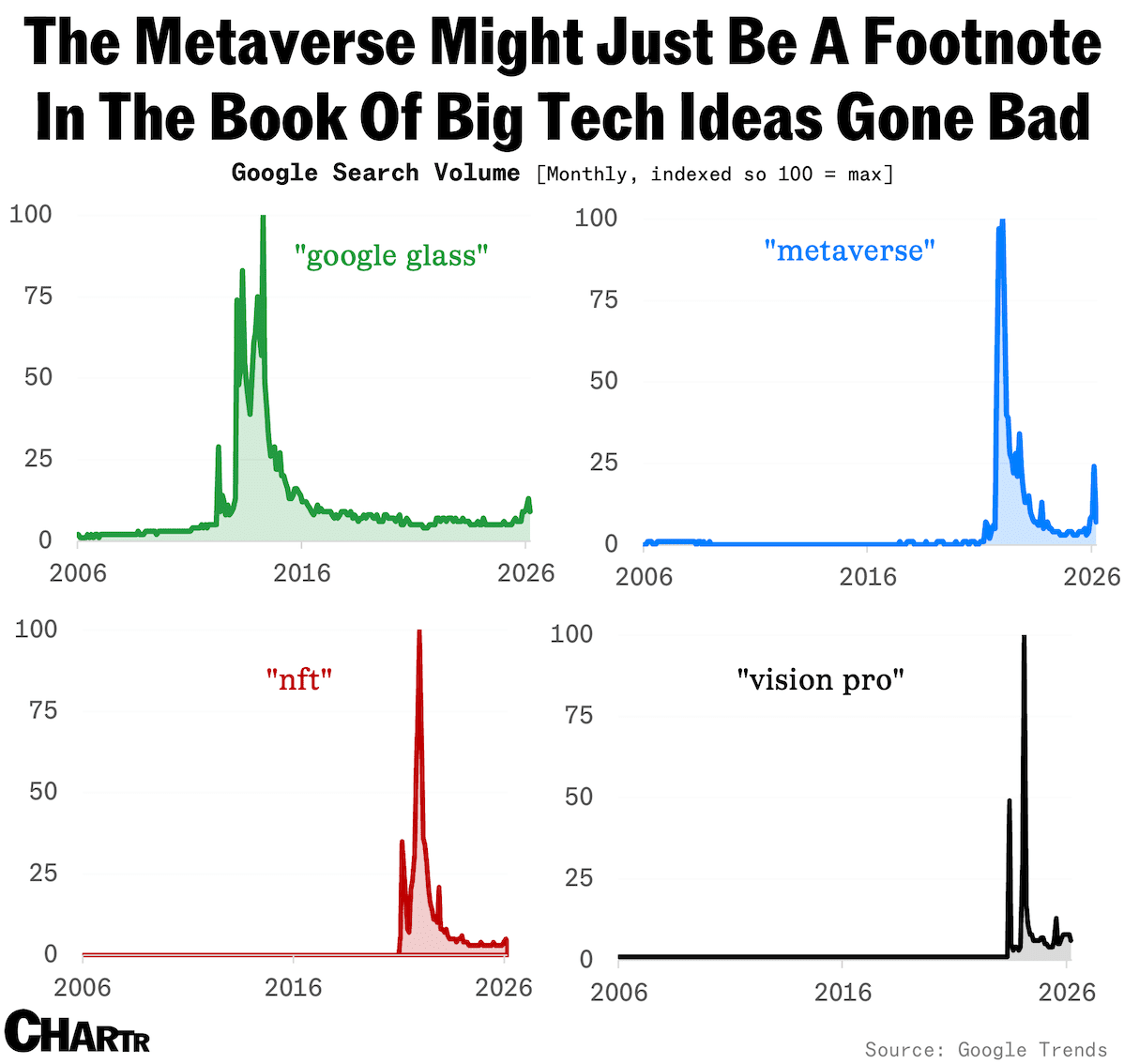
Metaverse was a costly wrong turn, but it’s hardly the only money-burning technology misstep
Source: Sherwood
Sign up for our reads-only mailing list here.
~~~
To learn how these reads are assembled each day, please see this.
Facts Only
* OpenAI is behind Anthropic’s Claude Code in the AI coding agent space.
* Some traders are leaving large hedge funds.
* Tech giants plan to use expensive, polluting equipment for power.
* Tesla fans are leaving the company’s online community.
* The Bezos administration at The Washington Post has implemented layoffs and editorial shifts.
* China’s Foreign Minister Wang Yi is involved in diplomatic efforts in the Middle East.
* A Tehran resident is documenting the impact of the war on Iranian civilians.
* There is debate about the validity of claims regarding an AI "bubble".
* Virtually everything known about psychopathy is being debunked.
Executive Summary
Full Take
The curated selection paints a picture of rapid, competing technological developments and the accompanying anxieties around their potential consequences. The core narrative centers on a disruption of established power structures – OpenAI’s vulnerability against Claude Code reveals a potential shift in AI dominance, mirroring the departure of traders from traditional hedge funds, signaling a desire for more direct control. These shifts aren’t simply about profit; the deliberate use of polluting energy sources by Meta and others exposes a tension between technological ambition and environmental responsibility, evoking a familiar image of homeowners resorting to makeshift solutions during crises – a “hurricane” metaphor hinting at systemic risk.
The Tesla story, framed as a “bait and switch,” reveals a critical vulnerability in the dynamics of online communities and influencer endorsements; it's a classic Motte-and-Bailey strategy designed to diffuse criticism by minimizing the core issue – Musk’s overstated claims about autonomous driving. This echoes the larger pattern of inflated expectations and subsequent disillusionment often found within Silicon Valley, characterized by a tendency towards hyperbolic marketing and a disregard for realistic timelines. The situation at The Washington Post reveals a classic corporate struggle: the billionaire owner, driven by losses, attempts to force efficiency, a tactic that could ultimately undermine journalistic independence – a potential Systemic risk.
The broader pattern – AI prognostication oscillating between doomsday fears and speculative bubbles – is highlighted by the Stratechery piece, which reveals a common distortion: the pressure to affirm the most pessimistic scenarios while simultaneously denying the possibility of a bubble. This embodies the ARC-0043 Motte-and-Bailey fallacy: acknowledging the fear while dismissing the evidence that might support it. Finally, the debunking of psychopathy – a concept deeply ingrained in popular culture – exemplifies the phenomenon of “Zombie Ideas” – ideas that persist despite overwhelming evidence to the contrary.
Questions arise: Are these shifts indicative of a fundamental restructuring of power, or simply tactical maneuvers within existing systems? And what responsibility do technologists bear for shaping public perception regarding complex issues like AI and climate change? Patterns detected: ARC-0043 Motte-and-Bailey, ARC-0024 Ambiguity.