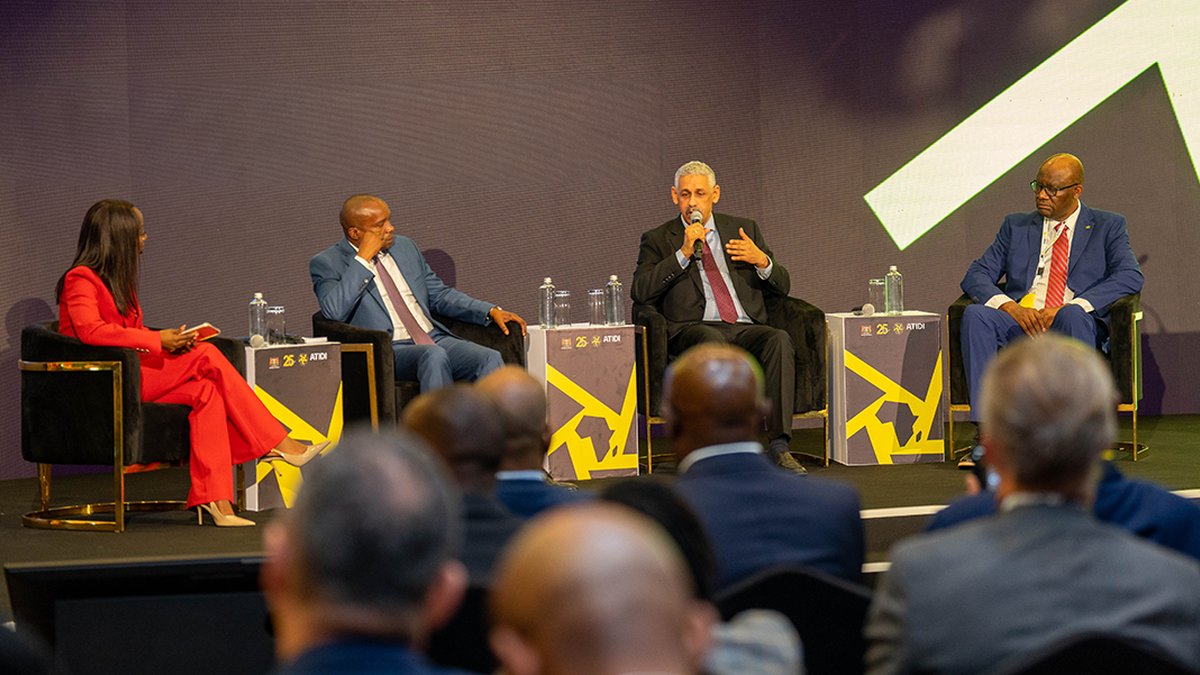
Africa’s quest for financing to fund its development ambitions can be met by tapping local sources, improving the investment environment and offering investors policy certainty. These were among the recommendations proffered by speakers at a leaders’ panel on the first day of African Trade and Investment Development Insurance’s annual general meetings held in Nairobi, Kenya from 30 June to 3 July 2026.
Opening the discussions, Sidi Ould Tah, president of the African Development Bank, made the case for the bank’s New African Financial Architecture for Development, which he said would strengthen coordination among Africa’s financial institutions and reduce dependence on external sources for development.
“The New African Financial Architecture for Development is meant to respond to a dire need among African countries and to fight fragmentation” Tah explained. “We have in Africa the largest number of financial institutions and development financial institutions in the world, yet the consolidated balance sheet of those institutions represents only 1% of the development financial institutions in the world. That shows the level of fragmentation we have and the low level of capitalisation we have in our financial institutions,” he added.
Rather than waiting on international reforms, Tah said NAFAD would organise African financial institutions across continental, regional and national levels while bringing together development finance institutions, commercial banks, guarantee agencies, insurers, private equity funds, pension funds, sovereign wealth funds and capital markets under a common framework. “What we lack on the continent is not resources. We are sitting on trillions of savings across the continent, but these trillions cannot be channelled to finance our development unless we have the confidence that ATIDI can provide us,” he said.
ATIDI’s president, Manuel Moses, reiterated that Africa’s most daunting challenge is not the lack of resources, but its inability to overcome the perceptions of risk associated with investing in the continent. He argued that sustainable economic growth depends on thriving businesses, but businesses can only flourish where governments provide predictable policy environments.
The mission for ATIDI, Moses said, is to provide that confidence to investors. “If we give confidence to investors, we can bring those enterprises that add value and we can work with investors to build the infrastructure that takes the raw materials where they are being produced and manufactured. Ultimately an economy will grow when businesses grow,” he stressed.
Moses noted that while governments often introduce investor-friendly policies, policy reversals or contract cancellations can derail projects years after investments have been made. Such uncertainty, he said, is particularly damaging for infrastructure investments that typically have lifespans of two decades or more. “You would put your money in a 25-year project assuming that the policies the government has provided for you would stay for 25 years. But 5 years later there’s a change of policy. Where does the investor go? The investor struggles,” he pointed out.
On ATIDI’s track record, Moses said it had mobilised a total of $93bn in investments between 2001 and 2026 despite having capital of less than $1bn, demonstrating the catalytic effect of risk insurance in attracting private finance. “Every dollar that we get from investors, we are able to multiply it up to 10 times. The more capital we get, the better we can organise and mobilise investments by de-risking capital that is already here.”
Kenya’s deputy president Professor Kithure Kindiki argued that governments must complement financial risk mitigation with consistent long-term policies capable of sustaining investment beyond electoral cycles. “One of the biggest problems for Africa and much of the developing world is policy disruption, where it is not clear that a programme on infrastructure transformation, a programme on housing, a programme on energy will be sustained in the long term. Many of the investors want a long-term commitment that they can invest in a long-term project,” he observed.
Rather than relying solely on either public funding or private finance, Kindiki said Kenya was pursuing a partnership model that would blend the two sources of capital. “Part of our moving into the future will involve making sure that we bridge the gap between public and private capital, because the public sector doesn’t have enough resources to undertake some of the ambitions that we have. It doesn’t have to be either-or. We should be doing that jointly.”
Giving further details about NAFAD, Tah said it would begin with strengthening ATIDI through fresh capital injections and a broader shareholder base to increase its capacity to mobilise investment across the continent. He said the AfDB was encouraging all African countries that have not yet joined ATIDI to do so, while also supporting existing members to increase their capital contributions. “We are really very keen to see all African countries joining ATIDI in the coming months and years,” he stressed.
Beyond ATIDI, Tah said NAFAD envisioned a fully integrated African financial ecosystem capable of mobilising domestic savings at scale for the continent’s development. “We are working with African pension funds to mobilise more resources to fund African development, as well as with the insurance industry, African sovereign wealth funds and with capital markets to deepen their markets and get them to work together toward a Pan-African stock exchange,” he revealed.
Tah also announced plans to recapitalise African development finance institutions more broadly and launch what he described as the “NAFAD Multiplier”, a mechanism which “will enable us, through injection of capital to regional and national institutions, to raise funds in their regional and domestic markets.”
Moses bemoaned the “Africa risk” premium, which disadvantages sovereigns on the continent and saddles them with higher borrowing costs. He pointed out that because many African countries sit in the “B” credit rating category, investors automatically assign a risk premium when pricing projects. He added that this is further compounded by what he described as an informal but real additional premium for investing in African markets. “In Africa, they even add another premium. We call it the buyer’s premium. So automatically, any project in Africa has a cost of business of 3%.”
In the light of this, he explained that ATIDI’s interventions are designed to alter the risk calculus by substituting sovereign-level risk perception with the institution’s own investment-grade rating, effectively reshaping how investors price African assets. Once ATIDI’s guarantee is factored into a transaction, he argued, investors effectively treat African projects as comparable to investment-grade exposures in developed markets, significantly compressing risk premiums. “So, where we were supposed to pay 3%, just because of our protection, they are now charging 1%. That’s how we reduce the cost of doing business for countries.”
Kindiki pointed to Kenya’s efforts to strengthen institutional governance as another way to overcome some of these structural constraints. He said Kenya was finalising what he described as a “business-friendly, investor-friendly governance structure” aimed at ensuring that pooled public and private capital is deployed efficiently into priority sectors of the economy.
The continent will also be well served by exploring new and innovative financing models, such as hybrid instruments which, as Tah noted, was pioneered by the AfDB in 2025. He said the AfDB now intended to scale up this approach not only for its own balance sheet but also across African development finance institutions, including regional lenders and specialised institutions such as ATIDI and the Trade and Development Bank.
Tah also stressed that MDBs also have a critical role in supporting structural reforms within African economies to strengthen investment climates and governance frameworks. He said such reforms were essential if Africa is to successfully mobilise its estimated domestic savings base while also attracting a greater share of global institutional capital. “Our aim is not only to leverage the $4 trillion African savings, but also to attract some of the $100 trillion of global savings which are not coming to Africa so far.”
However, he cautioned that unlocking this capital would require stronger institutions, improved governance, and predictable legal and regulatory frameworks that reduce uncertainty for investors. “We need strong institutions, the rule of law in Africa, and also to make sure that we have an enabling investment environment.”
Moses said many African countries have made significant progress in streamlining investment processes through one-stop investment centres and clearer licensing regimes but noted that investors remain primarily concerned by the possibility of reversals. “So, my appeal to all the governments is, please stick to your promises. Because your promises, when they are broken, result in claims unattended,” he charged.
Even as it gets its house in order, Africa will also benefit from the proposed reforms to the global financial system, which the AfDB has been a leading proponent of. Tah noted that there is growing recognition of the desire to reshape the global financial architecture through NAFAD, including at the recent Africa Forward Summit in Nairobi and the G7 summit in Evian, France.
“What we came up with from Evian was very clear, with ATIDI and NAFAD mentioned and endorsed by the leaders of the G7,” he reported, adding that “we are quite optimistic that in the coming months and coming years, the voice of Africa will be better heard on the international arena.”
In his closing remarks, Kindiki drew attention to the need to empower citizens to sustain the continent’s political stability. “We are the architects of our own destiny, and at the centre of that destiny is the empowerment of the citizen, especially economic empowerment. For that to happen, business, investment, and wealth creation is extremely important.”
He ascribed many of Africa’s political tensions to underlying economic grievances, arguing that instability can often be mitigated through more inclusive development strategies that address unemployment, inequality and uneven access to opportunity. “Many of the political challenges that we face as Kenya and as Africa can be mitigated by a robust economic programme that responds to the economic needs of the people,” he argued.
Kindiki further emphasised that Africa’s development trajectory must be grounded in confidence in its own institutions, capabilities and policy direction, rather than excessive reliance on external validation. “We must believe in ourselves. If you don’t believe in yourself, nobody will; we must believe in ourselves before we start asking other people to believe in us.”
Sentinel — Human
The article presents a structured summary of statements made at an investment development meeting, focusing on institutional reform and the mitigation of investment risk across the African continent.