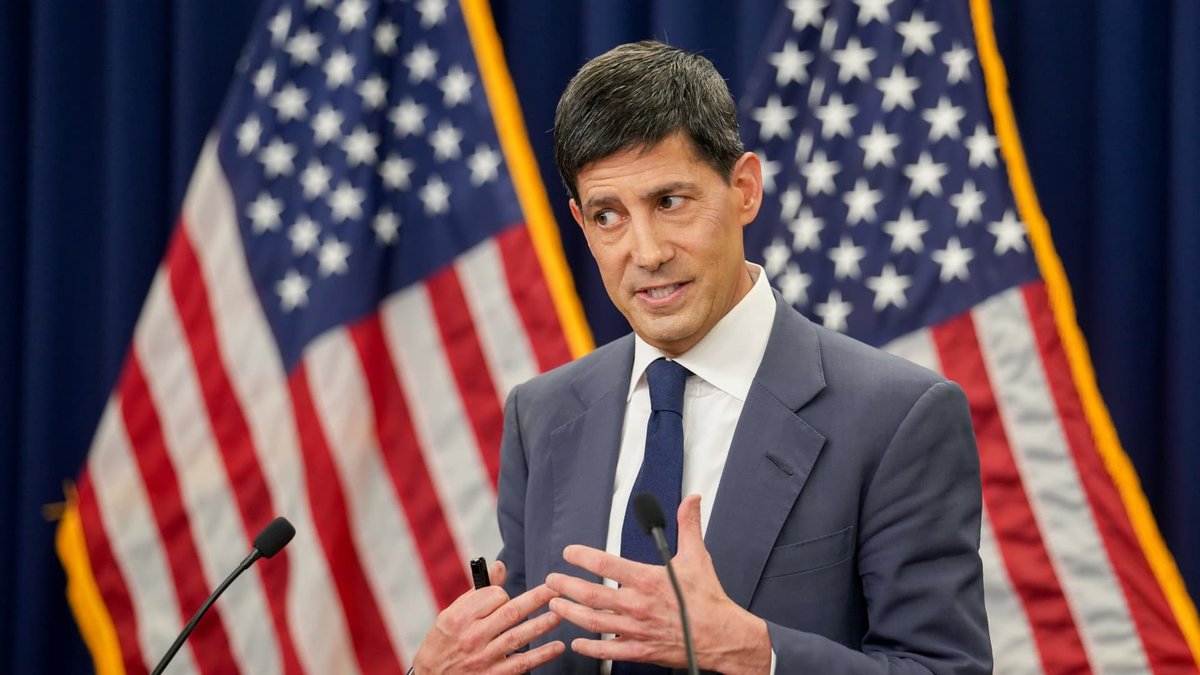
Federal Reserve Chairman Kevin Warsh on Thursday released names of the experts who will comprise five task forces to examine the institution's operations — a list that includes several prominent Wall Street names, business leaders and a wide expanse of academicians and former Fed officials.
Warsh first disclosed his intention to create the task forces last month, saying they would tackle communications, data, the Fed's balance sheet, data, productivity and jobs and the framework for how the policymakers view inflation. The group's will tackle everything from inflation to artificial intelligence as part of Warsh's promised review of monetary policy.
Among the prominent names involved are venture capitalist Marc Andreessen, former Bank of England Governor Mervin King, and Greg Mankiw, former chairman of the White House's Council of Economic Advisers. Doug McMillon, the former CEO of Walmart, leads the names of business executives involved. Several of the names, including King, had been leaked previously.
"I am honored that the best minds from a range of disciplines have agreed to work with us to sharpen our performance as an institution," Warsh said. "The goal is straightforward: to ensure the Fed is best positioned to achieve our objectives in this consequential time."
A Fed news release did not indicate a timeline of when the task forces would complete their work, though Warsh has said he expects changes to come this year.
The statement also noted that the panels will "operate independently, with a mandate to follow the evidence, provide candid feedback, and produce rigorous findings" that will be reported back to officials on the Federal Open Market Committee.
Members represent a swath of interests, spanning ideologies and backgrounds.
Others named to the task forces include Raghuram Rajan, former governor the Reserve Bank of India; former Fed Governor Jeremy Stein and William White, a Canadian economist who warned about central bank easy money prior to the 2008 global financial crisis.
For Andreesen, this is the second prominent appointment in recent days, having been named in late June to the U.S. Defense Policy Board, a civilian advisory group for the Pentagon. Andreesen is on the productivity and jobs task force.
When he initially announced the task forces, Warsh, who has been chairman for less than two months, said the groups would "start with first principles; ask hard questions; examine current practice; consider alternatives; and, ultimately, propose next steps for policymaker consideration."
The chairman said in the Thursday announcement that the Fed has "resolve to pursue our mandate with rigor."
The task forces are expected to take a sharp look at Fed orthodoxy. Warsh already has had an impact on Fed communications as officials look to provide less guidance about where policy is headed and focus more on their "reaction function," or the conditions under which they will adjust interest rates. The post-meeting statement in June was notably shorter than prior versions.
The members of the task forces are:
Communications: Peter R. Fisher, professor of practice, Foster School of Business, University of Washington; Arminio Fraga, founder and chairman, Gávea Investimentos and the former president of the Central Bank of Brazil; and King.
Balance Sheet Policy: Karen Dynan, Harvard economist; Rajan and Stein.
Data: McMillon, Harvard economist Raj Chetty and University of Chicago economist Kevin Murphy.
Productivity and Jobs: Andreesen, Stanford economist Charles I. Jones, and Asha Sharma, executive vice president and XBOX CEO at Microsoft.
Inflation Frameworks: Mankiw, White and New York University economist Thomas Sargent.
The groups will be supported as well by Fed staff.
Facts Only
* Federal Reserve Chairman Kevin Warsh released names of experts for five task forces.
* Task forces will examine communications, data, the Fed's balance sheet, productivity and jobs, and the inflation framework for policymakers.
* Prominent names include Marc Andreessen, Mervin King, Greg Mankiw, Doug McMillon, Raghuram Rajan, Jeremy Stein, and William White.
* Task forces will operate independently to follow evidence and produce rigorous findings reported to FOMC officials.
* The task forces are expected to review Fed orthodoxy.
* Specific panel assignments include Communications (Fisher, Fraga, King), Balance Sheet Policy (Dynan, Rajan, Stein), Data (McMillon, Chetty, Murphy), Productivity and Jobs (Andreesen, Jones, Sharma), Inflation Frameworks (Mankiw, White, Sargent).
Executive Summary
Full Take
Sentinel — Human
The text reads like a factual report on a high-level announcement, exhibiting the complexity and specific linkage characteristic of professional journalism rather than generic AI output.