- Key Takeaways
- Why Radiation Dangers for Human Habitats on the Moon Are Different From Earth Orbit
- How Solar Particle Events Turn the Sun Into an Operational Hazard
- Why Galactic Cosmic Rays Are Harder to Stop Than Solar Storms
- What Radiation Does to People Inside and Outside a Lunar Habitat
- How Radiation Harms Habitats, Electronics, and Surface Infrastructure
- Which Shielding Strategies Can Reduce the Danger
- Why Radiation Changes the Space Economy Case for Lunar Habitats
- How Lunar Base Designers Should Treat Radiation as a System Problem
- Summary
- Appendix: Useful Books Available on Amazon
- Appendix: Top Questions Answered in This Article
- Appendix: Glossary of Key Terms
Key Takeaways
- Lunar bases need shielding because the Moon lacks Earth’s atmosphere and magnetic field.
- Solar storms create short bursts of risk, but cosmic rays create constant exposure.
- Regolith, water, storm shelters, monitoring, and procedures must work as one system.
Why Radiation Dangers for Human Habitats on the Moon Are Different From Earth Orbit
China’s Chang’e 4 lander measured an average lunar-surface radiation dose equivalent of about 1,369 microsieverts per day, a figure published in Science Advances after the Lunar Lander Neutrons and Dosimetry instrument operated on the far side of the Moon. That measurement gives lunar planners a real surface benchmark rather than a number derived only from models or short Apollo-era exposures. For radiation dangers for human habitats on the Moon, the measurement says something direct: a lunar base sits in an environment where the exposure clock keeps running whenever people, electronics, and supplies are outside adequate shielding.
Earth orbit can give a misleading impression of space radiation risk. Astronauts aboard the International Space Station live above most of the atmosphere, yet they remain partly protected by Earth’s magnetic field. A lunar surface crew does not have that benefit. The Moon has only a tenuous exosphere, no thick blanket of air, and no global magnetic field comparable to Earth’s. A surface habitat has to supply the shielding function that Earth supplies naturally.
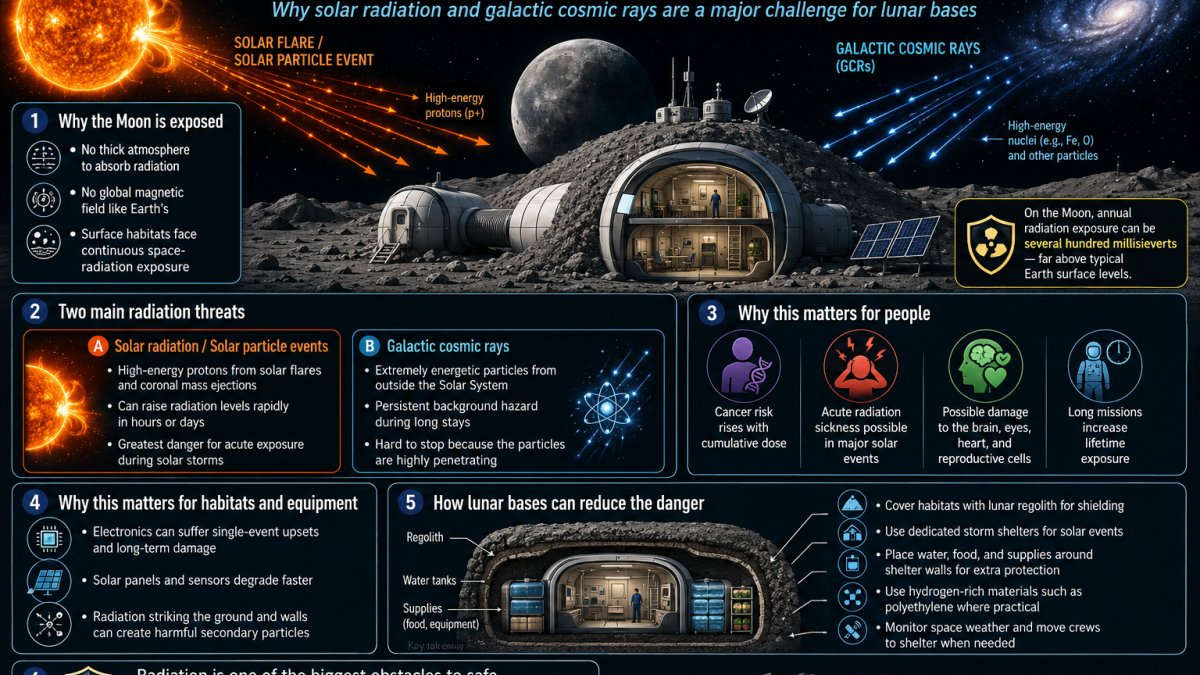
The previous infographic separated the problem into two main radiation threats: solar radiation from solar particle events and galactic cosmic rays from beyond the Solar System. That distinction matters because the two hazards behave differently. Solar particle events can arrive as sudden bursts of high-energy particles associated with solar flares and coronal mass ejections. Galactic cosmic rays arrive as a persistent background of highly energetic atomic nuclei, including protons and heavier elements. One hazard resembles a storm. The other resembles climate.
NASA’s Space Radiation Element describes the broader human-health problem as ionizing radiation exposure outside Earth’s protective atmosphere. Ionizing radiation can damage DNA and tissues because it carries enough energy to remove electrons from atoms. For short missions, radiation can be managed as a mission exposure item. For human habitats on the Moon, it becomes a design condition for walls, operations, crew schedules, spacesuits, emergency response, medical monitoring, power systems, robotics, and surface logistics.
Apollo did not solve this problem because Apollo did not have to support a long-duration settlement. The lunar landing missions were short, crews spent limited time on the surface, and the missions avoided large solar particle events. A habitat intended for weeks, months, or repeated occupation faces a different problem. It needs radiation protection that works during ordinary days and during extreme solar activity.
New Space Economy’s article on living on the Moon frames the lunar surface as a place where habitats must handle radiation, dust, temperature swings, vacuum, logistics, power, and maintenance together. That integrated view is the right one. Radiation shielding is not a separate add-on that can be attached after the habitat is designed. It affects mass, layout, site selection, power distribution, storage placement, emergency access, surface mobility, and commercial feasibility.
The direct danger to people receives most attention, for good reason. Cancer risk rises with cumulative dose. Major solar events can create acute exposure concerns. Research also examines possible effects involving cognition, the cardiovascular system, eyes, and reproductive cells. Yet habitats and equipment matter as well. Electronics can suffer single-event upsets, solar arrays can degrade, optical systems can lose performance, and shielding can create secondary particles when high-energy radiation hits habitat walls or lunar soil.
That is why the design answer cannot be a single material or a single rule. Lunar radiation protection needs layered defense. Regolith can provide bulk shielding. Water and supplies can surround high-use areas. Storm shelters can protect crews during particle events. Space-weather monitoring can guide operations. Radiation-hardened electronics can reduce system failure. Surface procedures can reduce unnecessary exposure during extravehicular activity. Human habitats on the Moon will be safe enough only when those measures work together.
How Solar Particle Events Turn the Sun Into an Operational Hazard
Solar particle events are bursts of energetic particles injected into interplanetary space. NASA’s Space Radiation Analysis Group explains that these events can include energetic electrons, protons, alpha particles, and heavier particles accelerated by shock waves ahead of fast coronal mass ejections and often associated with solar flares. The fastest particles can arrive quickly enough that a surface crew cannot treat solar radiation as a distant warning problem.
For a lunar base, the acute danger comes from timing and intensity. A crew member walking on the surface, driving a rover, repairing a solar array, or transferring cargo has little time to add mass between the body and the incoming particles. A suit protects against vacuum, temperature extremes, micrometeoroids, and dust contamination, but a suit cannot carry the same shielding mass as a habitat. A pressurized rover improves the situation, yet even a rover needs a radiation response concept if crews travel beyond quick walking distance from shelter.
The Sun does not produce the same particle environment every day. Solar activity follows an approximate 11-year cycle, with more flares, coronal mass ejections, and solar particle events near solar maximum. NASA’s Artemis II space-weather coverage notes that mission teams monitor solar eruptions continuously because a significant event near a crewed spacecraft could raise radiation levels inside the vehicle. That same logic applies to lunar habitats, except surface crews may be operating with more distance between people and the most shielded area.
Solar particle events are not always the same size. Smaller events may affect electronics, instruments, and operations without creating a severe health emergency. A larger event can force rapid sheltering and mission changes. The danger grows when crews are outside, when a vehicle is lightly shielded, or when shelter access is delayed by distance, dust, terrain, suit problems, or communications loss.
NASA’s Design for Ionizing Radiation Protection technical brief, derived from NASA-STD-3001, states that individual astronaut career effective radiation dose from spaceflight exposure is limited to 600 millisieverts and that short-term exposure from solar particle events is limited to 250 millisieverts per event to reduce acute effects. Those limits illustrate why mission designers cannot treat solar storms as rare inconveniences. They shape the permissible exposure budget for a career and for a single event.
Solar-particle protection favors practical mass placement. Water, food, equipment, spare clothing, batteries, and waste containers can become part of shelter design if placed around a small protected volume. This approach already appears in spacecraft planning. A lunar habitat can take the concept further by designing storm-shelter zones from the start, with water tanks and dense supplies arranged so crews can reach a protected core quickly.
The safest storm shelter is not necessarily the largest room. A smaller, tightly shielded area can offer better protection per kilogram of material because it reduces the wall area that needs shielding. That creates a tension between habitability and emergency design. Crews need enough room for breathing, thermal control, communications, medical supplies, dosimetry, sanitation, and several hours or days of occupancy. They do not need the storm shelter to replicate the full habitat.
New Space Economy’s coverage of space weather forecasting for Artemis astronauts captures another important point: forecasting needs to improve as human activity extends beyond low Earth orbit. A forecast does not stop particles, but it can change crew behavior. It can delay a surface sortie, shorten rover travel, move astronauts into shelter, protect sensitive equipment, and postpone cargo handling.
The operational lesson is simple without being easy. The Moon turns solar forecasting into safety infrastructure. A lunar habitat needs space-weather information, dose-rate monitors, warning thresholds, rehearsed shelter procedures, and clear decision authority. Crews cannot debate what to do after radiation alarms sound. The habitat, rover, mission control, and crew procedures need a shared response plan before the mission starts.
Why Galactic Cosmic Rays Are Harder to Stop Than Solar Storms
Galactic cosmic rays are different from solar particle events because they arrive continuously from outside the Solar System and carry very high energies. NASA’s radiation guidance describes galactic cosmic rays as penetrating protons and heavy nuclei. In practical terms, they include particles that can pass through common shielding more easily than lower-energy solar particles.
The main danger from galactic cosmic rays is cumulative dose. They do not usually create the sudden emergency profile associated with a large solar particle event, yet they keep adding exposure through time. A week on the Moon is one thing. A 30-day surface mission is another. A base that supports repeated crews over years creates a new radiation-management problem because the habitat becomes part of a long-term human exploration system.
High-energy particles also create a secondary-radiation problem. When cosmic rays strike metal, regolith, or other materials, they can generate showers of secondary particles, including neutrons. This is why shielding is not a simple case of adding more metal. Thick, dense shielding can reduce some radiation components yet produce additional radiation components that matter biologically. NASA’s OCHMO technical brief notes that shielding is less effective for galactic cosmic rays because secondary radiation can form in shielding and tissue.
Hydrogen-rich materials are often attractive for radiation protection because low-atomic-number materials can reduce certain particle interactions. Water and polyethylene can help because they contain abundant hydrogen. For a lunar habitat, that creates a design opportunity: materials already needed for life support and operations can become radiation assets. Water tanks, food storage, waste storage, and polymers can be placed to reduce exposure in crew areas.
Regolith shielding also has a strong practical case. Lunar soil does not need to be launched from Earth, and mass launched from Earth remains expensive even with lower launch prices. Covering habitats with regolith can reduce exposure to solar particles and some secondary effects when designed correctly. The same regolith cover can also help with thermal stability and micrometeoroid protection. New Space Economy’s article The Moon Is an Equipment Killer makes the broader engineering point: lunar hardware faces radiation, vacuum, dust, heat, cold, and mechanical wear as a combined survival test.
Galactic cosmic rays make underground, bermed, and covered habitats more attractive, but they do not make the design problem disappear. A habitat buried under loose material has to handle structural loads. A regolith cover can shift mass onto modules that were never designed to act like buried civil structures. Designers may need arches, vaults, external frames, bagged regolith, sintered panels, protective berms, or canopy structures that hold soil above the pressure vessel without crushing it.
Lava tubes and subsurface voids often appear in lunar-settlement discussions because deep natural shielding could reduce radiation exposure. The concept is appealing, but a real habitat cannot assume that a usable lava tube will sit near the best power, communications, landing, science, and resource locations. Entry, inspection, mapping, sealing, anchoring, dust control, thermal design, emergency egress, and legal coordination all remain hard problems.
Unlike solar particle events, galactic cosmic rays cannot be managed mainly by short warning and sheltering. Crews cannot stay inside a tiny storm shelter for months. The whole habitat, the normal sleep area, the medical area, and at least part of the work area need acceptable exposure levels. Surface operations have to limit unnecessary time outside. Rovers need enough shielding for planned travel. Maintenance procedures need robotic options where exposure would otherwise accumulate.
The radiation problem is also biological, not only physical. Space radiation differs from terrestrial occupational radiation in particle type, energy, and mixed-field complexity. NASA’s Human Research Program studies health outcomes because the body’s response to chronic exposure in deep space remains an active area of research. Cancer risk receives the most public attention, yet researchers also study central nervous system effects, degenerative tissue effects, and other health risks.
That uncertainty matters for settlement claims. A base plan that works on paper by averaging dose over time may still be unacceptable if it ignores crew age, sex, mission history, shield geometry, organ dose, solar-cycle timing, and activity patterns. Radiation design needs to track where people actually spend time. A crew that sleeps behind water walls and spends work periods in lightly shielded labs has a different exposure profile than a crew that lives in a uniformly shielded buried module.
What Radiation Does to People Inside and Outside a Lunar Habitat
Human tissue is vulnerable to ionizing radiation because charged particles and secondary radiation can disrupt molecules inside cells. DNA damage can sometimes be repaired. At other times, repair can fail or misrepair can occur. Radiation risk depends on dose, dose rate, particle type, energy, shielding, organ exposure, individual susceptibility, and mission duration.
NASA identifies space radiation as a human health risk for missions outside Earth’s protective atmosphere. The expected long-term concern is increased cancer risk after the mission. The shorter-term danger comes from intense solar particle events that can produce acute radiation effects if crews lack effective shielding. Those two risk profiles have different medical and operational meanings.
Cancer risk grows with cumulative exposure, so every surface activity belongs to a mission radiation budget. A single spacewalk may not dominate a career, but repeated extravehicular activities, rover traverses, lightly shielded work areas, and transit exposure add up. For a lunar base, this makes radiation a scheduling issue. Planners need to decide how much time crews can spend in suits, how often they should use rovers, where they should sleep, and when robotic systems should substitute for human labor.
Acute radiation sickness is a different concern. It is associated with high exposure over a short period. The symptoms and severity depend on dose and timing. The important point for lunar operations is that a severe solar particle event could create a medical emergency during a mission, not just a future health risk. Storm shelters, alarms, dosimeters, and operational discipline are direct health-protection tools.
Radiation also raises concerns for eyes, the nervous system, cardiovascular tissues, and reproductive cells. NASA’s technical brief lists cancer, cognition, motor function, behavior, neurological disorders, acute radiation syndromes, skin injuries, and blood-forming organ effects among radiation-related concerns. A lunar habitat must support medical tracking that goes beyond a simple daily number. Personal dosimeters, area monitors, activity logs, and post-mission health data all help convert exposure into risk assessment.
The previous infographic noted that long missions increase lifetime exposure. That statement has a direct policy implication. A lunar base crew cannot be managed like an Apollo crew with a short visit and a small total exposure window. Mission planners may need rotation rules, cumulative career tracking, shielded crew quarters, limits on surface time, and medical selection criteria that account for prior spaceflight exposure.
Crew psychology and behavior also matter. Radiation is invisible, and invisible hazards can lead to complacency if alarms rarely sound. The reverse danger is excessive caution that prevents useful work. A base needs clear exposure rules that crews trust. Those rules should be built into work planning rather than left to individual judgment during a demanding surface sortie.
Radiation risk also interacts with other lunar hazards. A dust-related suit problem could delay a crew member during a solar-particle warning. A power fault could reduce storm-shelter ventilation. A rover breakdown could trap astronauts away from the best shielding. A communications failure could slow warnings from Earth or from lunar monitoring assets. New Space Economy’s article on existential threats to a Moon colony treats radiation as part of a broader settlement-risk network, which is a better model than a hazard-by-hazard checklist.
Medical countermeasures may help in the future, but they cannot replace shielding and exposure control. Drugs, biomarkers, and biological research may reduce uncertainty or improve treatment. They do not change the need to keep dose as low as reasonably achievable. NASA’s standard language reflects that principle by requiring exposures to be minimized under the ALARA principle, meaning as low as reasonably achievable.
A human lunar habitat is, in effect, a health machine. It supplies oxygen, removes carbon dioxide, controls temperature, handles waste, filters dust, and reduces radiation exposure. Radiation protection belongs in that same life-support category. It is not optional equipment for long-duration operations. It is one of the conditions that determines whether crews can live, work, sleep, heal, and return safely.
How Radiation Harms Habitats, Electronics, and Surface Infrastructure
Radiation does not need to injure a person directly to endanger a lunar base. It can damage the machines that keep people alive. A surface habitat depends on life-support processors, pumps, valves, sensors, computers, communications links, power electronics, battery systems, rover interfaces, airlock controls, thermal loops, scientific instruments, and warning systems. A radiation-induced fault in any of those systems can become a crew-safety problem.
Single-event effects occur when a charged particle deposits energy in an electronic component. A bit can flip. A sensor can give a false reading. A processor can reset. A power device can latch up or fail. Radiation-hardened electronics reduce the risk, but they add cost, supply-chain constraints, and design limits. Commercial off-the-shelf hardware may be attractive for cost and performance, yet lunar service demands qualification that goes far beyond ordinary terrestrial use.
Total ionizing dose is another problem. Over time, radiation can degrade materials and semiconductor devices. A sensor that works on landing day may drift after months of exposure. Solar panels can lose efficiency. Optical coatings can darken. Insulators can degrade. The longer the base operates, the more radiation becomes a maintenance and replacement issue.
The previous infographic pointed to solar panels and sensors as vulnerable systems. That matters because power is not a luxury on the Moon. Power runs heaters during cold periods, keeps life-support systems active, charges rovers, powers communications, and supports science payloads. If radiation accelerates solar-array degradation, the base needs larger margins, spare panels, repair capability, or alternative power.
Radiation also complicates external infrastructure. Communications relays, navigation beacons, landing aids, robotic construction equipment, science stations, and resource-processing units may operate outside the habitat’s thickest shielding. NASA’s interest in lunar communications and navigation systems shows that sustained lunar operations depend on distributed hardware, not only one crew cabin. New Space Economy’s article on NASA’s Lunar Communications Relay and Navigation Systems program places radiation alongside line-of-sight, terrain, and power as design concerns for lunar infrastructure.
Radiation can also create operational false alarms and data corruption. A scientific instrument may record particle strikes that look like signals. A rover navigation system may reset at the wrong time. A storage device may corrupt a file that contains maintenance data. Redundant systems, error correction, watchdog timers, shielding, fault-tolerant software, and periodic validation become part of the radiation strategy.
A habitat’s physical materials face radiation exposure as well. Polymers, seals, adhesives, coatings, and fabrics may become brittle or less reliable over time. Materials exposed outside the pressure vessel face ultraviolet radiation, charged-particle radiation, thermal cycling, vacuum, and dust abrasion together. Radiation rarely acts alone in lunar engineering. Its effects combine with temperature extremes and mechanical wear.
That combined environment affects business and logistics. Replacement parts need launch capacity, cargo manifests, storage volume, and installation time. If radiation shortens component life, the operating cost of a Moon base rises. If electronics need more shielding, payload mass rises. If maintenance requires frequent extravehicular activity, crew exposure rises. A radiation problem can become a supply-chain problem, a launch problem, a staffing problem, and an insurance problem.
For commercial lunar activity, radiation reliability will influence contracts and warranties. A company providing power, communications, mobility, resource extraction, construction, or habitat services has to prove that hardware can survive the expected dose environment. Qualification standards, test facilities, simulation tools, and radiation-environment models become part of the lunar economy.
New Space Economy’s article on NASA Moon base plans presents lunar base development as a layered buildout involving power, payload delivery, infrastructure, mobility, surface science, and operations. Radiation touches each layer. A lunar base is not shielded if only the crew quarters are protected and the surrounding systems fail under particle exposure.
The best engineering answer is graceful degradation. Hardware should not move from perfect operation to catastrophic failure without warning. Radiation design should favor redundancy, replaceable modules, sheltered electronics bays, autonomous safe modes, diagnostic logs, and physical access for repair. A crew should know when a component is degrading before it becomes a life-support emergency.
Which Shielding Strategies Can Reduce the Danger
A lunar base can reduce radiation danger by placing mass intelligently between people and particles. That sounds simple, but the source, energy, direction, and timing of radiation determine which material and layout work best. Solar particles, galactic cosmic rays, secondary neutrons, gamma rays, ultraviolet radiation, and electronics effects do not respond identically to the same wall.
Regolith is the most discussed lunar shielding material because it already exists at the destination. Moving soil on the Moon is still hard, but it is far easier than launching equivalent shielding mass from Earth. A habitat can use berms, covered modules, sandbag-like containers, sintered blocks, excavated trenches, or canopy-supported soil covers. The right choice depends on site geology, dust behavior, construction equipment, load paths, thermal design, and maintenance access.
Regolith shielding needs engineering restraint. Too little cover may leave crews exposed to unnecessary dose. Too much cover may add structural risk or make repairs difficult. The habitat pressure shell, external insulation, airlocks, hatches, antennas, radiators, cables, and docking ports all need access. A buried habitat without maintainable interfaces can become difficult to service.
Water shielding is attractive because water is already needed for life support. Tanks can be placed around sleeping quarters or storm shelters. A base near polar resources may eventually produce or process local water, though that depends on site access, extraction technology, power, storage, and operational maturity. New Space Economy’s article on water stored in Moon materials explains why lunar water is both a resource opportunity and a planning problem rather than a guaranteed nearby utility.
Food, waste, clothing, spare parts, and equipment can add shielding value. This method is attractive because it uses mass already present in the base. It also changes the interior layout. Storage should not be treated as leftover space. In a radiation-aware habitat, storage can form protective walls around high-occupancy zones.
Polyethylene and other hydrogen-rich materials can help in selected applications. They are not magic materials, and they still have mass and fire-safety considerations. They can be useful in panels, storm shelters, rover protection, and personal protective equipment. Material selection has to consider radiation, flammability, off-gassing, mechanical properties, thermal performance, repairability, and compatibility with lunar dust.
Storm shelters deserve special design attention. The previous infographic described a dedicated protected area for solar events. That area should be easy to reach, simple to close out, stocked with emergency supplies, connected to communications, supported by power and ventilation, and instrumented with radiation monitors. A shelter that requires a complex setup during an alarm invites error.
Space-weather monitoring is part of shielding because it changes exposure behavior. NASA’s Artemis planning uses radiation trackers and ground monitoring for crewed lunar missions. A lunar base can extend that approach with surface dosimeters, heliophysics data, local alarms, forecast products, rover warnings, and surface operations rules. A warning that arrives too late has little value. A warning that crews ignore has no value.
Rover shielding creates a difficult balance. Pressurized rovers expand surface reach, but heavy shielding reduces range, payload, speed, or energy margin. A rover may need a protected zone rather than uniformly thick walls. The vehicle also needs a plan for sheltering if a solar event begins during a traverse. NASA’s pressurized rover work is relevant because mobility will shape how far crews travel from base protection.
Active shielding, such as magnetic or electrostatic concepts, appears in research discussions, but practical lunar habitat use remains uncertain. Passive shielding with regolith, water, supplies, and carefully chosen materials is more mature. Active systems would need power, reliability, field safety, mass, fault tolerance, and proof that they reduce the specific radiation components that matter most for humans.
Site selection also affects the shielding plan. Polar areas may offer access to long-duration sunlight and nearby permanently shadowed regions, but radiation exposure still needs shielding. Terrain can help or hurt. A crater wall might reduce some sky exposure from one direction, yet it can limit power, communications, mobility, and thermal conditions. Subsurface sites may offer protection, but they add access and construction problems.
Radiation shielding is most effective when designed as architecture rather than as armor. Bedrooms, medical areas, command stations, and storm shelters should sit in the most protected zones. Lower-occupancy equipment rooms can sit in less protected areas. External service corridors, robotic workstations, and modular replacement bays can reduce crew time in exposed conditions. The habitat floor plan becomes a dose-management tool.
Why Radiation Changes the Space Economy Case for Lunar Habitats
Radiation affects the economics of lunar habitation because shielding has mass, construction demands, testing costs, qualification burdens, operating procedures, crew-time limits, insurance implications, and maintenance consequences. A habitat that looks affordable without radiation protection may become unrealistic once protection is included.
Launch cost matters, but it is not the only cost. If shielding mass must come from Earth, every kilogram competes with life support, science payloads, spares, tools, mobility systems, and power hardware. If shielding comes from local regolith, the base needs excavation equipment, grading systems, construction robotics, dust control, verification instruments, and crew or robotic oversight. Local material reduces imported mass but adds surface operations.
This creates demand for new lunar services. Companies may provide robotic grading, regolith bagging, sintering, berm construction, surface mapping, radiation monitoring, shelter modules, hardened electronics, fault-tolerant control systems, and dosimetry services. Government procurement will likely create early demand, but commercial customers may follow if science, resource extraction, communications, tourism, media, and research activities require protected facilities.
Radiation also affects the value of site preparation. A prepared pad, buried cable route, shielded equipment bay, or regolith berm can serve multiple missions. Infrastructure that reduces radiation exposure can become shared lunar capital. A base is more than a habitat; it is a collection of protected places, safe routes, warning systems, spare-parts stores, power nodes, and communications links.
Insurance and liability will not ignore radiation. A commercial operator sending people or valuable hardware to the Moon will need credible exposure models and mitigation plans. Customers will ask how systems were tested, how dose is tracked, what alert thresholds exist, and what failure modes remain. A lunar habitat provider that cannot document radiation performance may struggle to win high-value contracts.
Workforce exposure also matters. If construction and maintenance require many hours of human extravehicular activity, the base consumes radiation budget during its own buildout. Robotic construction can reduce human exposure, but robots need radiation-tolerant electronics and reliable autonomy. A radiation-safe lunar economy may rely heavily on machines doing the dirty, repetitive, and exposed work before crews arrive.
New Space Economy’s article on the Artemis Foundation Surface Habitat describes a habitat as the core living and working node for sustained lunar presence. In commercial terms, that habitat also anchors demand for power, maintenance, logistics, mobility, communications, water, waste handling, software, medical systems, and construction. Radiation protection is one of the design features that determines whether those adjacent markets can function around real human occupancy.
Tourism claims deserve caution. Short tourist stays may tolerate lower cumulative dose than long professional missions, but short stays still face solar-event risk. A high-net-worth customer is unlikely to accept a habitat with unclear shelter capability. Operators would need medical screening, informed consent, exposure monitoring, emergency procedures, and a transportation plan that handles solar activity during transit and surface stay.
Science operations face their own tradeoffs. The Moon is attractive for geology, astronomy, radio science, heliophysics, and technology demonstration. Human crews can increase field productivity, repair equipment, and make judgments that robots cannot easily match. Radiation exposure adds cost to every human hour outside shelter. That may push mission planners to use crews for high-value tasks and robots for routine collection, inspection, and setup.
Government agencies will remain central because radiation protection depends on standards, long-duration biomedical data, mission assurance, and infrastructure investment. Yet the commercial sector can supply many elements: hardened subsystems, autonomous construction machinery, monitoring networks, modular shelters, materials testing, radiation-analysis software, and logistics support. The market will favor providers that translate radiation science into reliable field equipment.
The business case for lunar habitats should include a radiation line item from day one. A base concept without credible shielding, monitoring, and emergency procedures is not cheaper; it is incomplete. If the Moon becomes a long-duration worksite, radiation protection will be one of the filters separating presentation graphics from buildable infrastructure.
How Lunar Base Designers Should Treat Radiation as a System Problem
Radiation protection for human habitats on the Moon should begin with a dose map. Designers need to know where people sleep, work, exercise, eat, enter suits, repair equipment, monitor systems, and take shelter. They also need to know where electronics sit, where water is stored, where spares accumulate, and where external equipment requires maintenance. The habitat should be evaluated by exposure pathways rather than wall thickness alone.
A good system starts with measurement. Surface dosimeters should track radiation outside the habitat, inside crew quarters, inside storm shelters, in rover cabins, near sensitive electronics, and near cargo zones. Personal dosimeters should track individual crew exposure. Data should link to activity logs so mission planners know which tasks drive dose. Without that connection, the base can measure radiation but fail to manage it.
The next layer is layout. Shielded sleep areas reduce dose because crews spend many hours there. Shielded medical and command areas protect high-use spaces. Storm shelters protect against short-duration solar events. Lower-use spaces can accept less shielding if crews spend little time there. This approach can reduce mass compared with trying to make every cubic meter equally protected.
The layout should also support fast movement. A storm shelter is less useful if a crew member has to pass through dusty equipment zones, narrow hatches, or poorly lit corridors to reach it. Airlock design matters because crews may be returning from a surface sortie when a warning arrives. Rover docking matters because a crew may need to transfer from vehicle to shelter quickly. Habitats should be designed around the worst plausible day, not the easiest ordinary day.
Procedures need the same discipline. A base should define radiation conditions under which extravehicular activity stops, rover travel is limited, robots take over, and crew move to shelter. Those thresholds should use dose-rate data, forecasts, mission phase, suit status, distance from shelter, and crew cumulative exposure. The rules should be simple enough to execute under stress.
Robotic systems can reduce exposure by handling high-dose tasks. Robots can inspect solar arrays, move regolith, check external cables, pre-position cargo, survey routes, and perform routine monitoring. Human crews can then focus on tasks that need judgment, repair skill, science interpretation, or safety authority. New Space Economy’s article on realistic NASA Moon base plans notes that mobility, terrain access, and infrastructure all shape the feasibility of lunar operations. Radiation adds another reason to value robotic reach.
Testing should happen before launch. Materials, sensors, electronics, seals, cables, coatings, and software should face radiation environments relevant to lunar use. Qualification should account for total dose, single-event effects, temperature cycling, vacuum, and dust. A component tested against only one stress may fail when the Moon combines multiple stresses.
Redundancy has to be physical and procedural. Two sensors in the same unshielded location can fail from the same event. Redundant systems should avoid shared exposure paths where possible. Backup shelters should exist if a main shelter is blocked. Rovers should carry enough protection and supplies for credible return delays. Communications should include fallback paths for space-weather alerts.
Radiation risk also needs governance. Mission control, crew commanders, medical officers, commercial operators, and agency officials need clear authority. If a forecast suggests elevated risk, who cancels a surface operation? If a crew member’s cumulative dose approaches a limit, who changes the mission plan? If a commercial payload requires a risky repair, who approves the exposure? A lunar base with multiple organizations will need rules before the conflict appears.
Designers should avoid two false comforts. One is assuming that short Artemis missions prove long-duration safety. They do not. Another is assuming that more mass always solves the problem. It does not. Shielding mass helps when chosen and placed well, but high-energy particles, secondary radiation, structural loads, logistics, and operational exposure complicate the answer.
The right design philosophy treats radiation protection as a living system. It combines shielding, monitoring, medical data, forecasting, training, maintenance, robotics, layout, standards, and operational authority. Such a system will never make the Moon Earth-like. It can make lunar work more predictable, more survivable, and more commercially credible.
Summary
Radiation is one of the hardest barriers between short lunar visits and sustained human habitation. The Moon lacks the atmospheric and magnetic shielding that protects people on Earth. Chang’e 4’s surface measurement of about 1,369 microsieverts per day gives planners a concrete warning about cumulative exposure, and NASA’s radiation standards show why both career dose and solar-event dose must be controlled.
The danger comes from two different sources. Solar particle events can create sudden exposure emergencies, so lunar bases need forecasting, alarms, storm shelters, and rapid shelter procedures. Galactic cosmic rays create constant exposure, so habitats need shielding in normal living and sleeping areas, not just emergency compartments. The same radiation environment also damages electronics, solar arrays, sensors, materials, and surface infrastructure.
Long-duration lunar habitats will need layered protection. Regolith, water, food, supplies, polyethylene, hardened electronics, robotic maintenance, local monitors, personal dosimeters, and surface procedures all have a place. No single measure is enough by itself. Radiation protection has to be designed into the habitat, rover, power system, construction plan, mission rules, and commercial model.
The space economy impact is direct. Radiation adds cost, mass, testing, standards, liability, and maintenance needs. It also creates demand for new services, including regolith construction, monitoring systems, hardened components, robotic inspection, and shelter modules. A credible lunar habitat business case begins with the same assumption as a credible safety case: radiation protection is part of the architecture, not a late-stage accessory.
Appendix: Useful Books Available on Amazon
- A City on Mars
- The Value of the Moon
- Moon Rush
- The Case for Space
- The High Frontier
- Space Settlements
Appendix: Top Questions Answered in This Article
Why Is Radiation More Dangerous on the Moon Than on Earth?
Earth has a thick atmosphere and a global magnetic field that reduce exposure from solar particles and cosmic rays. The Moon has only a tenuous exosphere and no comparable global magnetic shield. Human habitats on the Moon must provide their own protection through mass, layout, monitoring, and operating rules.
What Are the Main Radiation Threats to Lunar Habitats?
The two main threats are solar particle events and galactic cosmic rays. Solar particle events can raise radiation levels quickly during solar storms. Galactic cosmic rays arrive continuously from deep space and add cumulative exposure during long stays.
How Much Radiation Has Been Measured on the Lunar Surface?
Chang’e 4’s Lunar Lander Neutrons and Dosimetry instrument measured an average dose equivalent of about 1,369 microsieverts per day on the lunar surface. That measurement is useful because it came from an active detector operating on the Moon rather than from a short crewed mission or a model alone.
Can Lunar Regolith Protect Astronauts From Radiation?
Lunar regolith can provide useful shielding because it adds mass without being launched from Earth. It can be piled over habitats, placed in berms, or contained in engineered structures. The design still has to manage structural load, maintenance access, dust, thermal behavior, and secondary-radiation effects.
Why Are Galactic Cosmic Rays So Difficult to Shield Against?
Galactic cosmic rays include highly energetic protons and heavy nuclei that can penetrate common spacecraft materials. Thick shielding can reduce some exposure, but it can also produce secondary particles when cosmic rays strike the shield. That makes material choice and geometry important.
What Is a Lunar Storm Shelter?
A lunar storm shelter is a small, heavily shielded area inside a habitat or rover where crews can wait during a solar particle event. It may use water, food, supplies, polyethylene, or other mass around the walls. It needs communications, ventilation, dosimetry, power, and easy access.
Do Solar Particle Events Give Crews Enough Warning?
Some space-weather warnings can help crews adjust operations, but the fastest particles from solar events can arrive quickly. Forecasting is useful only when tied to clear rules. A lunar base needs alerts, local radiation monitors, rehearsed shelter procedures, and conservative surface-activity planning.
How Does Radiation Affect Lunar Equipment?
Radiation can flip bits, reset electronics, degrade solar panels, damage sensors, and shorten material life. It can also corrupt data or produce false signals in instruments. Hardened electronics, shielding, redundancy, error correction, and replaceable components help reduce these risks.
Will Underground Lunar Habitats Solve the Radiation Problem?
Subsurface habitats could reduce radiation exposure, but they introduce access, construction, inspection, sealing, emergency-egress, and logistics challenges. A lava tube or buried structure may be valuable only if it sits near power, communications, landing access, science targets, and maintainable infrastructure.
Why Does Radiation Matter to the Lunar Economy?
Radiation changes mass budgets, construction plans, testing requirements, maintenance needs, crew exposure limits, and insurance risk. It also creates markets for shielding systems, regolith construction, radiation monitoring, hardened electronics, autonomous repair, and habitat design services.
Appendix: Glossary of Key Terms
Chang’e 4
Chang’e 4 is a Chinese lunar mission that landed on the far side of the Moon in January 2019. Its Lunar Lander Neutrons and Dosimetry instrument provided active radiation measurements from the lunar surface, making it an important benchmark for human surface-mission planning.
Ionizing Radiation
Ionizing radiation carries enough energy to remove electrons from atoms or molecules. In human tissue, that process can damage DNA and other cellular structures. On the Moon, ionizing radiation comes mainly from galactic cosmic rays, solar particle events, and secondary particles produced by impacts with material.
Solar Particle Event
A solar particle event is a burst of energetic particles from the Sun, often associated with solar flares and coronal mass ejections. These events can raise radiation levels quickly in deep space and on the lunar surface, creating the need for storm shelters and rapid operational response.
Galactic Cosmic Rays
Galactic cosmic rays are high-energy particles that originate outside the Solar System. They include protons and heavier atomic nuclei. They arrive continuously and are difficult to shield against because their energies are high enough to penetrate many common spacecraft and habitat materials.
Regolith
Regolith is the loose layer of dust, broken rock, and granular material covering the Moon’s surface. It can be used as shielding mass for habitats, but moving and placing it safely requires excavation equipment, structural planning, dust control, and verification that the resulting shield performs as intended.
Secondary Radiation
Secondary radiation forms when incoming high-energy particles strike shielding, soil, spacecraft walls, or human tissue and produce additional particles. This effect is important because adding shielding without considering material choice and geometry can reduce one hazard but create another.
Storm Shelter
A storm shelter is a protected area where astronauts can take refuge during a solar particle event. In a lunar habitat, it would likely be a compact shielded volume surrounded by water, supplies, or hydrogen-rich materials and equipped with communications, monitoring, and life-support connections.
Dosimeter
A dosimeter is a device that measures radiation exposure. Lunar crews will need personal dosimeters and area monitors so mission planners can track individual dose, compare exposure in different habitat zones, and adjust surface operations when exposure approaches planned limits.
Polyethylene
Polyethylene is a hydrogen-rich plastic that can help shield against certain radiation components. It appears in space-radiation discussions because hydrogen-rich materials can perform better than some metals for selected particle environments. Its use still requires fire, structural, thermal, and compatibility assessment.
ALARA Principle
ALARA means as low as reasonably achievable. It is a radiation-protection principle that requires exposure to be minimized through design, operations, monitoring, and procedures. For lunar habitats, it supports conservative planning rather than treating exposure limits as targets to be used up.