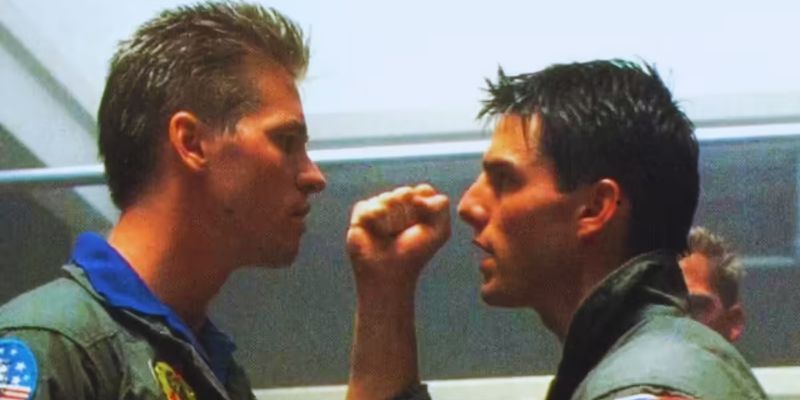
Val Kilmer is returning to the screen. But not exactly. Not in some retro montage. Not in a long-gone flashback. No, I’m talking about the real deal.
Well, sort of. This time, he’ll be brought to life via AI. I can’t blame you if you’re both amazed and a bit disturbed by this news.
The basic gist is that producers are utilizing AI technology to digitally recreate the image and voice of the Top Gun and The Doors star.
If you’re a fan of either film, you have to admit that it’s a little surreal to have your memories be able to talk back at you.
But the real question here is, is this a good thing or should you be a little freaked out? Perhaps a bit of both?
Hollywood has always been in the business of cheating death, in one way or another. Now it’s a little closer to actually doing it. This isn’t the first time AI has been used to impact the legacy of a late actor.
We’ve seen deepfakes and other AI-based technology used to recreate actors’ performances, to sometimes chilling effect. If you’ve been following the evolution of synthetic media, you know how fast the tech is evolving.
There’s a fantastic explainer on how it works and where it’s going here. It’s remarkable, if a bit unnerving.
Many in the film industry are hailing this news as a quantum leap for storytelling. Imagine being able to finish projects actors weren’t able to complete in their lifetime.
Imagine being able to depict historical figures in ways we’ve never seen. But others are sounding alarms. Who owns the rights to someone’s likeness when they’re gone? Who gets to decide how they’re used?
These aren’t theoretical questions anymore; they’re being played out in real-time. You can already see elements of this debate playing out in discussions around digital rights and identity.
For example, many lawyers have been sounding alarms over the lack of legal protections around the use of a deceased person’s likeness. Let’s just say it’s a bit of a legal gray area at the moment.
But there’s an emotional component to this as well. While fans may appreciate the opportunity to see Kilmer “again,” does it feel right? Or is it just plain weird?
I have to think of the line at which nostalgia tips into the uncanny valley. You know it when you see it, but it still doesn’t feel quite…right. Of course, that isn’t stopping filmmakers, who are eager to embrace the tech.
It’s just too promising to ignore. AI-generated performances are becoming increasingly affordable, efficient, and convincing by the day.
There’s a smart analysis of AI’s increasingly important role in film production. Perhaps that’s where things get a little dodgy. Once that Pandora’s box is opened, there’s really no closing it again.
If Val Kilmer can be brought back to life, who might be next? Movie legends? Historical icons?
Anyone who’s left behind enough of a digital footprint and has sufficient demand? There’s another, less obvious issue here: what about actors who are still alive?
If studios have the ability to recreate performances digitally, does that further consolidate their power at the expense of human actors? Or does it enable a new form of collaboration? Hard to say.
The film industry is still in the process of sorting that out. You can’t blame filmmakers for being excited about the prospect of bringing actors back, though. If nothing else, it’s a powerfully emotional draw.
There’s something profound about revisiting actors and characters we love, even in a simulated way. It’s about memory, and connection, and maybe even the refusal to accept loss.
And that gets at the complicated emotional role AI is likely to play in our lives, because AI doesn’t just allow us to recreate faces and voices, it complicates our relationship with absence.
So yes, Val Kilmer is back. Kind of. And while the tech that’s enabling his return is undeniably cool, the most important part of this story may be what it says about us: our addiction to resurrection, our desire to rewrite every ending, and our refusal to let go.
Whether this is the future of Hollywood, or a cautionary tale, remains to be seen. But one thing is for sure: Tinseltown just crossed a rubicon it cannot uncross.
Facts Only
Val Kilmer is returning to the screen via AI technology
Producers are utilizing AI to digitally recreate Kilmer's image and voice
This development raises questions about digital rights, identity, and consolidation of studio power
The technology is becoming increasingly affordable, efficient, and convincing
Executive Summary
Full Take
In the context of the ongoing evolution of synthetic media, Kilmer's digital resurrection presents both opportunities and challenges. On one hand, it offers a potential solution for completing projects that actors were unable to finish in their lifetime and the opportunity to depict historical figures in new ways. On the other hand, it raises ethical questions about ownership of a deceased person's likeness, the emotional impact on fans, and the potential consolidation of studio power at the expense of human actors. Furthermore, there are implications for living actors as well, as studios gain the ability to recreate performances digitally, potentially altering the landscape of film production.
Patterns detected: ARC-0024 Ambiguity (the development has both positive and negative aspects), ARC-0043 Motte-and-Bailey (arguments for and against digital resurrection are presented).
Sentinel — Human
The article shows signs of human authorship. The text exhibits a personal voice, idiosyncratic emphasis, and stylistic fingerprint, while the sentence length variance is inconsistent with uniform rhythm expected in AI text.