Share & more
The images that stay with me the most from my time serving as Sudan’s deputy humanitarian coordinator, focused on Darfur in 2024 and 2025, are familiar ones: people fleeing with nothing, children weakened by hunger, hospitals struggling to function.
Yet what I left with was not just the images of a humanitarian tragedy. It was the conviction that Sudan's crisis is, at its core, a crisis of accountability – owed at every level.
The primary responsibility is with those fighting. They have a duty to protect civilians, uphold international humanitarian law, and allow impartial aid to reach those who need it. Yet neither the Sudanese Armed Forces (SAF) nor the Rapid Support Forces (RSF) have met those obligations.
But accountability does not end with the conflict parties. It also belongs to the humanitarian system itself, and I include myself here. No coordinator, agency, or NGO can guarantee civilian safety in an active war. But we can ask ourselves difficult questions.
Were we close enough to the people we were meant to serve? Did we document obstruction precisely and consistently? Did we escalate repeated violations beyond the walls of technical coordination meetings? Did we share even a fraction of the risks that Sudanese responders carry every day?
Accountability also belongs to those beyond the battlefield: to Security Council members who passed resolutions and then declined to enforce them; to donor governments who reduced funds to humanitarian actors contributing to measurable protection outcomes; to regional actors who engaged in lengthy processes while civilians ran out of food and time.
Sudan’s crisis shows that the international response system has failed, humanitarian, political, and diplomatic alike.
What is needed now is not another declaration of concern, not another high-level meeting that produces a communiqué instead of consequences, not another round of commitments that carry no mechanism for enforcement. What is needed is structural change: defining red lines on access, on civilian protection, on attacks against medical facilities, and being willing to escalate when those lines are crossed, publicly and collectively.
Begging for access
While leading inter-agency missions in Darfur, I saw some of the most difficult scenes of the war: people escaping attacks by the RSF in Zam Zam and El Fasher, and arriving in Tawila, where there were too few shelters, and buckling health services.
I saw a handful of local NGOs providing food and essential care long before international aid could be mobilised. Even when it was, the international response was far smaller than during the previous Darfur crisis in the 2000s, when I also worked on the ground for the UN.
Throughout my recent posting, I witnessed armed factions weaponising aid. The SAF were reluctant to allow an international response in the RSF’s stronghold, while the RSF sought to restrict aid reaching parts of Darfur where their control was contested.
In this fraught context, humanitarian diplomacy became the art of begging for access, instead of what it should be: holding parties to their legal obligations and being willing to say so publicly when they refuse.
Although the SAF has allowed the Adré border crossing from Chad to be used for humanitarian aid into Darfur, its operation is subject to periodic political extensions, and the UN is not allowed to establish a full presence on the ground in all RSF areas.
There are also challenges engaging with the RSF-affiliated National Agency for Humanitarian Affairs, NAHA, which oversees and manages humanitarian aid operations in the regions controlled by the group.
Humanitarian actors need interlocutors in areas controlled by de facto authorities. But the measures announced by NAHA in April – compulsory re-registration, mandatory technical agreements, deadlines for UN agencies to reopen offices – risk turning NAHA into a licensing authority over the very operations it is supposed to facilitate.
Passive language
As our ability to help people has been hindered, the humanitarian system has too often described obstruction in the passive voice.
Delayed visas, blocked convoys, checkpoint fees, demands for beneficiary data, armed interference at distribution sites – these are routinely described as “bureaucratic impediments” or “access constraints”. I used some of that language myself, at times, because it was the language of reports and coordination meetings.
But this language can obscure something more deliberate: the systematic obstruction of impartial relief by parties who have calculated that starving civilians serves their purposes.
Too often we have also defined success by trucks dispatched, tonnes delivered, people reached, and funding received. These numbers matter, but they can conceal failure.
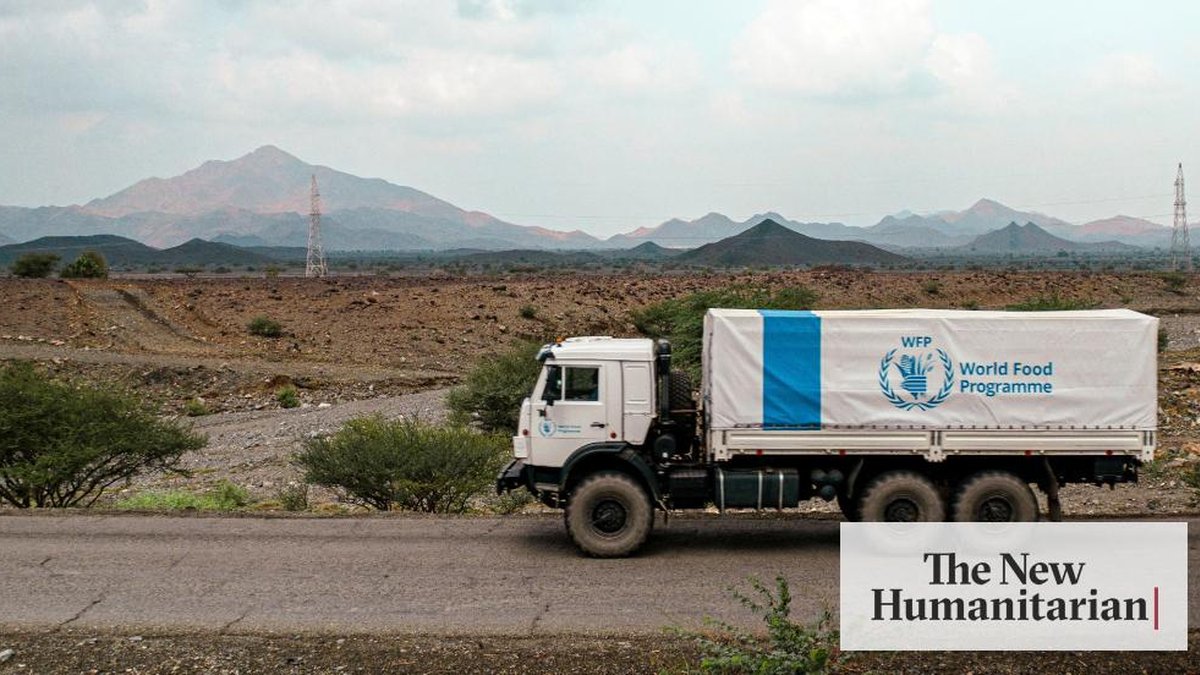
In June 2025, a WFP and UNICEF convoy carrying food and nutrition supplies towards besieged El Fasher was attacked near Al Koma after travelling more than 1,800 kilometres from Port Sudan. Five Sudanese contractors were killed.
The story here was never that a convoy had travelled across Sudan. It was that five Sudanese people lost their lives and civilians remained beyond its reach. What unfolded was a failure of protection, security guarantees, command responsibility, and accountability.
The question we should be asking going forward is not therefore simply whether aid enters Darfur, it is whether civilians are safer, malnourished children reach treatment, women can move without fear, medical staff can work without being attacked.
Warnings ignored
While international NGOs are stretched thin – and operating from a distance in conditions that demand proximity – Sudanese responders have shown what local leadership looks like.
Emergency Response Rooms, local committees, medical volunteers, women’s groups, Sudanese NGOs, community kitchens, are keeping people alive in places we simply cannot reach. They deserve far more than they receive: more funding, more recognition, and more of the decision-making authority that remained, for too long, elsewhere.
Yet many are still treated as subcontractors and “partners”. They take the greatest risks while receiving short-term funding, weak insurance, limited overheads, and little influence over priorities.
We must also change a system that produces detailed reports but cannot translate evidence into protection.
The RSF atrocities in El Fasher made this painfully clear to me. The warnings there were loud, repeated, and documented. Humanitarian agencies had mapped every closed route, every truck turned back, every civilian trapped without a safe way out. Health workers, Sudanese civil society, local responders, UN officials, all of us had been raising the alarm. But the information we had was never converted into protection.
I am not suggesting that an outside actor will be able to command the war to stop, but the international community has the information, the platforms, and the leverage to act differently and has chosen not to.
Doing better
Accountability is not a principle for after the war. It is the condition for ending it.
Doing better requires immediate shifts: access commitments that are documented and verifiable, a sustained UN field presence close to affected communities, Sudanese responders financed as decision-makers, and humanitarian evidence connected directly to senior political action.
The aid community’s response to access challenges must, meanwhile, be collective. Fragmented bilateral deals allow armed authorities to play agencies against one another. Instead, we must hold firm against taxation, interference in needs assessments, demands for sensitive data, or politically conditioned access.
As a humanitarian community, we have developed sophisticated ways to document obstructions, but no predictable collective trigger to convert our appeals into senior political action.
For their part, Security Council members, Jeddah facilitators, regional organisations, and influential states must stop treating documentation as sufficient action. Violations must generate sustained pressure, clear benchmarks, and consequences for persistent non-compliance.
The measure of reform will not be the number of consultations held or the tonnage of aid delivered. It will be whether the next threatened community receives a different care from the one given to the people of El Fasher and Zam Zam. And it will be whether those of us who were there, in the field, in the coordination rooms, in the Security Council chamber can say with honesty: this time, we did not simply watch, report, and move on.
As well as a humanitarian catastrophe, Sudan’s war is a test of whether an international system built for different conditions can adapt to today’s realities – shrinking funding, attention drifting to other wars, and armed factions weaponising aid. Right now, we are failing that test.
Antoine Gérard served as Sudan’s Deputy Humanitarian Coordinator in 2024-2025, with a focus on Darfur. He writes in a personal capacity.
Sentinel — Human
The text reads as a deeply personal reflection layered over expert observation, demonstrating the voice of an experienced field operator engaging in principled political analysis.