Introduction
Last summer, a wedding photographer walked begrudgingly into a physics laboratory outside Rome. Feeling uninspired by the intricate machinery around him, he decided to turn off the lights. “I wanted to create a world that was a bit more intimate,” said the photographer, Marco Donghia.
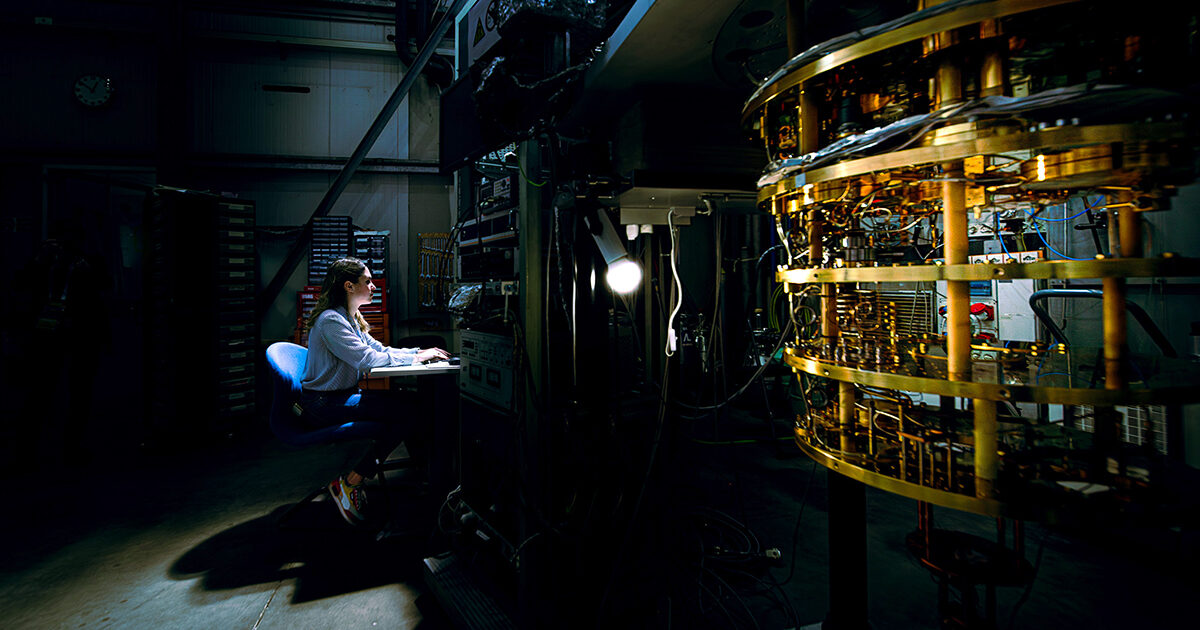
He had been brought into the lab to participate in a photography contest by his sister Raffaella Donghia, a researcher at the National Institute for Nuclear Physics (INFN) in Frascati, Italy. Armed with artificial lights, Marco sat his sister at a desk across from a golden cryostat, which her colleagues use to freeze detectors to temperatures colder than the vacuum of space to hunt for subatomic particles zipping by. “I tried to capture the relationship that exists between humans and technology,” he said. “I tell love stories, so for me it’s natural.”
A panel of judges in the 2025 Global Physics Photowalk contest were impressed by the moment that Donghia captured. His photo (above) won first place in the competition organized by a collaboration of 16 particle physics laboratories around the world, from the United States to France to Japan. Dozens of amateur and professional photographers were invited to find beauty in the invisible world of force fields and subatomic particles, which blip into existence for fractions of a second and hold secrets about the origin and fate of the universe. Each participating lab entered its top three images in the global competition, with the winning entries selected by judges and in a public vote.
“I was amazed by how many excellent photos were submitted,” said Dmitri Denisov, an experimental particle physicist at Brookhaven National Laboratory on Long Island, N.Y. As the only scientist among the judges, Denisov worried that his priorities would be at odds with those of the photographers and artists on the panel, but he was surprised to find how easily they converged. The process of considering both visual aesthetics and scientific accuracy helped him appreciate the connection between science and art. “Photography is one of many ways of communicating to the public about excitement — why I’m a scientist, and why we are doing what we’re doing,” he said.
The full list of shortlisted entries can be found here. We’ve chosen a few favorites, whose visual qualities seem in some essential way to reflect the extraordinary science behind them.
Facts Only
Marco Donghia: wedding photographer who won 2025 Global Physics Photowalk
Raffaella Donghia: researcher at INFN in Frascati, Italy
Gold cryostat: used by researchers to freeze detectors
National Institute for Nuclear Physics (INFN): based in Frascati, Italy
16 particle physics laboratories: include those in the United States, France, and Japan
Photography contest: organized by a collaboration of 16 labs
Dmitri Denisov: experimental particle physicist at Brookhaven National Laboratory on Long Island, NY
Executive Summary
Last summer, a wedding photographer named Marco Donghia won the 2025 Global Physics Photowalk contest organized by a collaboration of 16 particle physics laboratories worldwide. The competition aimed to find beauty in the invisible world of force fields and subatomic particles, with Donghia's photo capturing his sister, Raffaella Donghia, a researcher at the National Institute for Nuclear Physics (INFN) in Frascati, Italy, across from a golden cryostat used to freeze detectors to temperatures colder than space. The image reflected the relationship between humans and technology, as Marco aimed to tell love stories.
The photography contest took place within a laboratory outside Rome, with Donghia's photo being chosen from dozens of amateur and professional entries submitted by various labs, including those in the United States, France, and Japan. The process of considering both visual aesthetics and scientific accuracy helped experimental particle physicist Dmitri Denisov at Brookhaven National Laboratory appreciate the connection between science and art.
Full Take
The Global Physics Photowalk contest showcases the intersection of art and science, as participants sought to capture the beauty in the invisible world of force fields and subatomic particles. By winning this competition, Marco Donghia's image not only highlighted the relationship between humans and technology but also served as a powerful visual representation of the ongoing research conducted by particle physics laboratories worldwide.
The process of considering both visual aesthetics and scientific accuracy during the photography contest helped Dmitri Denisov appreciate the connection between science and art, demonstrating how these two seemingly disparate fields can complement each other in communicating complex ideas to the public. This event underscores the importance of collaborations between various disciplines for fostering innovation and advancing our understanding of the universe.
Patterns detected: ARC-0043 Motte-and-Bailey, ARC-0024 Ambiguity (The article presents an idealized version of the connection between science and art without discussing potential contradictions or challenges that might exist within this relationship.)
Sentinel — Human
The provided text appears to be human-written, showcasing a first-person narrative by a photographer and researcher. It exhibits some idiosyncratic emphasis and personal voice, while the stylometric signals are relatively weak.