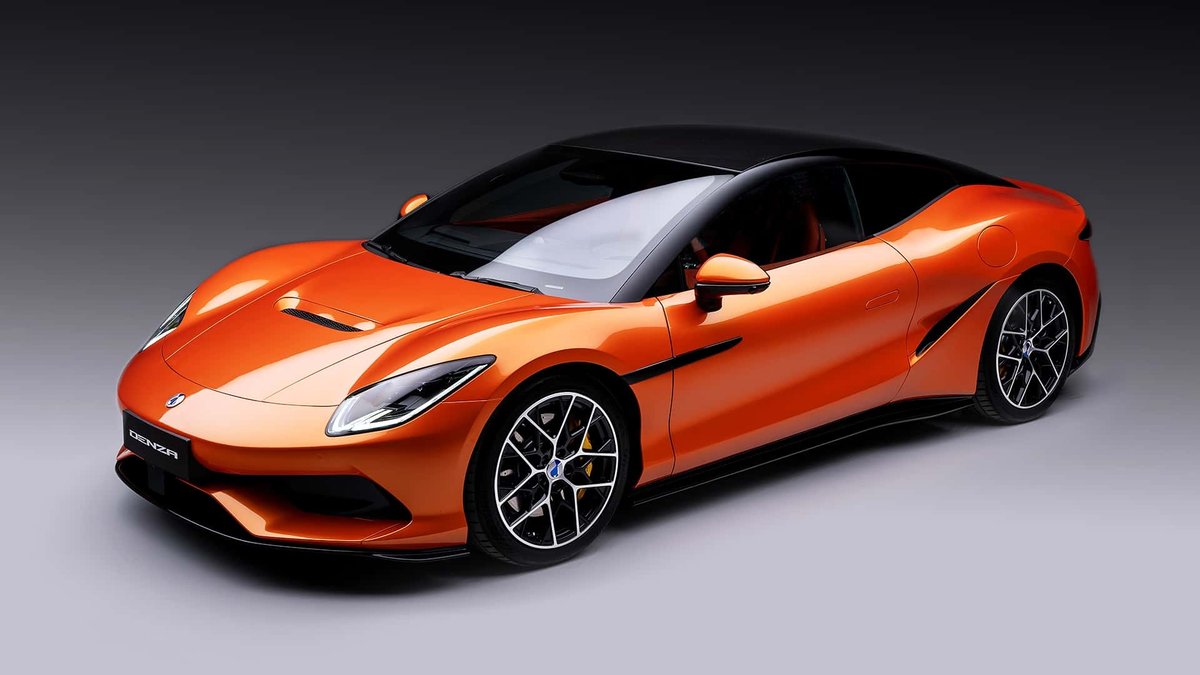
This EV Supercar Packs 1,582 HP And 1.5-Megawatt Charging
BYD’s Denza Z can hit 62 mph in under 2 seconds and charge from 10% to 97% in just nine minutes.
- The Denza Z combines 1,582 hp with 1.5-megawatt charging and a nine-minute 10–97% recharge.
- Its Racing version can hit 62 mph in 1.96 seconds and top out at 217 mph.
- In China, it starts at just over $190,000, but pricing in Europe has not been confirmed.
While Western manufacturers are still unsure whether it’s worthwhile to produce electric sports cars and supercars, another one seems to be popping up in China every other day. The Denza Z is one of the latest, and the manufacturer just confirmed some impressive key specs that make it both one of the fastest-accelerating cars in the world and one of the fastest-charging, too.
Its three motors deliver 1,582 hp, but its more interesting number may be the 1,500 kilowatts it can accept while charging from a BYD Flash charging station capable of maxing it out. It features a 76-kilowatt-hour battery pack with a lithium iron phosphate (LFP) chemistry that can go from 10% to 70% in five minutes or to 97% in nine minutes.
Gallery: Denza Z (2027)
The manufacturer says it can still charge from 20% to 97% in 12 minutes with an outside temperature of -22°F (-30°C). It also notes that the battery completed a combined fast-charging and nail-penetration test without fire, smoke, or thermal runaway, including after 500 full-power cycles.
Battery degradation is also 2.5% slower in this battery than in BYD’s previous LFP battery series.
The charging specs seem to closely match what BYD posted for the Denza Z9 GT fastback, even though its 122.5-kWh battery is much larger. In a European demonstration, it charged to 97% in nine minutes and 22 seconds, publicly proving its charging power outside of China for the first time.
Denza is not alone in pushing charging power past the megawatt mark. Geely’s Lynk & Co 10+ has reportedly charged from 10% to 97% in eight minutes and 42 seconds, while CATL says its third-generation Shenxing LFP battery can reach 90% in six minutes and 27 seconds. All these were controlled tests in ideal conditions, but they show what is possible with current Chinese battery tech.
The Denza Z is also about how it drives, and it comes in three flavors, and they all have different range ratings: the coupe goes farthest at 410 km (255 miles), followed by the convertible with 400 km (249 miles), and the track variant, where it drops to 380 km (236 miles). Whichever version you choose, air suspension is standard.
The Racing version normally hits 62 mph (100 km/h) from a standstill in 2.25 seconds, like the standard coupe, but equipped with optional grippier semi-slick tires, which drops to 1.96 seconds. It also needs just 6 seconds to hit 124 mph (200 km/h) and can reach 217 mph (350 km/h) in its fastest configuration.
All versions get standard ceramic brakes, which BYD says not only save 66 pounds (30 kg) of unsprung mass but also are expected to last 186,000 miles (300,000 km).
Even with its fairly small battery, the Z is not especially light. The Coupe weighs 2,230 kg (4,916 pounds), while the Spider is slightly heavier at 2,300 kg (5,071 pounds). With one motor powering each rear wheel, the Z has precise torque vectoring, which should help it round corners and hide some of its heft.
Denza has confirmed that the Z will be available in Europe, but hasn’t provided any pricing information yet. ITHome says that in China, the coupe starts at around $191,000 and the convertible pushes that to $214,000. The brand still has to prove itself outside China, but with high-spec halo vehicles like the Z9 and the Z supercar, it’s making its intentions clear: it wants to dethrone the European premium car establishment.
That’s why Denza brought the Z to the Goodwood Festival of Speed, one of Europe’s most influential automotive events, and put former F1 champion Jenson Button, along with journalists and creators from across the continent, behind the wheel to experience and demonstrate its performance firsthand.
RECOMMENDED FOR YOU
Feds Are Looking to Remove a Major Roadblock for Driverless Robotaxis: The Steering Wheel
Americans Just Aren’t Buying Audi EVs
New Jersey Law Would Outlaw Tesla's Camera-Based Robotaxi Tech
Buying A Ford EV Still Comes With A Free Home Charger
Mercedes EV Sales Jumped 50% In Q2. That's Mostly Thanks To Europe
This Hyundai Ioniq 6 Lease Deal Is Cheaper Than A Nice Night Out
I Saw Scout's New Trucks Up Close. They Could Be Worth The Wait
Facts Only
* The Denza Z combines 1,582 hp with 1.5-megawatt charging.
* The Racing version can hit 62 mph in 1.96 seconds and top out at 217 mph.
* The vehicle features a 76-kilowatt-hour battery pack with LFP chemistry.
* The battery can charge from 10% to 70% in five minutes or 97% in nine minutes.
* The manufacturer claims the vehicle can charge from 20% to 97% in 12 minutes at -22°F (-30°C).
* The battery successfully completed fast-charging and nail-penetration tests without fire, smoke, or thermal runaway after 500 full-power cycles.
* Battery degradation is 2.5% slower than in BYD’s previous LFP battery series.
* The Coupe weighs 2,230 kg (4,916 pounds), and the Spider weighs 2,300 kg (5,071 pounds).
* Public pricing for Europe has not been confirmed; China pricing starts at just over $190,000 for the coupe.
Executive Summary
Full Take
The narrative positions electric supercar development as a potential disruption to the established European premium automotive sector, fueled by rapid advancements demonstrated in the Chinese market. The emphasis on extreme performance metrics—speed and charging rates that push beyond previous benchmarks—suggests an embedded competitive drive not just for technological superiority but for redefining luxury automotive standards. The juxtaposition of massive power output (1,582 hp) with breakthrough energy management (1.5 MW charging) forces an examination of whether current infrastructure and regulatory frameworks are adequately prepared to handle this technological acceleration. Furthermore, the discussion surrounding battery safety and degradation during extreme cycling suggests a necessary shift in engineering priorities from mere capacity to operational endurance and thermal resilience when deploying high-performance energy systems. The implications point toward a future where performance benchmarks might be set by rapidly evolving manufacturing capabilities rather than established legacy norms.
Bridge questions: What are the tangible long-term economic implications of this level of charging speed on global EV adoption strategies? How will regulatory bodies adapt to certifications that rely on real-world extreme endurance testing like nail penetration, and what standards must precede widespread European deployment? If Chinese innovation dictates future performance benchmarks, how can established markets effectively integrate such disruptive technology without sacrificing existing consumer expectations for safety and reliability?
Sentinel — Human
The text reads like a synthesized automotive feature that blends factual specifications with industry commentary, suggesting a human editorial voice rather than purely machine-generated output.