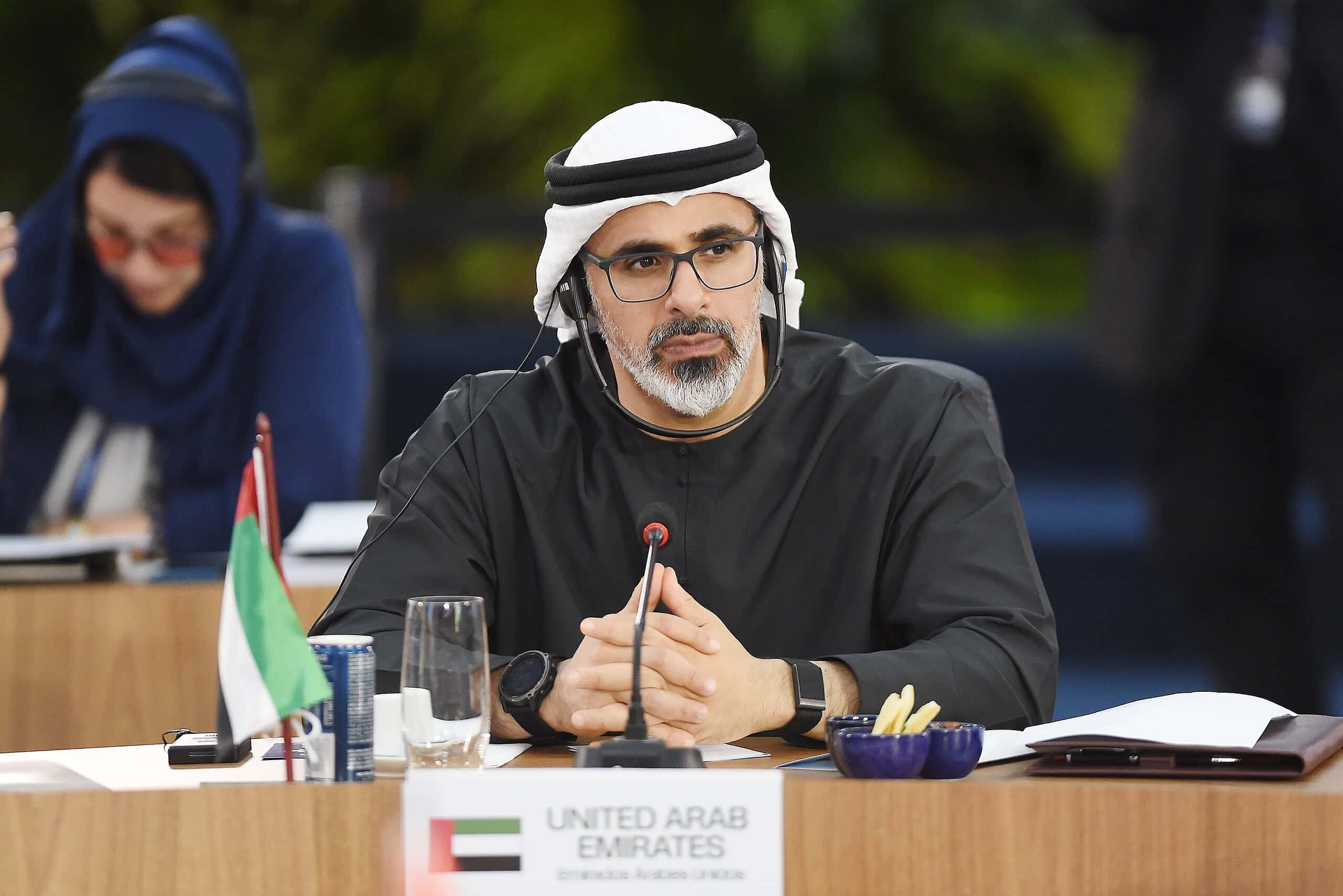
Abu Dhabi consolidates ADQ into L’Imad, creating $300 billion sovereign powerhouse under crown prince as emirate centralizes control over strategic investments.
L’Imad, Abu Dhabi’s newest sovereign wealth fund, took over the assets of rival state-owned fund ADQ, a development that sees a greater role in the emirate’s investment strategy by the emirate’s crown prince Sheikh Khaled bin Mohammed bin Zayed, son of the UAE president Mohammed bin Zayed.
The consolidation signals Abu Dhabi’s intentions to leverage capital for adaptability and power projection. And placing L’Imad under the direct supervision of the Crown Prince is significant. According to Dubai brokerage firm Century Financial, “Abu Dhabi is treating its investment platform as a long-term project managed by top government leaders.”
Prior to the merger, ADQ held assets of $263 billion with major investments spanning airlines, energy, infrastructure, and healthcare. Following the transfer of ADQ’s assets, L’Imad will have around $300 billion in assets under management, according to data from Global SWF, a platform focusing on central banks, sovereign wealth funds and public pension funds.
ADQ was previously chaired by Sheikh Tahnoon bin Zayed, the UAE’s influential national security adviser. He chairs the emirate’s principal wealth fund Adia (Abu Dhabi Investment Authority) that oversees $1.18 trillion in assets under management.
L’Imad’s rapid ascendancy—formed last year—looks set to become an important investment vehicle under the chairmanship of the 44-year-old crown prince. In January, the Abu Dhabi media office said the emirate’s Supreme Council for Financial and Economic Affairs had passed a resolution consolidating the assets of L’Imad and ADQ “to create a sovereign investment powerhouse with a diversified asset base.”
The new entity includes 25 investment companies and platforms and over 250 group subsidiaries. Jassem Al-Zaabi—who is also chairman the emirate’s department of finance and vice chairman of the UAE central bank—was appointed managing director and chief executive. Meanwhile Mohamed al Suwaidi, ADQ’s first chief executive, has left to become executive chair of Abu Dhabi investment manager, Lunate.
Facts Only
Abu Dhabi consolidated ADQ into L’Imad, creating a sovereign wealth fund with $300 billion in assets.
L’Imad is now under the direct supervision of Crown Prince Sheikh Khaled bin Mohammed bin Zayed.
ADQ previously managed $263 billion in assets across airlines, energy, infrastructure, and healthcare.
The merger includes 25 investment companies and over 250 subsidiaries.
Jassem Al-Zaabi was appointed managing director and CEO of L’Imad.
Mohamed al Suwaidi, former ADQ CEO, has become executive chair of Lunate.
Sheikh Tahnoon bin Zayed previously chaired ADQ and remains chair of Adia, which oversees $1.18 trillion.
The consolidation was approved by Abu Dhabi’s Supreme Council for Financial and Economic Affairs.
L’Imad was formed in 2023.
The move is described as part of Abu Dhabi’s long-term investment strategy.
Executive Summary
Full Take
The consolidation of ADQ into L’Imad under the crown prince’s direct oversight suggests a deliberate centralization of Abu Dhabi’s financial power, likely aimed at enhancing strategic agility. The narrative presents this as a rationalization of resources, but the rapid ascent of L’Imad—formed just last year—raises questions about the motivations behind such a swift restructuring. Is this purely about efficiency, or does it reflect a broader shift in power dynamics within Abu Dhabi’s leadership? The involvement of high-profile figures like Sheikh Tahnoon bin Zayed, who retains control over Adia, hints at a layered governance structure where influence is carefully balanced.
Patterns detected: none
The paradigm driving this narrative is one of state-led capitalism, where sovereign wealth funds are leveraged not just for financial returns but as instruments of geopolitical and economic influence. The unstated assumption is that centralization equates to strength, but history shows that such consolidations can also introduce risks—bureaucratic inertia, reduced accountability, or overconcentration of power. For human agency, the implications are mixed: while the emirate may gain greater investment flexibility, the lack of transparency in decision-making could limit public oversight.
Key questions to consider: How will this consolidation affect Abu Dhabi’s relationships with global investors? What safeguards exist to prevent potential conflicts of interest given the crown prince’s direct involvement? And if this model succeeds, could other Gulf states follow suit, further reshaping regional economic governance?
If this were part of a coordinated influence campaign, the playbook might emphasize the inevitability of centralization, framing it as a necessary step for progress while downplaying potential risks. However, the content does not exhibit overt manipulation patterns—it presents facts with minimal editorializing, leaving room for independent assessment.
Sentinel — Human
The article shows strong signs of human authorship with specific attributions and contextual depth, though minor stylometric patterns suggest possible AI assistance in drafting.