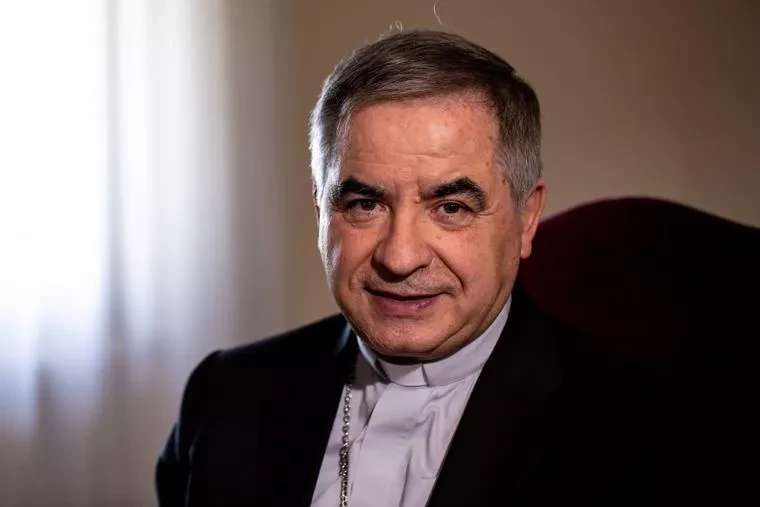
The Vatican Court of Appeal has ordered a partial retrial in the high-profile London property finance case, ruling that key parts of the original proceedings were invalid due to procedural issues.
The case stems from the Vatican Secretariat of State’s investment of approximately 350 million pounds in a luxury property in London’s Chelsea neighborhood on Sloane Avenue, an operation that generated estimated losses of up to 139 million euros for the Holy See.
In a March 17 decision, judges found a “relative nullity” in the trial involving the Secretariat of State’s investment in the London building, widely known as the “trial of the century.” The ruling does not overturn the original trial or its verdicts but requires that portions of the case be reheard.
The original trial concluded in December 2023 after 86 hearings. The Vatican tribunal sentenced Cardinal Angelo Becciu to five years and six months in prison, along with a lifetime ban from public office, marking the first time a cardinal had ever been convicted by a Holy See court. Nine of the 10 defendants were found guilty of various charges, including embezzlement, fraud, money laundering, and abuse of power.
The court determined that four decrees issued by Pope Francis during the investigation — which altered procedural rules and were not publicly promulgated — undermined the legitimacy of some investigative acts.
As a result, prosecutors must refile the full body of evidence by April 30, with a new timetable for proceedings to follow.
The original trial ended with prison sentences totaling more than 37 years and roughly 200 million euros (about $231 million) in damages ordered.
Defense attorneys had long argued that the case was compromised by incomplete evidence filings and procedural irregularities. The appeals court upheld many of those objections while maintaining that the first-instance judgment still carries legal effect.
The case centers on the Secretariat of State’s controversial London property investment along with related financial dealings involving Becciu and other defendants.
The ruling marks a major development in the Vatican’s most complex financial prosecution in recent history and raises fresh uncertainty about the durability of the original convictions.
“If the Vatican finances are sound, it means that our Church will continue. If the Vatican finances are not sound, it’s going to have problems,” former Vatican auditor general Libero Milone said.
Facts Only
The Vatican Court of Appeal ordered a partial retrial in the London property finance case due to procedural issues.
The case involves the Vatican Secretariat of State’s investment of approximately 350 million pounds in a luxury property in London’s Chelsea neighborhood.
Estimated losses from the investment totaled up to 139 million euros for the Holy See.
The original trial concluded in December 2023 after 86 hearings.
Cardinal Angelo Becciu was sentenced to five years and six months in prison, along with a lifetime ban from public office.
Nine of the ten defendants were found guilty of charges including embezzlement, fraud, money laundering, and abuse of power.
The appeals court found that four decrees issued by Pope Francis during the investigation altered procedural rules and were not publicly promulgated.
Prosecutors must refile the full body of evidence by April 30, with a new timetable for proceedings to follow.
The original trial resulted in prison sentences totaling more than 37 years and roughly 200 million euros in damages.
Defense attorneys argued that the case was compromised by incomplete evidence filings and procedural irregularities.
The appeals court upheld many of these objections while maintaining the legal effect of the first-instance judgment.
Executive Summary
The Vatican Court of Appeal has ordered a partial retrial in the high-profile London property finance case, citing procedural issues in the original trial. The case involves the Vatican Secretariat of State’s investment of approximately 350 million pounds in a luxury London property, which resulted in estimated losses of up to 139 million euros. The original trial, concluded in December 2023, saw Cardinal Angelo Becciu sentenced to five years and six months in prison, along with a lifetime ban from public office, marking the first conviction of a cardinal by a Holy See court. Nine of the ten defendants were found guilty of charges including embezzlement, fraud, and money laundering.
The appeals court ruled that four decrees issued by Pope Francis during the investigation, which altered procedural rules without public promulgation, undermined the legitimacy of some investigative acts. Prosecutors must now refile the full body of evidence by April 30, with a new timetable for proceedings to follow. While the original verdicts remain legally effective, the ruling introduces uncertainty about their durability. Defense attorneys had argued that the case was compromised by procedural irregularities, and the appeals court upheld many of these objections. The case highlights ongoing concerns about the Vatican’s financial management and the broader implications for the Church’s stability.
Full Take
The Vatican’s decision to order a partial retrial in the London property case underscores the complexity of balancing justice with institutional integrity. The strongest version of this narrative highlights the Vatican’s commitment to procedural fairness, even when it complicates high-profile convictions. The appeals court’s ruling acknowledges flaws in the original trial—specifically, the lack of public promulgation of Pope Francis’s decrees—while preserving the legal weight of the initial verdicts. This creates a tension between accountability and due process, a dynamic familiar in institutions where transparency and tradition often clash.
Patterns detected: none. The narrative does not exhibit clear manipulation tactics, though the emphasis on procedural irregularities could be framed as a way to undermine confidence in the Vatican’s judicial system. The root cause appears to be the tension between the Vatican’s need for financial accountability and its historical resistance to full transparency. The implications are significant: if the retrial overturns key convictions, it could erode trust in the Vatican’s ability to police its own financial dealings. Conversely, if the verdicts hold, it may reinforce perceptions of systemic opacity.
The broader question is whether this case reflects a genuine effort at reform or a performative gesture to appease critics. Who benefits from this uncertainty? The defendants gain a chance to challenge their convictions, while the Vatican risks further reputational damage if the retrial exposes deeper flaws. Second-order consequences could include increased scrutiny of Vatican finances and a chilling effect on future investments.
Bridge questions: How might the Vatican’s handling of this case influence its broader financial reforms? What would it take for the retrial to restore confidence in the Vatican’s judicial process? Are there alternative explanations for the procedural issues beyond institutional incompetence?
Counterstrike scan: A coordinated influence campaign might exploit this narrative to portray the Vatican as corrupt or incompetent, amplifying doubts about its financial management. However, the article itself does not align with such a pattern, as it presents the facts without overt sensationalism or distortion.
Sentinel — Human
The article shows strong signs of human authorship, with natural stylistic variation, specific sourcing, and contextual depth typical of professional journalism.