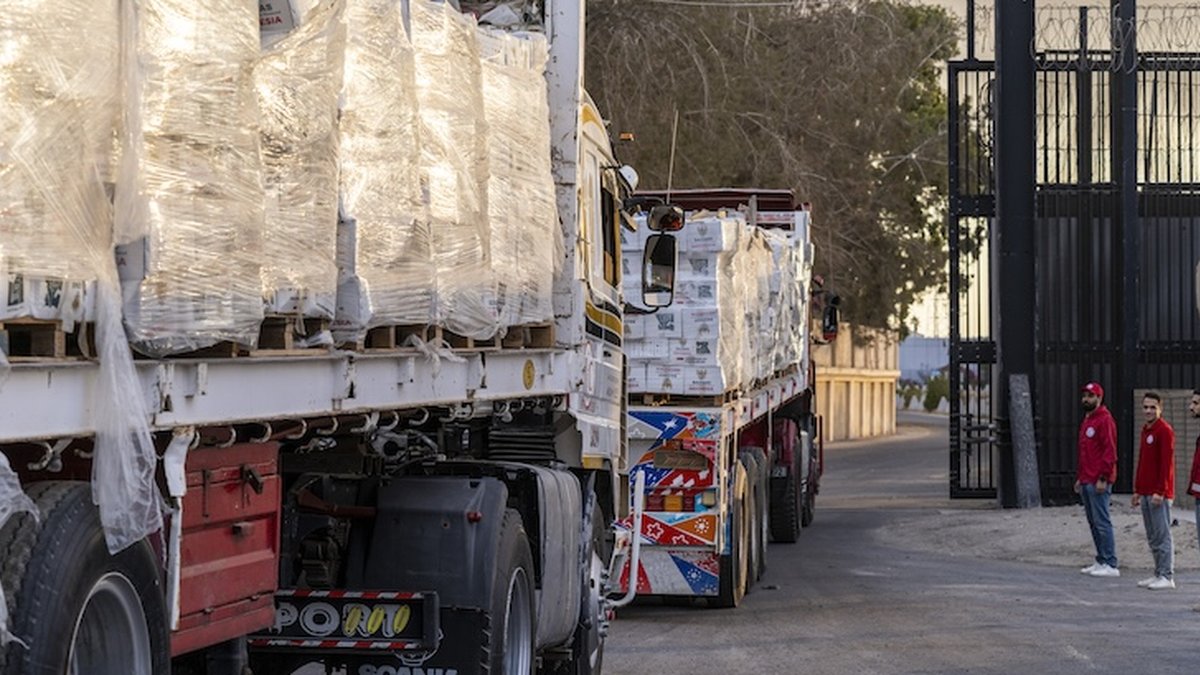
Given that there is no good-faith argument that Israel is carrying out genocide in Gaza, it is best to avoid getting sucked into debates that treat it as a legitimate question. But we should still note for posterity the reality of Israeli humanitarian coordination in Hamas-controlled Gaza.
The Israeli agency in charge of such coordination—COGAT—has released updated statistics covering the influx of food, water, and medical aid to Gaza since the cease-fire agreement with Hamas went into effect in October. The numbers include stats from the NGOs and the UN officials who participate in aid delivery.
The most notable statistic in the report, in fact, is sourced right to Hamas itself: “The Hamas-controlled Gaza Chamber of Commerce stated on 12 June 2026 that Gaza had more than six months of food and clothing stocks, compatible with our own calculations of entry vs the need.”
Despite the responses of trolls on social media, the COGAT report does not claim that life in Gaza is perfect. It certainly doesn’t discount, for example, the challenges of a population relying on so much temporary housing. Indeed, Gaza has a government, and that government has failed spectacularly to fulfill its obligations. So here we are, with Israel and NGOs filling the roles for which Hamas should be responsible.
As the report itself plainly states, “The primary challenges to food availability and affordability are not related to the volume of aid entering Gaza but to its management, taxation, and circulation in the Hamas controlled areas of the Gaza Strip.” If Israel’s critics would like it to occupy the entire strip and fix this, they should say so.
Limited storage is a much bigger problem than lack of goods. “The surplus food accumulated during the ceasefire period is substantially greater than the pre-war food stocks in Gaza, according to one study. While [the World Food Program] and the Nutritional Cluster have expanded storage capacity in Gaza in coordination with COGAT and the CMCC, it appears that storage capacity is insufficient to meet the incoming supply which, as shown above, exceeds the assessed needs.”
The result: Food that made it into the strip under Israel’s supervision is rotting. “On 22 June 2026, authorities reported 423 kg of spoiled refrigerated chicken in the Central Governorate; more than 5 tons of rotten, insect-infested cheese in Gaza Governorate; and at least 294 kg of mortadella, meat and frozen chicken destroyed or seized at Yarmouk Market. Khan Younis reports identified 1,000 kg of spoiled frozen food and dairy products…. While these incidents are not exhaustive or representative accounting of waste, they serve as an indication that large scale spoilage is indeed occurring.”
This was a problem during the war at times as well. Finding a solution would be a major boost to the economy, at least in terms of purchasing power. Prices on food staples have already dropped significantly since the cease-fire went into effect—food CPI has dropped over 70 percent. This despite the fact that for part of this time, Israel was facilitating the delivery of this aid under missile attack from Iran.
Honestly, this discussion gets tiring. But the answer remains what it has always been: Hamas should disarm, abide by the agreement, and allow the process to work as designed.
Facts Only
* The Israeli agency COGAT released updated statistics on the influx of food, water, and medical aid to Gaza since the October cease-fire agreement with Hamas.
* Statistics include data from NGOs and UN officials participating in aid delivery.
* The Hamas-controlled Gaza Chamber of Commerce stated on June 12, 2026, that Gaza had more than six months of food and clothing stocks based on their calculations of entry versus need.
* Challenges to food availability and affordability are attributed to management, taxation, and circulation in Hamas-controlled areas.
* Surplus food accumulated during the ceasefire period was substantially greater than pre-war food stocks in Gaza according to one study.
* Spoilage incidents reported include 423 kg of spoiled refrigerated chicken in the Central Governorate and more than 5 tons of rotten, insect-infested cheese in Gaza Governorate.
* At least 294 kg of mortadella, meat, and frozen chicken were destroyed or seized at Yarmouk Market.
* Food CPI has dropped over 70 percent since the cease-fire went into effect.
Executive Summary
Full Take
Sentinel — Human
The text functions as an opinion piece blending specific claims about humanitarian logistics with strong political commentary; the presence of detailed, time-specific figures suggests human sourcing or careful synthesis rather than pure generation.