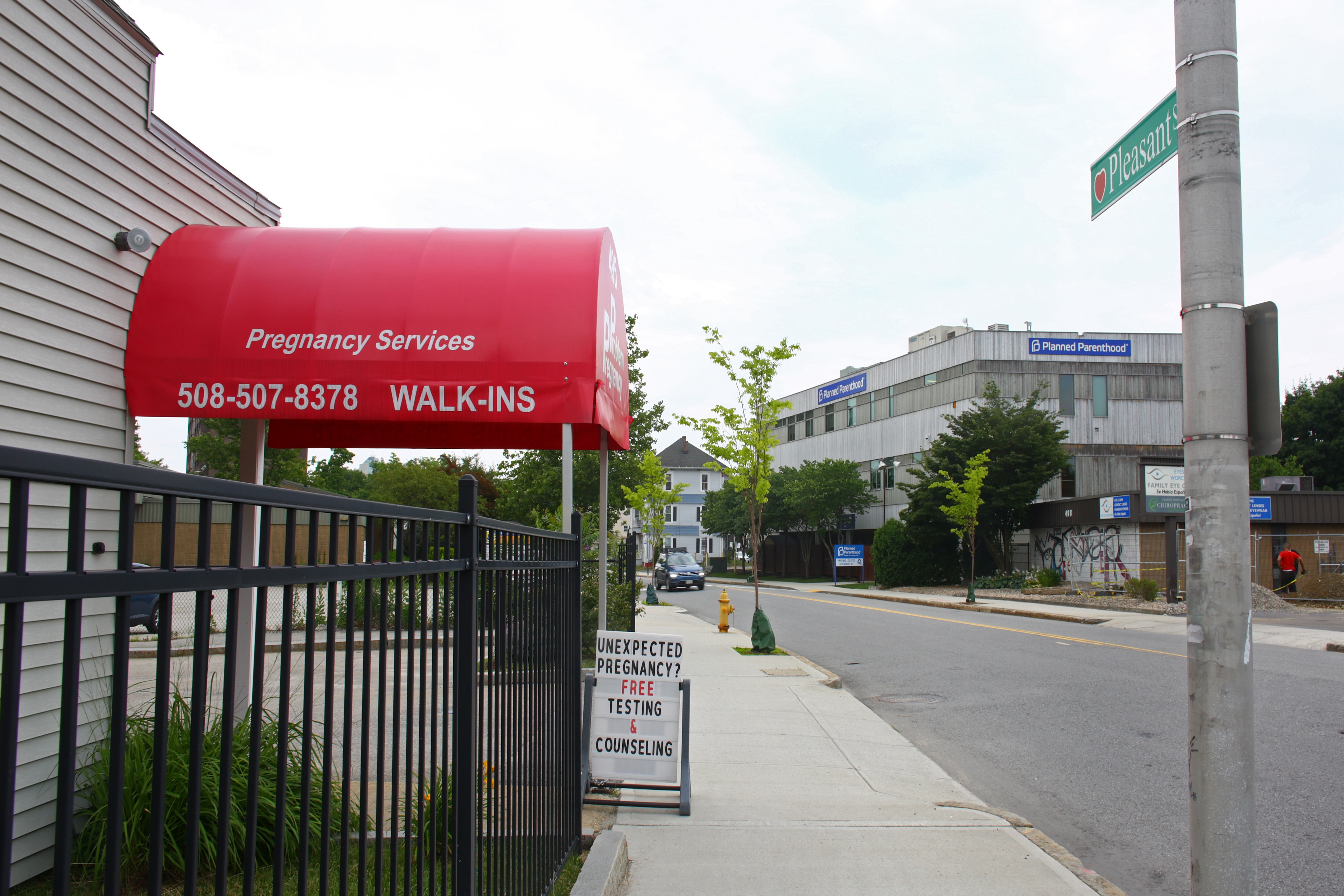
Conservative lawmakers in multiple states are pushing legislation drafted by an anti-abortion advocacy group to increase protections for crisis pregnancy centers, organizations that provide some health-related services but also work to dissuade women from having abortions.
The legislation would prohibit state and local governments from requiring crisis pregnancy centers to perform abortions, provide referrals for abortion services, or inform patients about such services or contraception options. It also would allow crisis pregnancy centers to sue the violating government entity.
Wyoming lawmakers passed a version of the Center Autonomy and Rights of Expression Act, or CARE Act, on March 4. Other versions have advanced in Kansas and Oklahoma this year. One was signed into law in Montana in 2025. The CARE Act is “model legislation” created by the Alliance Defending Freedom, an anti-abortion, conservative Christian legal advocacy group.
A similar proposal, the Let Pregnancy Centers Serve Act, was introduced in Congress last year but hasn’t moved out of the House Energy and Commerce Committee.
The Wyoming bill says that pregnancy centers, many of which are affiliated with religious organizations, need legal protection after facing “unprecedented attacks” following the Supreme Court’s overturning of Roe v. Wade. It says that several state legislatures have introduced bills that would undermine the centers’ freedom of speech and association rights. Opponents of these centers say they falsely present themselves to consumers as medical clinics, though they are not subject to state and federal laws that protect patients in medical facilities.
“Across the country, government officials are increasingly, increasingly targeting pregnancy care centers,” Valerie Berry, executive director of the LifeChoice Pregnancy Care Center in Cheyenne, said at a February legislative hearing on the Wyoming bill. “This legislation is not about creating division. It’s about protecting constitutional freedoms, freedom of speech, and freedom of conscience.”
Wyoming state Rep. Ken Clouston, a Republican, expressed concern at the hearing about granting protections to pregnancy centers that other private businesses do not have.
“They have protections in place,” he said. “My issue with this is giving extra special protections.”
In 2022, Wellspring Health Access, the only clinic in Wyoming that provides abortions, was targeted in an arson attack.
“We are the ones providing the accurate information on reproductive health care, and we suffer the consequences for that,” Julie Burkhart, the president and founder of Wellspring Health Access, told KFF Health News.
Mary Ziegler, a professor at the University of California-Davis School of Law, said the proposed legislation would insulate crisis pregnancy centers from having to meet the standards that medical organizations face. It would blur the line between advocacy and medical practice, she said. And such legislation provides Republicans with a potentially useful campaign message ahead of midterm elections.
“The GOP needs a messaging strategy as for how it cares about women even if it bans abortion and even if it doesn’t want to commit state resources to helping people before and after pregnancy,” Ziegler said. “The strategy is to outsource that to pregnancy counseling centers, which of course increases the incentive to protect them.”
Model Legislation
The Alliance Defending Freedom is the same group that helped overturn Roe v. Wade, the 1973 court ruling that protected the right to abortion nationwide. The group drafted the Gestational Age Act, model legislation to establish a 15-week abortion ban that was the basis of a 2018 Mississippi law. That led to the Dobbs v. Jackson Women’s Health Organization Supreme Court case that overturned Roe.
The alliance said its attorneys were unavailable to comment on the organization’s strategy for the CARE Act. In promotional materials for the bill, the group said federal, state, and local efforts are targeting pregnancy care centers in a “clear attempt to undermine and impede” their work and shut them down.
In recent years, some pregnancy centers have been targeted with vandalism and threats.
But the attacks the model legislation primarily aims to address are the legal and regulatory efforts by some states seeking more oversight of the crisis pregnancy centers, including a California law requiring centers to clearly inform patients about their services. That law was overturned when the Supreme Court ruled in favor of crisis pregnancy centers’ argument that it violated their First Amendment rights.
The Supreme Court is considering a case this year that will decide whether states can subpoena the organizations for donor and internal information.
It’s unlikely that crisis pregnancy centers would face such regulatory measures in the conservative states where the legislation is under consideration. One Wyoming lawmaker acknowledged that in the February committee hearing.
Differing Services
During that hearing, state Rep. Rachel Rodriguez-Williams, a Republican who heads the committee sponsoring the bill, presented the measure as “so important, especially with our maternity desert,” referring to a lack of access to maternity health care services.
Some crisis pregnancy centers may have a few licensed clinicians, but many do not. Many offer free resources, such as diapers, baby clothing, and other items, sometimes in exchange for participation in counseling or parenting classes.
Planned Parenthood clinics, by contrast, provide a range of health services, such as testing and treatment for sexually transmitted infections, primary care, and screenings for cervical cancer. They also are regulated as medically licensed organizations.
Since Roe was overturned, the abortion rights movement has faced significant challenges. Congressional Republicans’ One Big Beautiful Bill Act, which President Donald Trump signed into law last summer, cut Medicaid payments to abortion providers. The move contributed to Planned Parenthood closing more than 50 of its clinics last year.
As of 2024, more than 2,500 crisis pregnancy centers operated nationwide, according to a map created by researchers at the University of Georgia, compared with 753 clinics providing abortions at the end of 2025.
The Charlotte Lozier Institute, a research organization affiliated with the anti-abortion nonprofit SBA Pro-Life America, has suggested that pregnancy centers could help fill the gap left by the Planned Parenthood closures.
Ziegler said that would leave patients vulnerable to medical risks.
Centers’ Growing Power
Previous efforts in California, Colorado, and Vermont to regulate crisis pregnancy centers arose from concerns over allegations of deceptive and misleading practices and questions about patient data privacy.
In 2024, a watchdog group asked attorneys general in five states to investigate whether centers were misleading patients into believing that their personal information was protected under the Health Insurance Portability and Accountability Act, known as HIPAA, and to find out how the centers were using patients’ information.
Courts, including the Supreme Court, have regularly decided in favor of faith-based organizations that argue the attempts at regulation are violations of their First Amendment rights to free speech and religious expression.
Crisis pregnancy centers also have seen a flood of funding since Roe was overturned.
At least 19 states have funded “life-affirming” organizations, including crisis pregnancy centers, according to the Lozier Institute.
Six states distribute a portion of their federal Temporary Assistance for Needy Families funding — cash payments meant for low-income families with children — to crisis pregnancy centers. Texas, Florida, Tennessee, and Oklahoma have provided tens of millions of dollars for the organizations.
One analysis found that crisis pregnancy centers also received $429 million in federal funding from 2017 to 2023, including from the 2020 relief package signed into law during Trump’s first term amid the covid pandemic.
Despite the challenges clinics that provide abortions face, Burkhart, the head of the Wellspring facility in Wyoming, said it’s important to continue offering access to people who need it. She’s helped open clinics in rural parts of other conservative states and said those clinics continue to see people walking through their doors.
“That proves to me, regardless of your religion, political party, there are times in people’s lives that people need access to qualified reproductive health care,” she said. “That includes abortion.”
Facts Only
* Wyoming passed the CARE Act on March 4, 2024.
* The legislation prohibits state/local governments from requiring CPCs to provide abortions, referrals, or information about services or contraception.
* CPCs can sue violating government entities.
* The Alliance Defending Freedom drafted the CARE Act.
* Kansas and Oklahoma have introduced similar legislation this year.
* Montana passed a version in 2025.
* Wellspring Health Access in Wyoming was targeted by an arson attack in 2022.
* Some state legislatures have introduced bills to undermine CPCs’ freedom of speech and association.
* Crisis pregnancy centers are often affiliated with religious organizations.
* Planned Parenthood clinics provide a wider range of health services and are regulated as medically licensed organizations.
* Over 2,500 crisis pregnancy centers operate nationwide, compared to 753 clinics providing abortions as of the end of 2025.
* At least 19 states have funded “life-affirming” organizations, including CPCs.
* Texas, Florida, Tennessee, and Oklahoma have provided tens of millions of dollars for CPCs.
Executive Summary
Full Take
The narrative presented here is a carefully constructed defense of a controversial sector of healthcare – crisis pregnancy centers – framed as a response to perceived attacks following *Roe v. Wade*. The “facts” provided are primarily oriented towards legitimizing the CARE Act model, a product of the Alliance Defending Freedom’s legal strategy. We see a classic “motte-and-bailey” maneuver: the core argument isn't about ensuring access to reproductive healthcare, but rather about defending the *right* of these centers to exist and operate, shielded from government oversight – a framing engineered to elicit sympathy for a group advocating for restricted abortion access. The timing – immediately following *Roe* – is highly significant; it’s a deliberate attempt to capitalize on the disruption and amplify concerns about potential government overreach. The emphasis on Wellspring’s arson attack isn’t neutral reporting; it’s a strategic deployment of emotionally charged imagery designed to evoke outrage and reinforce the narrative of CPCs as victims.
Furthermore, the article subtly reinforces a narrative of vulnerability and “maternity deserts,” leveraging a well-worn rhetorical tactic to generate support for their services. The conflation of CPCs with legitimate medical providers is another form of distortion – they are explicitly acknowledged to *not* meet the standards of regulated medical facilities. The discussion of funding trends is presented without critical analysis, simply noting that "at least 19 states" have provided funds, implying legitimacy and highlighting the scale of the movement. The framing of opposition as “unprecedented attacks” suggests a power imbalance and a potential authoritarian threat. The inclusion of Valerie Berry and Mary Ziegler’s perspectives – one a devout defender of the centers' "constitutional freedoms," the other a skeptical legal observer – underscores the polarized nature of the debate and the deliberate use of competing narratives.
The article's final section highlighting the scale of funding and the shift in numbers of clinics (2,500 vs. 753) is designed to create a sense of momentum and growth, suggesting that CPCs are filling a void left by reduced abortion access. However, Ziegler’s cautionary note about potential patient vulnerability due to the centers’ lack of medical oversight adds a crucial, albeit brief, counterpoint. The pattern here is clear: the narrative is constructed to prioritize the interests of a particular ideological group (anti-abortion advocates) by deploying a range of rhetorical devices and strategic framing. It avoids directly addressing the ethical and practical concerns surrounding misleading patients and the potential harm to women’s health. **ARC-0043 Motte-and-Bailey:** The core of the narrative pivots from ensuring reproductive health access to protecting a specific, ideologically-driven organization from regulation, obscuring the underlying issues. **ARC-0024 Ambiguity:** The definition of “reproductive health care” is left deliberately vague, allowing CPCs to avoid any discussion of abortion services while simultaneously positioning themselves as providers within the broader healthcare landscape. **ARC-0017 Appeal to Emotion:** The arson attack serves as a primary emotional hook, designed to trigger outrage and support for a specific position.
Sentinel — Likely Human
This article presents a balanced overview of legislation aimed at protecting crisis pregnancy centers, but contains several stylistic and factual anomalies—including a demonstrably false timeline—suggesting possible AI-assisted writing or a lack of rigorous journalistic oversight. The use of uniform sentence structure and excessive hedging raises concerns about the origin of the text.”