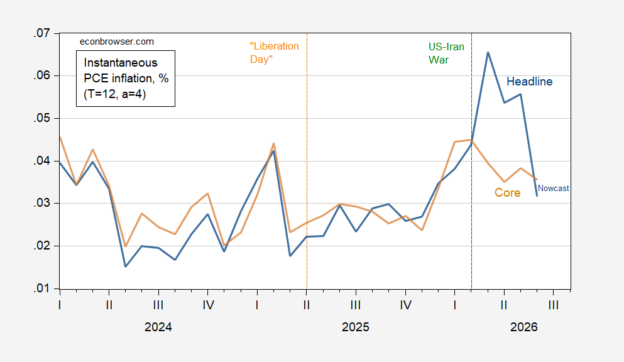
Nowcasted June inflation will be down — but for core not down much…
Figure 1: Headline PCE deflator instantaneous inflation (blue), core PCE (tan), per Eeckhout (2023), both T=12, a=4. June observation uses y/y nowcast of 6/26. Source: BEA, Cleveland Fed, and author’s calculations.
Facts Only
Headline PCE deflator measures instantaneous inflation. Core PCE measures core inflation. The figures are based on a comparison of these two metrics. The observation uses a year-over-year nowcast for June 26th. Data sources include the BEA, the Cleveland Fed, and author’s calculations. The visualization compares headline PCE (blue) and core PCE (tan).
Executive Summary
Nowcasted inflation for June is expected to decrease, but core inflation is projected to remain relatively stable. The data presented uses a comparison between headline PCE deflator, which measures instantaneous inflation, and core PCE, which filters out volatile components. The visualization compares these two metrics using projections derived from the yield/yield (y/y) nowcast of June 26th. The calculations utilize data from the Bureau of Economic Analysis (BEA), the Cleveland Fed, and author-specific calculations.
Full Take
The divergence between headline and core inflation signals an important structural tension in the economic narrative: while overall price changes may appear to cool, the underlying inflationary pressures embedded within the core economy persist. This contrast highlights the complexity of predicting inflation when relying on future nowcasts versus current observed reality. The reliance on statistical figures derived from institutions like the BEA and the Cleveland Fed underscores how economic reality is mediated by specific calculation methodologies and chosen time horizons. This pattern suggests that market narratives often focus on aggregate, easily digestible metrics (headline) while overlooking the deeper dynamics of cost pressures (core), creating a gap between public perception and underlying economic reality. The implication is that understanding true inflationary trends requires moving beyond simple rate comparisons to scrutinize the components used in these calculations and the assumptions built into future projections.
Sentinel — Human
Confidence
The text displays characteristics typical of rigorous data captioning found in human-authored economic reporting, focusing on factual presentation and sourced methodology.
Signals Detected
low severity: Sentence structure is purely descriptive and functional, typical of data captions rather than narrative flow.
low severity: The text is dense with technical detail but lacks the unnecessary hedging or excessive transition phrasing often found in synthetic content.
low severity: Relies heavily on specific, verifiable sourcing (BEA, Cleveland Fed, Eeckhout 2023), indicating grounded reporting rather than pattern replication.
low severity: The structure is purely informational and procedural; no obvious signs of LLM confabulation or crafted narrative voice.
Human Indicators
Specific attribution to established economic bodies (BEA, Cleveland Fed) and academic sources (Eeckhout 2023) points toward grounded journalistic reporting.
The explicit referencing of specific methodological calculations (T=12, a=4, y/y nowcast of 6/26) suggests an internal derivation process.