The Velvet Touch: Bringing Flossflower to the Front Range
By Ross
While the Colorado landscape is often defined by the rugged architecture of yuccas and the golden resilience of prairie grasses, every gardener occasionally craves a touch of softness. In the heat of a Fort Collins July, nothing provides that visual relief quite like Ageratum houstonianum, more commonly known as the Flossflower. With its clusters of fringed, pom-pom-like blooms in shades of cerulean, violet, and white, it offers a "velvet" texture that bridges the gap between structured perennials and fluid groundcovers.
A Cool Blue Anchor in a Sun-Drenched Climate
On the Front Range, true blue is a rare and precious commodity in the floral palette. Ageratum is one of the few annuals that provides a consistent, cooling blue hue that remains vibrant even under our intense high-altitude UV rays. Traditionally used as a low-growing border plant, newer triploid hybrids available at local institutions like the Plantorium have pushed the boundaries of what this plant can do, offering taller varieties that excel as cut flowers or mid-border anchors.
The beauty of the Flossflower lies in its "tassel" florets—magnificent, thin structures that create a fuzzy, mist-like appearance. When planted en masse, they create a shimmering carpet that seems to hum with the activity of local pollinators.
<figure>
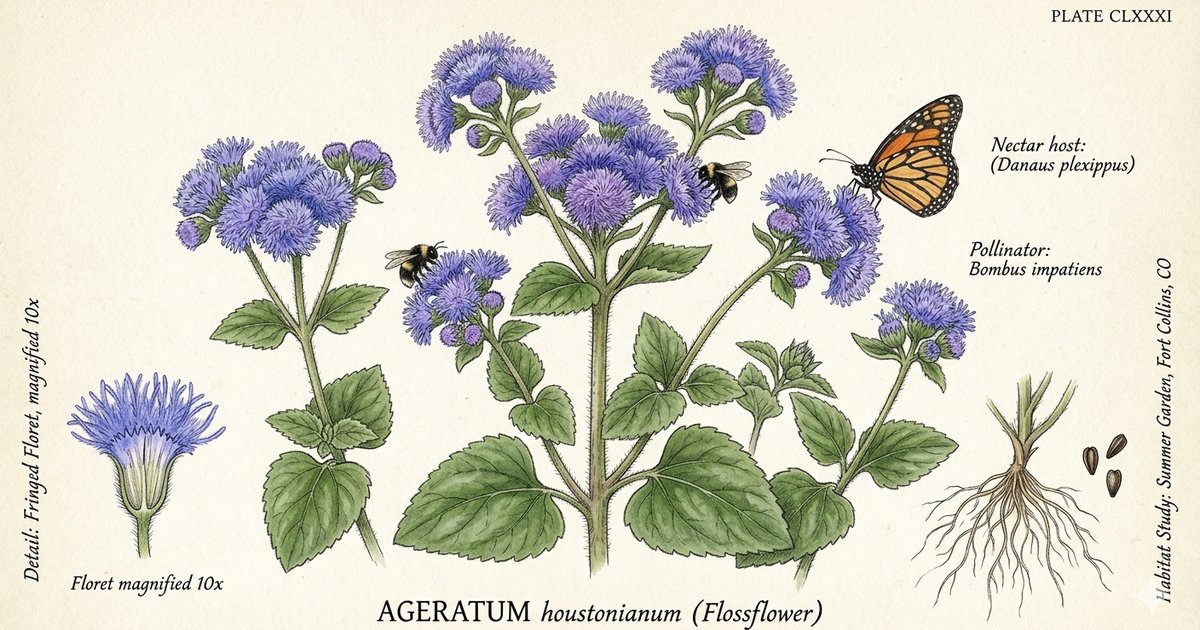
<img src="watermarked_img_3277553764826542428.png" alt="A detailed Audubon-style botanical illustration of Ageratum houstonianum, showing its blue-violet fringed flowers, heart-shaped leaves, a visiting Monarch butterfly, a bumblebee, and a magnified floret detail against a cream paper background." />
<figcaption><em>Plate CLXXXI: Ageratum houstonianum. A study in the delicate symmetry and pollinator value of the Flossflower within the summer gardens of Fort Collins.</em></figcaption>
</figure>
Success in Local Soils
While many of our favorite xeric plants thrive on neglect, Ageratum appreciates a bit more hospitality. To see it truly flourish in Larimer County, consider these three pillars of care:
- Consistent Hydration: Unlike the desert-dwelling Hyssop, Ageratum prefers "cool feet." In our semi-arid climate, a layer of organic mulch is essential to keep the soil moisture even and prevent the delicate root system from baking.
- The Afternoon Break: While it loves the sun, the sheer intensity of a Colorado afternoon can sometimes scorch the foliage. In Fort Collins, Ageratum often performs best in locations that receive six hours of morning light but find themselves in dappled shade by 3:00 PM.
- Soil Enrichment: Our local clay can be heavy and alkaline. When transplanting your starts, amending the area with a high-quality compost will provide the slightly acidic-to-neutral environment these plants prefer, ensuring the foliage stays a rich, healthy green rather than yellowing.
The Pollinator Connection
The Flossflower is more than just a pretty face; it is a vital nectar station for a variety of "human-friendly" garden guests. As an "Audubon-style" observation would reveal, the flat-topped clusters act as perfect landing pads for butterflies. It is common to see Monarchs (Danaus plexippus) and Western Tiger Swallowtails pausing on the blooms, alongside various species of Bombus (bumblebees) that are attracted to the rich nectar stores hidden within the fringed florets.
In a world of sharp thorns and dry stones, Ageratum reminds us that there is always room for a little softness. Whether lining a flagstone path or filling a terracotta pot on a backyard patio, it remains a timeless classic for the discerning Colorado gardener.
Facts Only
*Ageratum houstonianum*, commonly known as Flossflower, is an annual plant with fringed, pom-pom-like blooms in shades of blue, violet, and white.
It is cultivated in the Front Range region of Colorado, particularly in Fort Collins.
The plant provides a rare true blue color in the local floral palette, remaining vibrant under high-altitude UV rays.
Newer triploid hybrids are available at local institutions like the Plantorium, offering taller varieties suitable for cut flowers or mid-border planting.
Flossflower’s "tassel" florets create a fuzzy, mist-like appearance, attracting pollinators such as Monarch butterflies and bumblebees.
It requires consistent hydration, afternoon shade, and soil enrichment to thrive in Larimer County’s semi-arid climate.
The plant is used as a low-growing border plant, groundcover, or in containers.
Its pollinator-friendly structure supports local ecosystems by providing nectar for butterflies and bees.
Executive Summary
Full Take
This article presents Flossflower as a solution to a perceived gap in Colorado’s gardening aesthetic—softness and true blue color—while framing it as both ecologically and visually beneficial. The narrative leans on emotional appeal ("velvet touch," "visual relief") and ecological virtue (pollinator support) to position the plant as a must-have for discerning gardeners. However, the piece assumes that gardeners prioritize aesthetics and pollinator support equally, without addressing potential trade-offs, such as water use in a semi-arid climate or competition with native species.
The strongest version of this narrative highlights the plant’s adaptability and pollinator benefits, which are well-supported by observational details (e.g., Monarch butterflies visiting the blooms). Yet, the article does not explore whether Flossflower could become invasive or disrupt local ecosystems, a common concern with non-native species. The focus on its "cool blue" rarity also risks oversimplifying the complexities of xeric gardening, where water conservation is critical.
Root cause: The paradigm here is the tension between ornamental gardening and ecological stewardship. The unstated assumption is that introducing non-native plants with pollinator benefits is inherently positive, without weighing long-term consequences. This echoes broader trends in horticulture where aesthetic and short-term ecological gains are prioritized over systemic resilience.
Implications: While Flossflower may enhance garden beauty and support pollinators, its water needs and potential ecological impact warrant deeper scrutiny. Who benefits? Gardeners and nurseries. Who bears costs? Potentially, native ecosystems if the plant spreads uncontrollably.
Bridge questions: How does Flossflower’s water requirement compare to native alternatives? What long-term studies exist on its ecological impact in Colorado? Would local ecologists endorse its widespread use?
Counterstrike scan: If this were part of a coordinated campaign, it might emphasize emotional and ecological appeals to drive sales of non-native plants, downplaying risks. However, the article does not exhibit overt manipulation patterns—it presents genuine horticultural advice with some unexamined assumptions.
Patterns detected: none