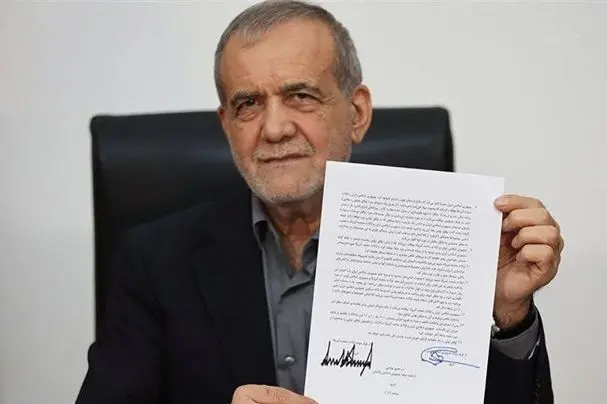
Washington/Tehran: Iran’s President Masoud Pezeshkian welcomed on Thursday what he called a “historic” deal with the United States to end their war and pave the way for negotiations toward a final settlement.
“This is a historic document and a message from a powerful Iran: peace will be achieved in the shadow of mutual respect,” Pezeshkian said, in a social media post showing an image of the document, which carried his signature as well as US President Donald Trump and their mediator, Pakistani Prime Minister Shehbaz Sharif.
Trump signed the agreement with Iran in Versailles, France on Wednesday that calls for Tehran to dilute its stockpile of highly enriched uranium and waives US-backed sanctions on the country, immediately allowing Iran to sell its oil freely in a major concession from Washington, according to details released by both countries.
In Tehran, Pezeshkian signed the deal on behalf of Iran, according to the state-run IRNA news agency, which posted an image of him holding up the deal with his signature and Trump’s.
The initial deal to end the war takes “immediate effect” after leaders from both countries signed it, Sharif, who helped mediate the agreement, said online.
The Pakistani leader signed the agreement on Thursday as mediator.
Iran’s Foreign Minister Abbas Araghchi stressed the importance of dialogue with Gulf Arab states to address misunderstandings and strengthen regional ties during a phone call with his Kuwaiti counterpart Sheikh Jarrah Jaber Al-Ahmad Al-Sabah on Thursday, according to his Telegram account.
Araghchi also expressed hope that the peace accord with the US would help restore peace and stability in the region.
Switzerland says talks planned for Friday between Iran and US
Initial talks between the United States and Iran are planned at the Buergenstock mountaintop resort in Switzerland on Friday.
In a statement, the Swiss foreign ministry said that as things stand, the plan is still for the US and Iran, and mediators Pakistan and Qatar, to meet tomorrow at Buergenstock for initial negotiations about implementing the agreement.
The ministry’s statement removed an earlier reference to “other involved countries” being at the meeting. It added that no further information is currently available regarding the schedule and details of this meeting.
The agreement calls for a permanent end to hostilities and starts a 60-day negotiating clock to reach a final deal on the future of Iran’s nuclear program, though Trump left the door open to resume attacks. It appears to offer Iran several benefits up front while extracting little in return.
The deal has been shrouded in secrecy and confusion for days. US officials refused to disclose the terms even after saying Trump and Vice President JD Vance digitally signed it over the weekend.
Trump signed a physical copy Wednesday while dining with French President Emmanuel Macron at Versailles, the palace where many historic agreements have been signed over the centuries, ending wars or territorial disputes.
The White House had planned a signing ceremony on Friday in Switzerland, but its fate is now uncertain, with conflicting information from the US, Iran and Pakistan.
“It’s signed,” Trump said as he left the dinner at Versailles, which followed his trip to the Group of Seven summit in France.
In a video posted online by a White House aide, Trump was seen seated at a table next to Macron signing a paper copy of the agreement. Trump then handed the document and pen to Secretary of State Marco Rubio as people in the room applauded.
“This was not easy,” Trump said right before he signed it, according to a video posted to social media by Macron.
Agencies
Facts Only
* Iran’s President Masoud Pezeshkian welcomed the deal on Thursday.
* The agreement was signed in Versailles, France, between Iran and the United States.
* The agreement calls for Tehran to dilute its stockpile of highly enriched uranium.
* The agreement waives US-backed sanctions on Iran.
* Iran is immediately allowed to sell its oil freely.
* Pakistani Prime Minister Shehbaz Sharif acted as a mediator in the agreement.
* Initial talks are planned for Friday between Iran and the US in Switzerland.
* The agreement calls for a permanent end to hostilities and starts a 60-day negotiating clock on the nuclear program.
* US officials have refused to disclose the terms of the agreement.
Executive Summary
Full Take
Sentinel — Human
This analysis suggests a high probability of human journalistic origin, characterized by complex attribution and the reporting of conflicting diplomatic details rather than simple, uniform synthesis.