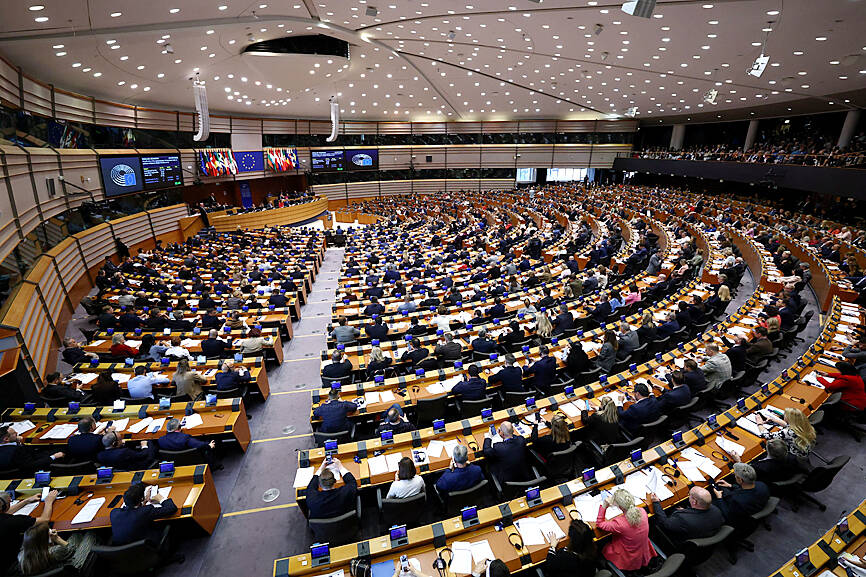
The European Parliament on Thursday passed a report calling for closer cooperation with like-minded partners, including Taiwan, to build a resilient web of trusted connectivity.
The European Commission and the EU high representative for foreign affairs and security policy in 2021 launched the Global Gateway, a strategic initiative to boost sustainable and high-quality infrastructure investments worldwide aimed at operating as a transparent and values-based alternative to other global infrastructure initiatives such as China’s Belt and Road Initiative.
Four years after its inception and one year into the current European Commission’s term, the European Parliament has been reviewing the progress of the initiative. It on Thursday passed a resolution on a progress report.
Photo: Reuters
The resolution was passed with 371 votes (62 percent) in favor, 146 (24 percent) against, and 80 abstentions.
The Global Gateway strategy aims to become “EU’s flagship framework for sustainable connectivity and global investment, and as an alternative to China’s Belt and Road Initiative,” the report said.
It said the initiative “calls for closer cooperation with like-minded partners with a view to building a resilient web of trusted connectivity, especially, but not exclusively, partners such as the United Kingdom, Canada, Japan, Australia, New Zealand, the Republic of Korea, India and Taiwan.”
In an environment of increased geopolitical rivalry and uncertainty, the Global Gateway initiative can boost smart, clean and secure links between the bloc and its partners, the report said, adding that it can help restore Europe’s industrial competitiveness, while reducing its dependencies in critical sectors and counterbalancing China’s growing global influence.
The Ministry of Foreign Affairs (MOFA) yesterday said that as authoritarian regimes leverage non-transparent lending and infrastructure projects to extend their global reach, it would deepen cooperation with the EU and other like-minded countries through its “integrated diplomacy” framework, and jointly promote a cooperation model consistent with democratic values.
It also said that it welcomed and appreciated a joint statement by German and Australian defense ministries released on Thursday, adding that it “underscored the importance of peace and stability across the Taiwan Strait, and reaffirmed their shared opposition to any unilateral action to change the status quo.”
The joint statement was issued after Australian Deputy Prime Minister and Minister for Defence Richard Marles met with German Minister of Defense Boris Pistorius in Canberra.
Taiwan, Australia and Germany are like-minded partners that share universal values such as democracy, freedom and the rule of law, MOFA said.
“The joint statement issued by these two nations once again demonstrates that maintaining peace and stability in the Taiwan Strait, the South China Sea and the broader Indo-Pacific region has become a matter of international consensus,” it added.
‘UNFRIENDLY’: Changing the nationality listing of Taiwanese residents to ‘China’ goes against EU foreign policy as well as democratic and human rights principles, MOFA said Taiwan yesterday called on Denmark to correct its designation of the nationality of Taiwanese residents as “China” or face retaliatory measures. The Danish government in 2024 changed the nationality of Taiwanese citizens on their residence permits from “Taiwan” to “China.” The decision goes against EU foreign policy and contravenes democratic and human rights principles, Ministry of Foreign Affairs (MOFA) spokesman Hsiao Kuang-wei (蕭光偉) said. Denmark should present a solution acceptable to Taiwan as soon as possible and correct the erroneous designation to preserve the longstanding friendship between the two nations, Hsiao said. The issue could damage Denmark’s image and business reputation in Taiwan,
KEY INDUSTRY: The vice premier discussed a plan to create a non-red drone supply chain by next year, which has been allocated a budget of more than NT$7.2 billion The government has budgeted NT$44.2 billion (US$1.38 billion) to cultivate Taiwan’s uncrewed aerial vehicle (UAV) industry over the next five years, which would make the nation a major player in the industry’s democratic supply chain in the Asia-Pacific region, Premier Cho Jung-tai (卓榮泰) said yesterday. Cho made the remarks during a visit to the facilities of Cub Elecparts Inc (為升電裝). Democratic Progressive Party (DPP) Legislator Chen Su-yueh (陳素月) and Chinese Nationalist Party (KMT) Legislator Hsieh Yi-fong (謝依鳳) also participated in the trip. Cub Elecparts has transitioned from the automotive industry to the defense industry, which is the top priority among the nation’s
Taiwan climbed to its highest position in global export rankings in more than three decades last year, buoyed by demand linked to artificial intelligence (AI) that lifted shipments of semiconductors and technology products, Ministry of Finance data released yesterday showed. Taiwan accounted for 2.4 percent of global exports last year, or about US$640 billion, ranking 12th worldwide, the data showed. That was up four places from a year earlier and marked the nation’s best ranking since 1994, the ministry said. Taiwan’s share of global exports rose by 0.5 percentage points from the previous year, the largest increase among major economies, reflecting the nation’s
FIRST TRIAL: Ko’s lawyers sought reduced bail and other concessions, as did other defendants, but the bail judge denied their requests, citing the severity of the sentences Former Taipei mayor Ko Wen-je (柯文哲) was yesterday sentenced to 17 years in prison and had his civil rights suspended for six years over corruption, embezzlement and other charges. Taipei prosecutors in December last year asked the Taipei District Court for a combined 28-year, six-month sentence for the four cases against Ko, who founded the Taiwan People’s Party (TPP). The cases were linked to the Core Pacific City (京華城購物中心) redevelopment project and the mismanagement of political donations. Other defendants convicted on separate charges included Chinese Nationalist Party (KMT) Taipei City Councilor Angela Ying (應曉薇), who was handed a 15-year, six-month sentence; Core Pacific
Facts Only
The European Parliament passed a resolution supporting the Global Gateway initiative, a strategic framework for sustainable infrastructure investments.
The resolution received 371 votes in favor, 146 against, and 80 abstentions.
The initiative aims to counter China’s Belt and Road Initiative and calls for cooperation with partners like Taiwan, the UK, Japan, and others.
The Global Gateway strategy seeks to boost Europe’s industrial competitiveness and reduce dependencies in critical sectors.
Taiwan’s Ministry of Foreign Affairs welcomed a joint statement by Germany and Australia opposing unilateral changes in the Taiwan Strait’s status quo.
Taiwan criticized Denmark for changing the nationality designation of Taiwanese residents to "China" on residence permits.
Taiwan has allocated NT$44.2 billion to develop its drone industry over the next five years.
Former Taipei Mayor Ko Wen-je was sentenced to 17 years in prison for corruption and embezzlement.
Taiwan’s global export ranking rose to 12th in 2023, its highest position in over three decades.
Executive Summary
The European Parliament has passed a resolution supporting the Global Gateway initiative, a strategic framework aimed at promoting sustainable and transparent infrastructure investments as an alternative to China’s Belt and Road Initiative. The resolution, approved with 371 votes in favor, emphasizes closer cooperation with like-minded partners, including Taiwan, the UK, Japan, and others, to build resilient connectivity networks. The initiative seeks to enhance Europe’s industrial competitiveness and reduce dependencies in critical sectors amid geopolitical tensions.
Separately, Taiwan’s Ministry of Foreign Affairs welcomed a joint statement by Germany and Australia reaffirming opposition to unilateral changes in the Taiwan Strait’s status quo. Meanwhile, Taiwan criticized Denmark for changing the nationality designation of Taiwanese residents to "China," calling it a violation of EU foreign policy and democratic principles. Domestically, Taiwan is investing NT$44.2 billion to develop its drone industry, aiming to strengthen its role in a democratic supply chain. Former Taipei Mayor Ko Wen-je was sentenced to 17 years in prison for corruption and embezzlement, highlighting ongoing legal and political challenges.
Full Take
The strongest version of this narrative highlights a coordinated effort by democratic nations to counter authoritarian influence through economic and strategic initiatives like the Global Gateway. The inclusion of Taiwan in such frameworks underscores its growing role in global supply chains and geopolitical alliances. However, the narrative also reveals tensions, such as Denmark’s nationality designation change, which Taiwan frames as undermining democratic principles. The legal case against Ko Wen-je adds a domestic layer, suggesting ongoing struggles with corruption and political accountability.
Patterns detected: ARC-0024 Ambiguity (in the framing of "like-minded partners" without clear criteria), ARC-0043 Motte-and-Bailey (Taiwan’s appeal to democratic values while navigating complex diplomatic realities).
Root cause: The narrative reflects a broader paradigm of democratic resilience against authoritarian expansion, with Taiwan as a focal point. Assumptions include the efficacy of economic initiatives as geopolitical tools and the alignment of democratic values with strategic interests.
Implications: For human agency, this means greater collaboration among democracies but also potential backlash from authoritarian regimes. Taiwan benefits from increased international support but faces diplomatic challenges, as seen with Denmark. Second-order consequences may include heightened tensions in the Indo-Pacific and shifts in global supply chains.
Bridge questions: How might smaller nations navigate the pressure to align with either democratic or authoritarian blocs? What metrics could define the success of initiatives like the Global Gateway beyond economic outcomes?
Counterstrike scan: A coordinated influence campaign might amplify divisions between democratic allies (e.g., Denmark’s policy) to weaken collective resilience. The actual content does not fully match this pattern, as it primarily reports on policy and legal developments rather than pushing a manipulative agenda.