This is part of Opinionpalooza, Slate’s coverage of the major decisions from the Supreme Court. Keep up with all of our Supreme Court coverage and analysis by signing up for weekly email roundups. The best way to support our work—and unlock exclusive legal analysis—is by joining Slate Plus. (If you are already a member, consider a donation or merch!)
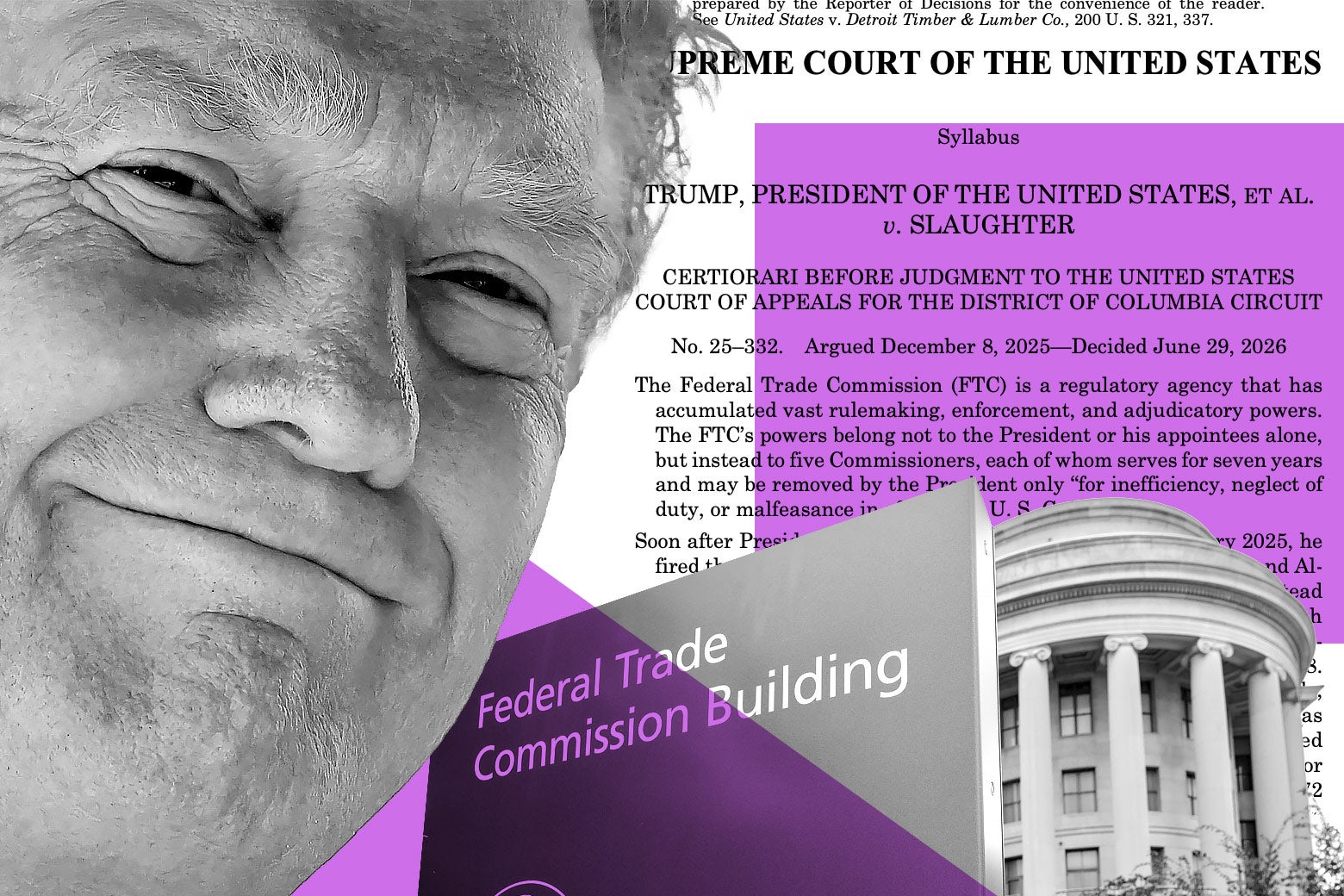
On Monday, the Supreme Court swung a wrecking ball into our federal government’s structure in Trump v. Slaughter, as the 6–3 conservative majority overturned a century’s old precedent and ruled that the president can now fire commissioners of the Federal Trade Commission for any reason whatsoever. This ruling undermines hundreds of statutes that created agencies that were once insulated from presidential control with political party requirements and removal restrictions. Nearly all federal agencies that everyday Americans rely on are now fully under President Donald Trump’s thumb. Worse, there are hidden dangers beyond the president firing high-ranking commissioners that the court failed to even acknowledge, ones that voters will need to prompt Congress to step in and correct before the presidency becomes too powerful to tame.
When Congress first created the FTC in the 1910s, it recognized that the agency’s mandates of protecting consumers and fighting monopolies should not be overly swayed by partisan politics. It therefore mandated that only three out of five commissioners at the top of the agency could be of the president’s party. Congress also decided that the president could only fire the commissioners for “inefficiency, malfeasance, or neglect,” also known as “for cause.” Just like a private employer might be required to provide some formal notice of poor performance before firing an employee, so too did the president need to identify some tangible reason why a commissioner was not performing their jobs properly. And the reason for firing couldn’t simply be that the president disagreed with the FTC commissioner’s policies, since that would go against Congress’ set-up of the agency that was meant to have some modicum of diversity of opinions and technical expertise.
But not anymore. As the Supreme Court held on Monday in a 6–3 opinion along partisan lines, for cause removal restrictions for nearly all boarded agencies are unconstitutional. The court finished its long-standing project of overturning 1935’s Humphrey’s Executor, which had considered the very same Federal Trade Commission Act statute that created the FTC and found that its for cause removal restrictions were lawful. In his first term, Trump showed a dollop of deference toward Humphrey’s, even nominating the Democrat Commissioner Rebecca Slaughter, who would bring this case. But by his second term, the Trump administration was tired of following the law as it was written; he fired Slaughter, intentionally refusing to give any reason for the firing, so as to create a test case that would allow the court to reconsider its precedent. This gambit succeeded with Monday’s opinion.
There are many problems with that opinion. Despite the Constitution not saying anything about the president’s ability to remove officers, the court held that the removal power is, and has always been, silently embedded into the generically broad concept of “executive power” in Article II of the Constitution. My Slate colleague Mark Joseph Stern goes into much more detail about the flaws in the court’s reasoning, but suffice to say that this decision will restructure every federal agency (except maybe one particularly favored institution: the Federal Reserve). And while there are hundreds of agencies that have some semblance of independence, three categories come to mind for immediate upheaval: (1) expert commissions, (2) Cabinets, and (3) controversial subordinate agencies.
First, there are the agencies that most resemble the FTC, with multimember commissions running the show. And there are a lot of them. Trump can now say “you’re fired” to commissioners of agencies that, like the FTC, play essential roles in our economy: for example, the Securities and Exchange Commission, which regulates corporate fraud in public markets, and the National Labor Relations Board, which issues important rules regarding unionization. Other agencies require highly technical expertise, like the Federal Energy Regulatory Commission, the Federal Communications Commission, the National Transportation Safety Board, and the Nuclear Regulatory Commission. Perhaps most dangerously, yet another set of agencies plays an important role in keeping our democratic system running, like the Federal Election Commission, and the Postal Regulatory Commission, which oversees a Postal Service that as we speak Trump is attempting to use to disenfranchise mail-in voters.
And you should feel little comfort from the idea that the Supreme Court complicated its above analysis by also ruling that the Federal Reserve Board members enjoy some protection in Trump v. Cook. The theory behind Cook was based on a long historical tradition of banks of the United States since the founding, plus Justice Brett Kavanaugh’s clear policy concerns over letting presidents manipulate interest rates. Neither of those concerns apply to the broad swath of non–Federal Reserve agencies.
This brings us to the second type of agency that is now at risk: Cabinet agencies. Now, historically, the heads of agencies like the State and Commerce and Defense departments have already been subject to at-will presidential control. But Slaughter opens the door to presidents exerting even more political influence down the chain of command. As Justice Sonia Sotomayor explained in her dissent, if it’s true that the Constitution requires the president to be able to micromanage who heads an agency, and that power cannot be circumscribed by Congress, then there’s no reason that power would not extend down to lower-level employees. Sotomayor noted that the solicitor general admitted this point at oral argument. Therefore, when a new president comes to Washington, an agency like the Environmental Protection Agency could lose not just the EPA administrator and deputy administrator, but the heads of every suboffice, down to the hardworking scientists in charge of measuring water quality.
It’s this last risk to federal offices that provides a small sliver of hope to fight back against the Supreme Court’s excesses in our third category, what you might call controversial subordinate agencies. Here we’re thinking about politically heated offices like the CIA, parts of the Department of Defense, and Department of Homeland Security groups like Customs and Border Patrol or the Immigration and Customs Enforcement. The idea here is simple. Trump will no doubt test the limits of whom he can fire before he leaves office. A future Democratic president should do the same. As outrage increases every week over the brutal actions of ICE, there is no reason a candidate for the Democratic nomination shouldn’t consider running on a platform of firing every member of ICE. On Day One of office, ICE can therefore be “abolished” without any need for congressional oversight. In Humphrey’s, the case the court overturned Monday, President Franklin Roosevelt had tried to fire an FTC commissioner with a one-line letter with no explanation. Trump similarly fired Slaughter and the other Democratic commissioner, Alvaro Bedoya, by simply stating that their “service on the FTC [was] inconsistent with [his] Administration’s priorities.” After Slaughter, such short letters may be enough to send ICE agents packing. Of course, that may also mean that it might be dangerously easy for Trump to do the same with agencies like the Department of Education, which the administration has been trying to dismantle from Day One. Each of these firings would be litigated, and the results are likely to be contradictory and confusing. The resulting equilibrium will be one neither Congress nor the founders intended, but this is the world the Supreme Court has created.
After Slaughter, Trump will begin to make Nixon’s Saturday Night Massacre look like a normal weekday. If Trump suspects that the agency member is investigating the president himself for a violation of the law, or one of Trump’s family members? Fired. What if the agency official refuses to use the agency’s power to attack the president’s main political rival? Fired. What if the agency official refuses to help Trump manipulate the midterm elections? Fired. The Supreme Court’s reckless logic leaves no room for carve-outs outside of Wall Street: “Subordinates who exercise the President’s power are subject to removal by him.” Full stop. Until there’s a new president, or a Congress with some spine, Americans will be left to suffer from the untold amounts of fraud and dysfunction that Trump is about to inflict on the executive branch and the country.
Sentinel — Human
This text is a persuasive opinion piece that uses legal facts to build an argument about executive power, exhibiting the rhetorical flair and interpretive depth typical of human political commentary.