Vance Weighs In on UFOs: ‘I Don’t Think They’re Aliens – I Think They’re Demons’
Log in to your existing account or sign up today!
Log in to your existing account or sign up today!
Log in to your existing account or sign up today!
Vice President J.D. Vance addressed the subject of UFOs and unidentified aerial phenomena in a new interview, saying he believes they are not extraterrestrial but instead something supernatural referenced in Scripture.
Vance addressed the issue in an interview with Benny Johnson, who asked if the Trump administration plans to release the full range of UFO files in government archives. Vance said the administration is “working on it,” but added that his attention has been more focused on priorities such as the economy.
But Vance said he has a keen interest in the subject.
NEW - U.S. Vice President Vance on UFOs: "I don't think they're aliens, I think they're demons."pic.twitter.com/5vHdxyUUbJ
— Disclose.tv (@disclosetv) March 27, 2026
“I have not been able to spend enough time on this to really understand it, but I am going to – trust me, I'm obsessed with this,” Vance said. “I've already had a couple of times where I'm like: alright, we're going to Area 51, we're going out to New Mexico … [to] get to the bottom of this – and then the timing of the trip just didn't work out.
“But trust me, anybody who's curious about this – I'm more curious than anybody,” Vance said, adding he has three more years to investigate it during the current Trump-Vance term.
“I'm gonna get to the bottom of it,” he said.
Vance then added that he believes such phenomena have a spiritual explanation.
“I don't think they're aliens. I think they're demons anyway, but that's a longer discussion,” he said.
Johnson, not willing to leave the topic there, asked the vice president to expand on his view.
Vance said it is unwise, as a Christian, to assume all unexplained phenomena are extraterrestrial.
“I think that celestial beings who fly around, who do weird things to people – I think that the desire to describe everything celestial, everything as otherworldly – to describe it as aliens – I mean every great world religion, including Christianity, the one that I believe in, has understood that there are weird things out there, and there are things that are very difficult to explain.
“And I naturally go – when I hear about [some] sort of extra-natural phenomenon, that's where I go to, is the Christian understanding.”
Vance said such beliefs align with a broader biblical view of spiritual reality.
“There's a lot of good out there, but there's also some evil out there, and I think that one of the devil's great tricks is to convince people he never existed.”
Related Article
10 Things to Know about J.D. Vance’s Faith and Beliefs
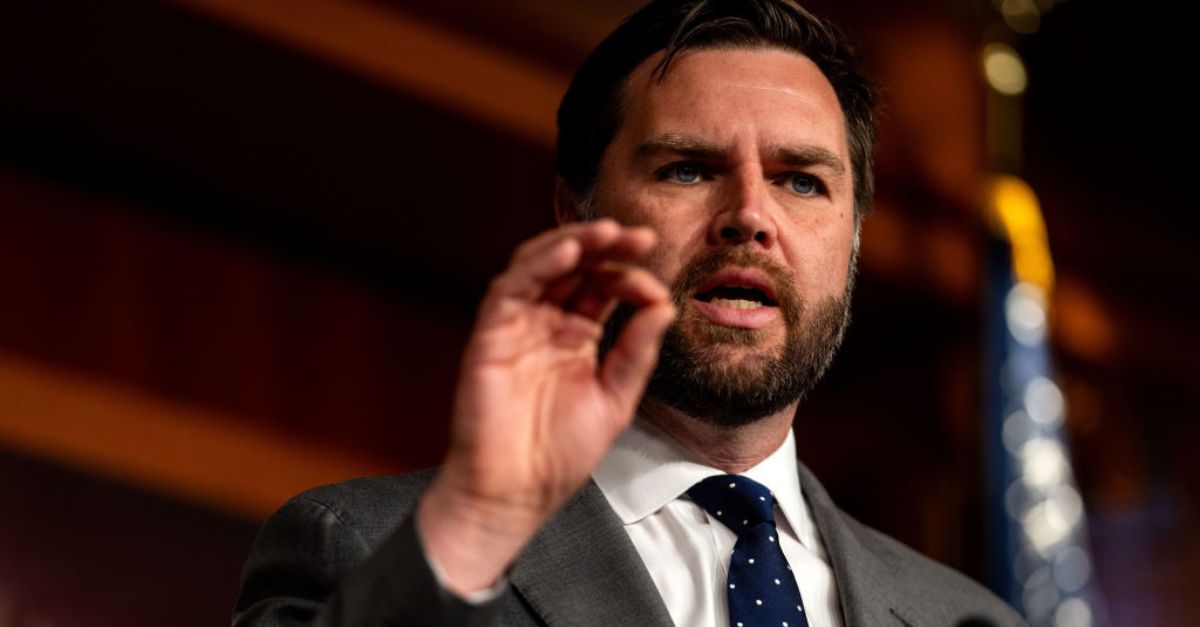
Photo Credit: ©Getty Images/Kent Nishimura/Stringer
Michael Foust has covered the intersection of faith and news for 20 years. His stories have appeared in Baptist Press, Christianity Today, The Christian Post, the Leaf-Chronicle, the Toronto Star and the Knoxville News-Sentinel.
Listen to Michael's Podcast! He is the host of Crosswalk Talk, a podcast where he talks with Christian movie stars, musicians, directors, and more. Hear how famous Christian figures keep their faith a priority in Hollywood and discover the best Christian movies, books, television, and other entertainment. You can find Crosswalk Talk on LifeAudio.com, or subscribe on Apple or Spotify so you never miss an interview that will be sure to encourage your faith.
Originally published March 30, 2026.
Log in to your existing account or sign up today!
Log in to your existing account or sign up today!
Log in to your existing account or sign up today!
Facts Only
Vice President J.D. Vance discussed UFOs and unidentified aerial phenomena in a March 2026 interview with Benny Johnson.
Vance stated the Trump administration is working on releasing UFO files but has prioritized economic issues.
He expressed strong personal interest in investigating UFOs, mentioning plans to visit Area 51 in New Mexico.
Vance believes UFOs are not extraterrestrial but supernatural entities, specifically describing them as "demons."
He cited Christian teachings as the basis for his interpretation, arguing that major religions acknowledge unexplained celestial phenomena.
Vance suggested that dismissing spiritual explanations for UFOs is unwise from a Christian perspective.
He referenced a biblical view of spiritual reality, emphasizing the existence of both good and evil forces.
The interview was published on March 30, 2026.
Vance has three more years in his term to explore the topic further.
He described his curiosity as obsessive, though logistical issues have delayed his investigations.
The discussion was part of a broader conversation about government transparency regarding UFO archives.
Vance’s comments align with his publicly expressed Christian faith and worldview.
Executive Summary
Vice President J.D. Vance addressed the topic of UFOs and unidentified aerial phenomena in a March 2026 interview with Benny Johnson. Vance expressed personal curiosity about the subject, stating he plans to investigate further during his term, including potential visits to locations like Area 51. While acknowledging the Trump administration is working on releasing UFO-related files, he emphasized that his immediate focus remains on economic priorities. Vance offered a spiritual interpretation of UFOs, suggesting they are not extraterrestrial but rather supernatural entities aligned with Christian teachings about celestial beings and demonic forces. He argued that Christianity and other major religions recognize unexplained phenomena, cautioning against dismissing spiritual explanations in favor of purely alien theories. His remarks reflect a broader belief in the existence of both good and evil spiritual forces, framing skepticism about UFOs as part of a Christian worldview.
The interview highlights Vance’s blend of political pragmatism and personal faith, as he balances institutional priorities with his own intellectual curiosity. His comments also underscore the ongoing cultural and political debate surrounding UFOs, where scientific, governmental, and religious perspectives often intersect. The discussion leaves open questions about how such beliefs might influence policy or public discourse on unexplained phenomena.
Full Take
Vance’s remarks on UFOs as "demons" rather than aliens present a fascinating intersection of faith, politics, and the unexplained. At its strongest, his narrative offers a coherent spiritual framework for interpreting phenomena that defy conventional explanation, grounding his perspective in Christian theology. By invoking Scripture and religious tradition, he provides a counterpoint to the secular, scientific dominant discourse on UFOs, appealing to audiences who prioritize faith-based worldviews. This steelman acknowledges the internal consistency of his argument—if one accepts the premise of supernatural beings, his interpretation follows logically.
However, the pattern scan reveals potential risks of **ARC-0024 Ambiguity** and **ARC-0043 Motte-and-Bailey**. Vance’s claim that UFOs are "demons" is presented as a personal belief, yet the framing—especially in a political context—could blur the line between private faith and public policy. The motte-and-bailey emerges if this spiritual interpretation is later retreated into ("It’s just my opinion") when challenged, while the bailey ("This should inform how we handle UFO disclosures") remains implied. Additionally, the demonization of UFOs (literally) risks **ARC-0012 Fear Appeals**, leveraging spiritual anxiety to shape perceptions of the unknown.
The root cause here is the tension between empirical inquiry and faith-based epistemology. Vance’s paradigm assumes that unexplained phenomena must fit within a Christian cosmology, sidestepping the possibility of neutral or non-spiritual explanations. This echoes historical patterns where religious institutions have framed the unknown through doctrinal lenses—sometimes to assert authority over mysteries. The implications for human agency are mixed: while his stance validates believers’ worldviews, it may marginalize secular or scientific perspectives in public discourse. Who benefits? Those who see spiritual warfare as a lens for modern mysteries. Who bears costs? Skeptics and researchers seeking empirical clarity, as well as individuals who might interpret UFO encounters through trauma or psychology rather than theology.
Bridge questions: How might Vance’s spiritual interpretation of UFOs influence government transparency efforts? What evidence would it take to shift his perspective—scientific, theological, or otherwise? Are there historical precedents where political leaders’ personal beliefs shaped public understanding of the unexplained?
Counterstrike scan: A coordinated influence campaign pushing this narrative might aim to polarize UFO discourse along religious lines, using spiritual fear to discredit secular investigations or vice versa. The actual content doesn’t fully match this pattern—Vance’s remarks appear genuine to his stated beliefs—but the potential for weaponization exists if others exploit the framing to delegitimize scientific inquiry or stoke cultural divisions. For now, it’s a personal conviction, not a systemic manipulation.
Sentinel — Human
The article shows strong signs of human authorship, including erratic sentence structure, personal voice, and verifiable attribution, with no significant stylometric or coordination red flags.