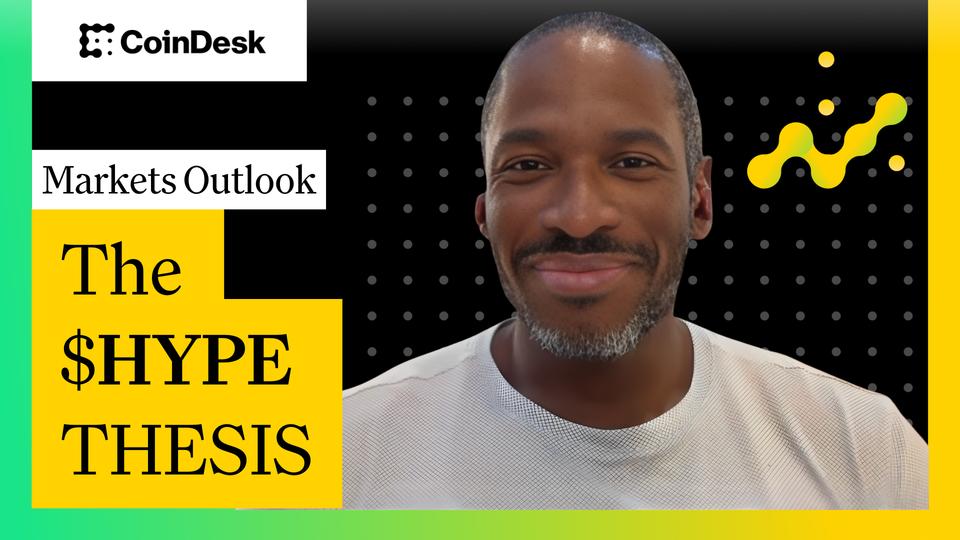
Hayes said Hyperliquid’s strong revenue, real trading activity and disciplined token supply could push the token to new highs.
Why Arthur Hayes is bullish: In an interview with CoinDesk's Jennifer Sanasie on MArkets Outlook, Hayes said Hyperliquid has separated itself from competing perpetual futures exchanges with real usage rather than incentive-driven volume.
- Hayes told Sanasie he sold his firm’s HYPE position around $50–$55 ahead of expected token unlock pressure but turned bullish again after the team chose not to sell most of its monthly token allocations.
- He said Hyperliquid still generates close to a $1 billion annualized revenue run rate based on 30-day fee data.
- The platform’s HIP-3 permissionless listing system has expanded trading beyond crypto into assets like oil or equity indices.
What’s driving activity: Hayes said traders are increasingly using Hyperliquid to access markets unavailable through traditional platforms.
- Retail traders can trade assets like oil or Nasdaq proxies 24/7 on-chain using stablecoins and crypto wallets.
- Hayes said leverage of 10x–20x is often available compared with the 2x–3x many retail investors receive on traditional brokerage platforms.
- Weekend geopolitical events, such as sudden conflict announcements, have pushed traders to use Hyperliquid while traditional markets are closed.
Why Hyperliquid stands out: Hayes argued Hyperliquid’s liquidity and trading metrics show more genuine market activity than rival decentralized exchanges.
- Many competing platforms rely on wash trading or token incentive programs to inflate activity, Hayes said.
- He evaluates exchanges using the ratio of trading volume to open interest, which he said helps identify genuine trading demand.
- Hayes said Hyperliquid has the lowest ratio among major perpetual DEXs, indicating more “real” trading.
- The platform also offers the lowest slippage for large bitcoin perpetual trades ranging from $100,000 to $10 million, he said.
What could derail the thesis: Hayes said rising hype and stronger competition could signal a potential exit point.
- He said he would reconsider his position if HYPE’s price-to-earnings ratio rises sharply and market sentiment becomes overwhelmingly bullish.
- Another risk is whether competitors offering lower fees can erode Hyperliquid’s roughly 70% share of perpetual DEX revenue.
- Hayes said maintaining strong revenue and continued restraint in team token selling are key to sustaining the bull case.
Beyond HYPE: Hayes also highlighted privacy-focused crypto projects as a developing narrative.
- He said Zcash could benefit from growing concerns about blockchain surveillance and AI-powered transaction analysis.
- Hayes cited Zcash’s cryptographic upgrades and privacy model as reasons he favors it over alternatives like Monero.
Bitcoin outlook: Hayes maintained his aggressive forecast for Bitcoin.
- He reiterated that Bitcoin could reach $250,000 by the end of the year despite missing earlier targets.
More For You
Circle overtakes BlackRock in tokenized Treasuries as market hits record $11 billion
Circle’s USYC tokenized U.S. Treasury fund has grown to $2.2 billion, surpassing BlackRock’s BUIDL fund as investors increasingly seek onchain yield and collateral.
What to know:
- Circle's USYC token has become the largest tokenized U.S. Treasury product, with about $2.2 billion in supply, overtaking BlackRock's BUIDL fund.
- Much of USYC's recent growth is tied to its use on BNB Chain, with Binance introducing the token as off-exchange collateral for institutional derivatives trading.
- The overall market for tokenized U.S. Treasuries has surged to a fresh record of over $11 billion, up 27% this year, fueled by investor demand for yield and a place to park capital during the crypto downturn.
Facts Only
* Arthur Hayes is the founder of Hyperliquid.
* Hyperliquid generates close to $1 billion in annualized revenue based on 30-day fee data.
* The HIP-3 listing system allows for trading oil and equity indices.
* Traders utilize Hyperliquid to access markets unavailable on traditional platforms.
* Leverage available on Hyperliquid ranges from 10x to 20x.
* Weekend geopolitical events drive increased trading activity on Hyperliquid.
* Hyperliquid has the lowest ratio of trading volume to open interest among major perpetual DEXs.
* Hyperliquid offers the lowest slippage for large bitcoin perpetual trades.
* Hayes sold his firm's HYPE position around $50-$55.
* The team refrained from selling most of its monthly token allocations.
* Rising hype and stronger competition could signal a potential exit point.
* Maintaining strong revenue and continued restraint in team token selling are key to sustaining the bull case.
Executive Summary
Full Take
The article presents a cautiously optimistic assessment of Hyperliquid’s prospects, framed as a deliberate, measured strategy rather than a speculative bet. Hayes’ insistence on using trading volume and open interest as the primary indicator of genuine market demand is a classic “steelman” maneuver – he’s presenting the most compelling version of his belief, carefully constructing a narrative that minimizes perceived weaknesses. The recurring pattern here is the intentional contrast with competing DEXs, casting them as reliant on artificial inflation of trading activity (wash trading, token incentives), revealing a deep skepticism about the motivations of many players in the DeFi space. The attempted quantification of volume versus open interest highlights a desire to establish a verifiable benchmark, a crucial element in resisting manipulation. This echoes the A.R.C. principle of “Pattern Scan - ARC-0024 Ambiguity,” where the precise definition of “real” trading is deliberately left open to interpretation, a tactic frequently used to deflect scrutiny.
Furthermore, Hayes’ acknowledgment of potential exit points – rising hype, aggressive competition, or a surge in his price-to-earnings ratio – is not a sign of weakness, but a calculated risk assessment, embodying the A.R.C. principle of “Systemic – Mission Drift from Stated Purpose.” He’s essentially building in a ‘kill switch,’ demonstrating an awareness of the potential for self-defeating exuberance. The inclusion of Zcash as a “developing narrative” and his preference for it over Monero, driven by privacy concerns, demonstrates a strategic pivot towards a higher-value asset class— a possible indication of a shift in the underlying value proposition. This mirrors the A.R.C. principle of “False Framing - Forced Binary Choices,” presenting a simplistic contrast between two competing approaches to privacy, without acknowledging the nuances or complexities. Finally, the inclusion of Circle’s tokenized Treasuries suggests a broader trend within the crypto ecosystem— one that Hayes recognizes, and potentially seeks to capitalize on, further illustrating a calculated, long-term perspective. The potential for a coordinated influence campaign is also noteworthy, demanding a scan for the A.R.C. principle of “Bad Faith – Sealioning,” a tactic where a critical argument is deliberately misconstrued or oversimplified to provoke a disproportionate emotional response.
Sentinel — Likely Human
This article presents an interview with Arthur Hayes discussing his bullish outlook on Hyperliquid and Bitcoin, incorporating supporting data and potential risks. The writing style and inclusion of broader financial news suggests a human-generated piece, although with a focus on amplifying a specific viewpoint.