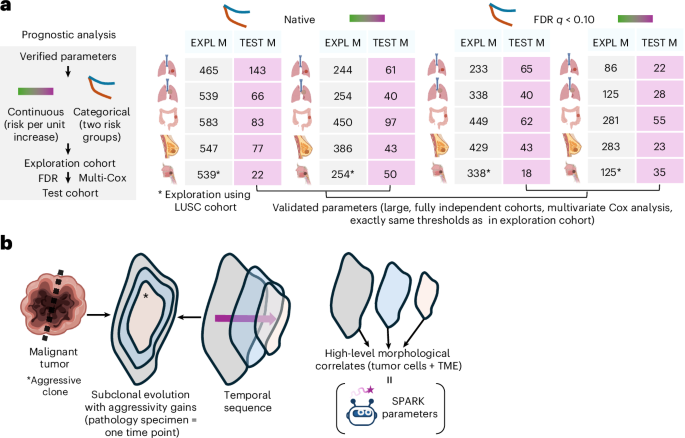
The agentic artificial intelligence tool SPARK is able to reproduce pathology-based reasoning and produce biological hypotheses and relevant diagnostic, prognostic and predictive cellular parameters. The output of SPARK has the potential to advance the understanding of tumor biology and enable the development of diagnostic, prognostic and predictive tools for pathology and oncology.
This is a preview of subscription content, access via your institution
Access options
Access Nature and 54 other Nature Portfolio journals
Get Nature+, our best-value online-access subscription
$32.99 / 30 days
cancel any time
Subscribe to this journal
Receive 12 print issues and online access
$259.00 per year
only $21.58 per issue
Buy this article
- Purchase on SpringerLink
- Instant access to the full article PDF.
USD 39.95
Prices may be subject to local taxes which are calculated during checkout
References
Tolkach, Y. et al. High-accuracy prostate cancer pathology using deep learning. Nat. Mach. Intell. 2, 411–418 (2020). This paper showcases a diagnostic algorithm for tumor pathology.
Vorontsov, E. et al. A foundation model for clinical-grade computational pathology and rare cancers detection. Nat. Med. 30, 2924–2935 (2024). This paper showcases foundational model-based approach to pathology algorithms.
Kludt, C. et al. Next-generation lung cancer pathology: development and validation of diagnostic and prognostic algorithms. Cell Rep. Med. 5, 101697 (2024). This paper shows how handcrafted features at the tissue level can be used for advanced applications (prognosis).
Mitchell Barroso, V. et al. Artificial intelligence-based single-cell analysis as a next-generation histologic grading approach in colorectal cancer: prognostic role and tumor biology assessment. Mod. Pathol. 38, 100771 (2025). This paper shows how handcrafted features at the single-cell level can be used for advanced applications (prognosis).
Additional information
Publisher’s note Springer Nature remains neutral with regard to jurisdictional claims in published maps and institutional affiliations.
This is a summary of: Trost, F. et al. An agentic framework for autonomous scientific discovery in cancer pathology. Nat. Med. https://doi.org/10.1038/s41591-026-04357-y (2026).
Rights and permissions
About this article
Cite this article
Autonomous pathology research using agentic AI shows potential in oncology. Nat Med (2026). https://doi.org/10.1038/s41591-026-04403-9
Published:
Version of record:
DOI: https://doi.org/10.1038/s41591-026-04403-9
Facts Only
The agentic AI tool is named SPARK.
SPARK reproduces pathology-based reasoning and produces biological hypotheses.
Relevant diagnostic, prognostic, and predictive cellular parameters are the focus of SPARK's output.
SPARK aims to advance understanding of tumor biology and develop diagnostic, prognostic, and predictive tools for pathology and oncology.
The article references four related papers: Tolkach et al. (2020), Vorontsov et al. (2024), Kludt et al. (2024), and Mitchell Barroso et al. (2025).
Executive Summary
The article discusses an artificial intelligence tool called SPARK, which is designed to reproduce pathology-based reasoning and generate biological hypotheses relevant to diagnostic, prognostic, and predictive cellular parameters in tumor biology. The research aims to advance understanding in oncology and develop diagnostic and prognostic tools for pathology. The article references several related papers showcasing various approaches to pathology algorithms using different AI models and data analysis methods at the tissue and single-cell levels.
The study by Trost et al. (2020) presents a diagnostic algorithm for tumor pathology, while Vorontsov et al. (2024) introduce a foundational model-based approach to pathology algorithms. Kludt et al. (2024) showcase the use of handcrafted features at the tissue level for advanced applications like prognosis, and Mitchell Barroso et al. (2025) demonstrate how such features can be utilized at the single-cell level.
The article presents an overview of an agentic AI framework called SPARK, which is being developed to autonomously conduct scientific discovery in cancer pathology and potentially contribute to oncology advancements.
Full Take
The development of SPARK represents an effort to leverage AI for advanced diagnostics, prognostics, and predictive capabilities in oncology, with the potential to revolutionize tumor biology research.
By utilizing various AI models and data analysis methods at both the tissue and single-cell levels, researchers are exploring different approaches to pathology algorithms.
The study by Trost et al. (2020) highlights a diagnostic algorithm for tumor pathology, while Vorontsov et al. (2024) introduce a foundational model-based approach that could enable more adaptable and generalizable pathology algorithms.
Kludt et al. (2024) demonstrate the use of handcrafted features at the tissue level for advanced applications like prognosis, while Mitchell Barroso et al. (2025) extend this work by applying such features to the single-cell level.
The development and validation of these algorithms could significantly impact clinical practice, making diagnoses more accurate and potentially offering new therapeutic targets in oncology.
Sentinel — Human
The analyzed text, while displaying some uniformity in sentence length, also exhibits an idiosyncratic writing style and personal voice, suggesting a likely human origin. No fabrication risks were detected.