With 76 months to get everything built and tested, veteran stadium builder says CIOB’s influence on construction professionalism is profound in Australia.
During their visit to Australia this month, CIOB President Paul Gandy and chief executive Dr Victoria Hills checked in on Brisbane, which is now gearing up for the Brisbane 2032 Summer Olympic and Paralympic Games.
In December, a consortium led by Laing O’Rourke and Aecom was named delivery partner for the A$7.1bn (£3.75bn) Games build-out.
Reviving a partnership formed to deliver the London 2012 Games, their “Unite32” team will be responsible for 17 new and upgraded venues in the state of Queensland in locations ranging from the Gold Coast south of Brisbane all the way up to Cairns, some 1,760km to the north on Australia’s eastern seaboard.
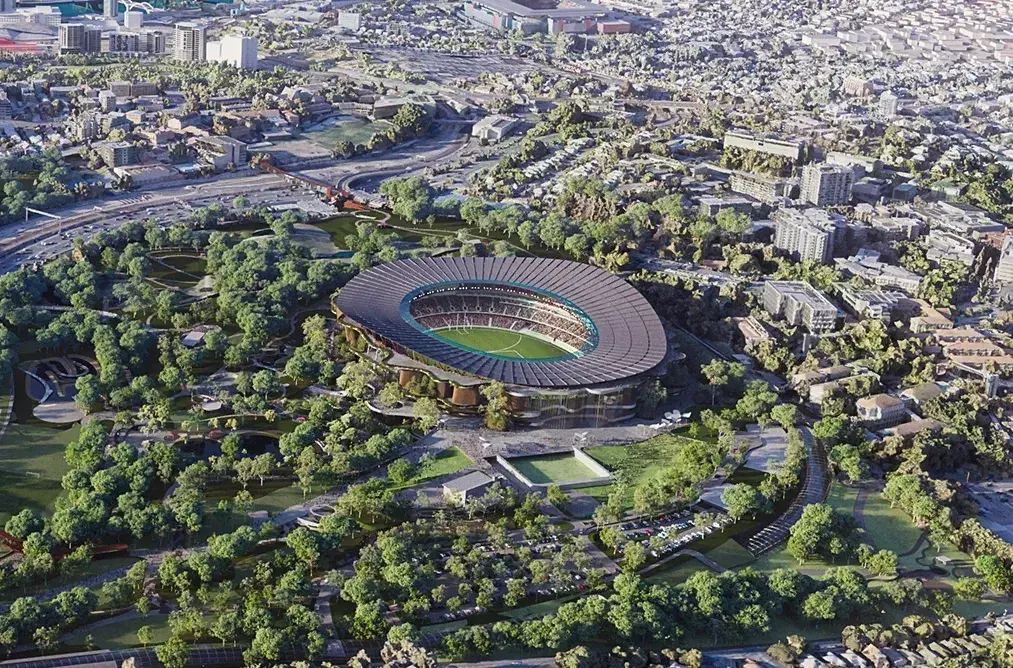
Centrepiece venues include the brand new, 63,0000-seat Brisbane Stadium, set to host the opening and closing ceremonies and athletics, and thereafter to be the city’s main stadium.
It’ll go up in Brisbane’s Victoria Park Precinct, now being master-planned for the Games by Arup.
Also going up in the park precinct will be the Athlete’s Village, set to be housing after the Games, and the new National Aquatic Centre, which will be Australia’s headquarters for water sports post-Games with a permanent capacity of 8,000 seats (25,000 during the tournament).
‘I can give you the best you can have’
While in Brisbane, Paul Gandy took part in a panel discussion at Victoria Park about delivering the venues and infrastructure for the Games.
He highlighted the need for a clear vision of the long-term legacy and a thorough understanding of what local communities will gain after the Games conclude. Drawing on lessons from London, he noted that transport infrastructure and connectivity are critical for delivering a successful event and ensuring lasting benefits for the region.
Asked what he thought CIOB and its members could bring to make Brisbane 2032 “the best Olympics ever”, Gandy said: “I think what the professions and professional contractors bring is competence. Being a professional is a demonstration that you want to be the best you can be, you want to maintain your social confidence, your professional capability, your technical capability, and it’s a badge that says to customers and the public, ‘I can give you the best you can have’.”
CIOB’s understated influence
The discussion was moderated by Alan Patching, professor of construction management at Queensland’s Bond University, who was project director and owning-entity chief executive for the design and construction of the Sydney Olympic Stadium for the Sydney 2000 Games.
At 115,0000 capacity, it remains the biggest purpose-built Olympics stadium ever constructed, and it finished on time and budget.
Speaking to GCR after the discussion, Patching said he believed CIOB plays a far bigger role in Australian construction professional competence “than they would ever imagine they do”.
“This is the academic side of me coming through. It’s a really good question,” he said. “I’ve never been asked that before, but CIOB accredits multiple university degrees in Australia. I’d go so far as to say if they’re not CIOB-accredited, they’re on the light side in terms of their accreditation.
“We’re writing our courses to suit the demands of bodies like CIOB so, in that sense, we’ve been developing over the last 10 years the people who will be on the design teams, the construction management teams, the project management teams who’ve gone through and done our degrees.
“If you did a study on how many people are involved in Olympic projects and find out which universities they went to, I bet well over 70% were educated at a university that was accredited by CIOB, among others.”
Will Brisbane be ready for 2032?
With the Brisbane Games kicking off on 23 July 2032, teams have 76 months and four days to get everything built and tested.
Patching was confident the venues would be ready – “Because,” he said, “there’s never been an Olympic Games in history where they didn’t get a finish.”
He went on: “Now, we’ve got six years to go and three months and everybody’s going, wow, wow, wow, wow.
“If you take it back to Australia in 1996 in July, I was engaged as the project director and CEO for the Sydney Olympic Stadium. In 1999, 30 months later to the day, it was done with not one day’s time extension, not one dollar over the original budget, no variations except a couple of internal ones to increase stadium capacity.
“It gave us a full 18 months before the Olympics, which meant two full seasons of football. And you might say, well, so what? It wasn’t about revenue. Well, it was, but it was more about testing security, testing transport, testing volunteer systems, all those sorts of things.
“And Olympic standards are very different. During the Games you’ve got to get everybody emptied and another crowd in and resupply all the stores and booze and food in a two or three-hour period. So that affects the design. We chilled the bottom of a garbage chute down to 13ºC so we could leave the food overnight and take it out the next morning without it smelling.
“We put all the CO2 in the basement and pumped it up because we didn’t have time to haul it up to all the levels. Now, the problem with that is you’ve got six kilometres of lines full of beer at the end of the night, so you better time when you’re going to turn it off or you’re going to have, you know, some very expensive beer being poured out of the lines down the track! That’s not the ideal design, but it’s what we had to do.”
‘People want to tell their family’
Patching acknowledged the state of Queensland suffers scarcity in skills and labour, but said that wouldn’t affect the Olympics per se.
“I’m optimistic because there will be a preference for most contractors, subcontractors and individuals to get involved in Olympics,” he said. “People just want to be able to tell their family they’re involved with the Olympics. It’s an amazing phenomenon. We had people coming from the UK just to take any job so they could get on the Olympics. It’s just the way it goes.
“But can they take it easy? No, they can’t. Because when you’ve got global events like we’ve got at the moment, they could affect it in all sorts of ways. But they should be fine provided they turn soil in June-July, which they’re on target to do.”
- Subscribe to our newsletter here to receive construction news and insights from around the world straight to your inbox
Facts Only
A consortium led by Laing O’Rourke and Aecom, named "Unite32," is the delivery partner for the A$7.1bn Brisbane 2032 Olympic Games construction.
The consortium will build 17 new and upgraded venues across Queensland, including the Gold Coast and Cairns.
The Brisbane Stadium, with 63,000 seats, will host the opening and closing ceremonies and athletics.
The Athlete’s Village and National Aquatic Centre will be constructed in Victoria Park Precinct.
The National Aquatic Centre will have a permanent capacity of 8,000 seats, expandable to 25,000 during the Games.
CIOB President Paul Gandy participated in a panel discussion in Brisbane, emphasizing the need for long-term legacy and community benefits.
Alan Patching, professor at Bond University, moderated the discussion and highlighted CIOB’s role in accrediting Australian construction degrees.
Patching noted that over 70% of professionals involved in Olympic projects likely graduated from CIOB-accredited universities.
The Brisbane Games begin on 23 July 2032, giving teams 76 months to complete construction.
Patching expressed confidence in the timeline, citing the historical completion of Olympic venues on time.
He shared examples from Sydney 2000, including innovative solutions for food storage and beer distribution.
Patching acknowledged labor shortages in Queensland but believed the Olympics would attract sufficient workforce due to its prestige.
Executive Summary
Full Take
The narrative around Brisbane 2032’s construction presents a compelling case for the role of professionalism and legacy planning in large-scale infrastructure projects. The strongest version of this story credits the CIOB and its members for elevating industry standards, with Paul Gandy’s emphasis on competence and long-term benefits resonating as a principled approach. Alan Patching’s insights add weight, particularly his assertion that CIOB’s accreditation shapes the workforce behind such projects. However, the article leans heavily on authority figures—Gandy and Patching—without exploring countervailing perspectives, such as critiques of Olympic cost overruns or displacement risks. The focus on past successes (London 2012, Sydney 2000) may downplay systemic challenges like labor shortages or inflation, which could derail even the best-laid plans.
Patterns detected: ARC-0024 Ambiguity (glossing over potential risks), ARC-0043 Motte-and-Bailey (emphasizing professionalism as a shield against scrutiny).
The root cause here is the tension between Olympic optimism and pragmatic risk assessment. The narrative assumes that prestige and professionalism alone can overcome structural hurdles, echoing the "Olympic effect"—where the allure of global events often overshadows local costs. The implications for human agency are mixed: while workers gain opportunities, communities may bear displacement or inflationary pressures. Second-order consequences could include a post-Games construction slump or unmet housing promises.
Bridge questions: How might the Brisbane 2032 legacy differ from past Olympics if labor shortages persist? What metrics would signal whether CIOB’s influence is truly transformative or merely symbolic? Would a cost-benefit analysis including social displacement change the narrative?
Counterstrike scan: A bad actor might exploit Olympic prestige to justify rushed contracts or labor exploitation, framing dissent as "anti-progress." This article doesn’t match that pattern—it’s a straightforward industry perspective—but the lack of critical voices leaves room for unchecked optimism.
Sentinel — Human
The article exhibits strong human signals, including personal anecdotes, natural digressions, and specific technical details, with minimal stylometric or coherence red flags.