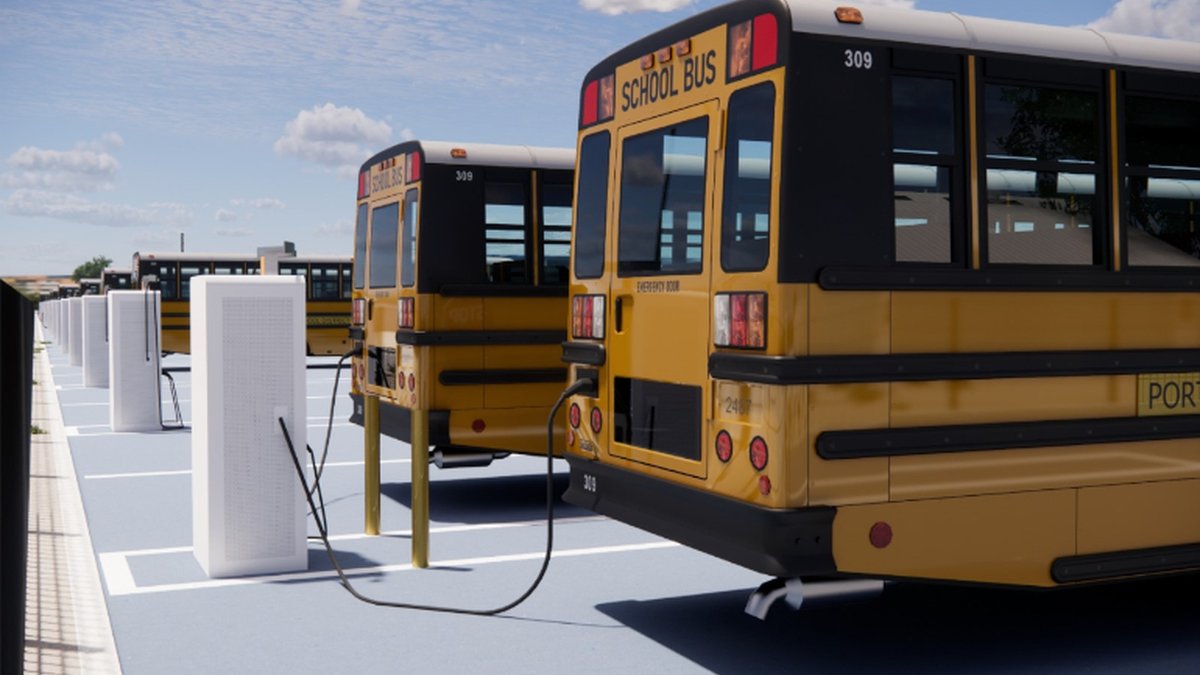
Porterville Unified School District (PUSD) in California is working with ForeFront Power to develop a solar, battery storage and EV charging fleet project to meet the district’s energy, transportation and resilience needs with clean, renewable, lower-cost electricity.
The project is being funded in part via a U.S. EPA Clean School Bus (CSB) Program grant, which the district secured with support from CALSTART, a nonprofit organization that connects businesses, government agencies and industry partners to accelerate the adoption of clean transportation technologies. PUSD is also working with The Mobility House (TMH), an independent charge management provider.
The PUSD Zero-Emission Transportation Infrastructure Project and Microgrid will include a 763-kW solar array mounted on existing shade structures at the district’s north and south parking lots, along with a 408-kW/1,632-kWh battery storage system to store solar energy, provide resiliency and discharge power to shave peak demand. A microgrid controller will enable the facility to disconnect from Southern California Edison’s electrical grid when needed, drawing power directly from PUSD’s on-site solar energy and battery storage assets.
The solar-plus-storage system will support 35 DC fast charger ports to serve the district’s planned fleet of electric school buses. These fast chargers will be connected to The Mobility House’s charge management system, ChargePilot, which will enable the fleet to draw power directly from PUSD’s on-site energy systems in tandem with grid electricity. The EV charging infrastructure will also include eight charging ports in the north parking lot that will serve the district’s “white fleet.” Two of the eight chargers will feature bidirectional charging capability, storing and discharging power back to the grid with vehicle-to-grid services (V2G).
Both V2G and microgrid technologies are integral to Porterville’s resiliency strategy, which includes protecting the broader community in the event of emergencies and power outages, such as public safety power shutoff (PSPS) events.
“We are excited to advance this important infrastructure project, which supports the district’s long-term goals for sustainability, energy resiliency, and responsible stewardship of public resources,” said Brad Rohrbach, PUSD assistant superintendent of business services. “This project represents a significant investment in our students, schools, and community, while helping position the district for a more efficient and sustainable future.”
Designed, engineered, and developed by ForeFront Power, the future project is designed for an expected lifetime of 30 years. During this period, PUSD will partner with ForeFront Power for ongoing asset management services. This project will provide PUSD with budget certainty while reducing its dependence on fossil fuels to power its fleet. The transition to electric buses will lower fuel and maintenance costs and provide long-term savings over the project’s lifetime, protecting PUSD’s budget from increasing diesel and utility rates.
“We applaud Porterville USD for pursuing this innovative project for zero-emission infrastructure,” said Dr. Ruben Fontes, CEO at ForeFront Power. “When complete, this clean energy portfolio will serve as a national model for how vulnerable communities can mitigate rising energy and fuel costs, improve public health, meet ambitious climate goals and protect themselves from climate emergencies.”
This upcoming project will also advance PUSD’s Climate Action Pathways for Schools (CAPS) initiative by linking classroom learning, career pathways, and real-world clean energy infrastructure. Through CAPS-aligned project-based units, energy audits, and analysis of the district’s solar, energy storage and EV charging systems, students will use the campus as a living lab to build skills in renewable energy, sustainability and conservation.
Tell Us What You Think!
Sentinel — Human
This article functions as a well-structured report detailing a multi-faceted infrastructure project, demonstrating the characteristic flow of human communication linking technical specifications with stakeholder objectives.