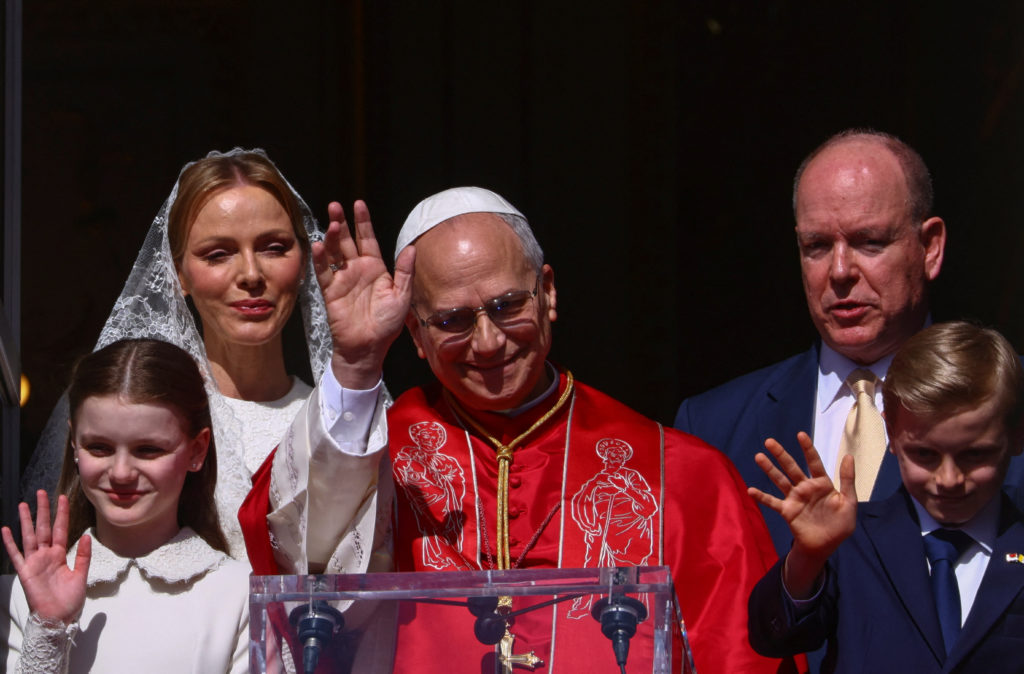
By — Paolo Santalucia, Associated Press Paolo Santalucia, Associated Press By — Nicole Winfield, Associated Press Nicole Winfield, Associated Press Leave your feedback Share Copy URL https://www.pbs.org/newshour/world/pope-leo-xiv-urges-monaco-residents-to-use-wealth-for-good-reject-idolatry-of-power-and-money-fueling-wars Email Facebook Twitter LinkedIn Pinterest Tumblr Share on Facebook Share on Twitter Pope Leo XIV urges Monaco residents to use wealth for good, reject "idolatry of power and money" fueling wars World Mar 28, 2026 12:57 PM EDT MONACO (AP) — Pope Leo XIV urged residents of the principality of Monaco on Saturday to use their wealth and influence for good and reject the "idolatry of power and money" that is fueling wars around the world. Leo made a one-day trip to the glitzy Mediterranean enclave, becoming the first pope to visit since Pope Paul III came in 1538. Prince Albert and Princess Charlene met Leo at the Monaco heliport, just down the coast from the marina that is home to the megayachts of the rich and famous. To celebrate his arrival, a cannon boomed in a ceremonial salute and boats in the marina sounded foghorns that at one point interrupted Leo's remarks. READ MORE: War is reducing international law to 'ashes,' Pope Leo laments in Ash Wednesday liturgy At the palace, members of the royal family stood in the courtyard to greet Leo, the women dressed in black and with lace head coverings. Charlene wore white — a protocol privilege granted by the Vatican to Catholic royal sovereigns when meeting popes, known in diplomatic terms as "le privilège du blanc." In his opening greeting from the palace balcony, Leo urged Monaco to use its wealth, influence and "gift of smallness" to do good in the world. It was important, he said in French, "especially at a historical moment when the display of power and the logic of oppression are harming the world and jeopardizing peace." A reference to abortion in Monaco Speaking later in the cathedral, Leo urged Monaco's Catholics to spread their faith "so that the life of every man and woman may be defended and promoted from conception until natural death," he said. Such terms are used by the Vatican to refer to Catholic teaching opposing abortion and euthanasia. Monaco is one of the few European countries where Catholicism is the official state religion. Prince Albert recently refused a proposal to legalize abortion, citing the important role Catholicism plays in Monaco's society. The decision was largely symbolic because abortion is a constitutional right in France, which surrounds the coastal principality of 2.2 square kilometers (about 1 square mile). READ MORE: In his first Christmas Day message, Pope Leo XIV calls for 'justice, peace and stability' in war-torn areas But in refusing to allow it in Monaco, Albert joined other European Catholic royals who have taken a similar stand over the years to uphold Catholic doctrine on an increasingly secular continent. When Pope Francis visited Belgium in 2024, he announced he was putting the late King Baudouin on the path to possible sainthood because he abdicated for a day in 1990 rather than approve legislation to legalize abortion. Pope urges Monaco to reject idolatry of war A coastal playground for the rich and famous, Monaco is renowned as much for its tax-friendly incentives and Formula 1 Grand Prix as its glamorous royal family. The son of the late American actress Grace Kelly, Albert spoke in perfect, unaccented English when he greeted Leo at the heliport. Leo was heard noting that he landed three minutes late. Leo's visit was designed to highlight how small states such as Monaco and the Holy See can punch above their weight on the global stage. Leo used his homily at Mass in the Monaco stadium to do just that, urging the faithful to reject the type of idolatry that has enslaved people in cycles of war and injustice. Today's wars, "stained with blood, are the fruit of the idolatry of power and money.," he said. "Let us not grow accustomed to the clamor of weapons and images of war! Peace is not merely a balance of power; it is the work of purified hearts, of those who see others as brothers and sisters to be protected, not enemies to be defeated." Though small, Monaco has made its mark as a strong campaigner for environmental protection as well as a supporter of initiatives to help Christians in the Middle East. It is a partner in the Aliph Foundation, which works in particular to rebuild and restore churches and other sites of cultural importance that get damaged or destroyed by conflict. READ MORE: Pope Leo calls for 'deep reflection' about treatment of detained migrants in the United States The government has also been a longtime supporter of church projects in Lebanon organized by l'Œuvre d'Orient, a French-based group that supports bishops, priests and religious orders working in 23 countries. Monaco's population of 38,000 is heavily Catholic and multinational, with only a fifth of the population actually citizens of the principality. On a sunny spring day, many people flocked to the palace grounds to greet Leo, and some lined the streets to wave Vatican and Monaco flags as his open-sided popemobile passed by. Claudine Fiori, Monaco resident, said it was a privilege and an emotional boost to welcome a pope. "His Highness invited him and he came and it was a beautiful surprise," Fiori said. "Thanks to the pope for coming here." Enrico Doja, a Monaco resident of Italian origin, said he appreciated that Leo spoke in French throughout the day. "This means that he is close to the people," he said. "And nowadays the world is unfortunately run mainly by people who are 'one man show,' and his role is to say 'we have to do things together.' " ___ Winfield reported from Rome. A free press is a cornerstone of a healthy democracy. Support trusted journalism and civil dialogue. Donate now By — Paolo Santalucia, Associated Press Paolo Santalucia, Associated Press By — Nicole Winfield, Associated Press Nicole Winfield, Associated Press
MONACO (AP) — Pope Leo XIV urged residents of the principality of Monaco on Saturday to use their wealth and influence for good and reject the "idolatry of power and money" that is fueling wars around the world. Leo made a one-day trip to the glitzy Mediterranean enclave, becoming the first pope to visit since Pope Paul III came in 1538. Prince Albert and Princess Charlene met Leo at the Monaco heliport, just down the coast from the marina that is home to the megayachts of the rich and famous. To celebrate his arrival, a cannon boomed in a ceremonial salute and boats in the marina sounded foghorns that at one point interrupted Leo's remarks. READ MORE: War is reducing international law to 'ashes,' Pope Leo laments in Ash Wednesday liturgy At the palace, members of the royal family stood in the courtyard to greet Leo, the women dressed in black and with lace head coverings. Charlene wore white — a protocol privilege granted by the Vatican to Catholic royal sovereigns when meeting popes, known in diplomatic terms as "le privilège du blanc." In his opening greeting from the palace balcony, Leo urged Monaco to use its wealth, influence and "gift of smallness" to do good in the world. It was important, he said in French, "especially at a historical moment when the display of power and the logic of oppression are harming the world and jeopardizing peace." A reference to abortion in Monaco Speaking later in the cathedral, Leo urged Monaco's Catholics to spread their faith "so that the life of every man and woman may be defended and promoted from conception until natural death," he said. Such terms are used by the Vatican to refer to Catholic teaching opposing abortion and euthanasia. Monaco is one of the few European countries where Catholicism is the official state religion. Prince Albert recently refused a proposal to legalize abortion, citing the important role Catholicism plays in Monaco's society. The decision was largely symbolic because abortion is a constitutional right in France, which surrounds the coastal principality of 2.2 square kilometers (about 1 square mile). READ MORE: In his first Christmas Day message, Pope Leo XIV calls for 'justice, peace and stability' in war-torn areas But in refusing to allow it in Monaco, Albert joined other European Catholic royals who have taken a similar stand over the years to uphold Catholic doctrine on an increasingly secular continent. When Pope Francis visited Belgium in 2024, he announced he was putting the late King Baudouin on the path to possible sainthood because he abdicated for a day in 1990 rather than approve legislation to legalize abortion. Pope urges Monaco to reject idolatry of war A coastal playground for the rich and famous, Monaco is renowned as much for its tax-friendly incentives and Formula 1 Grand Prix as its glamorous royal family. The son of the late American actress Grace Kelly, Albert spoke in perfect, unaccented English when he greeted Leo at the heliport. Leo was heard noting that he landed three minutes late. Leo's visit was designed to highlight how small states such as Monaco and the Holy See can punch above their weight on the global stage. Leo used his homily at Mass in the Monaco stadium to do just that, urging the faithful to reject the type of idolatry that has enslaved people in cycles of war and injustice. Today's wars, "stained with blood, are the fruit of the idolatry of power and money.," he said. "Let us not grow accustomed to the clamor of weapons and images of war! Peace is not merely a balance of power; it is the work of purified hearts, of those who see others as brothers and sisters to be protected, not enemies to be defeated." Though small, Monaco has made its mark as a strong campaigner for environmental protection as well as a supporter of initiatives to help Christians in the Middle East. It is a partner in the Aliph Foundation, which works in particular to rebuild and restore churches and other sites of cultural importance that get damaged or destroyed by conflict. READ MORE: Pope Leo calls for 'deep reflection' about treatment of detained migrants in the United States The government has also been a longtime supporter of church projects in Lebanon organized by l'Œuvre d'Orient, a French-based group that supports bishops, priests and religious orders working in 23 countries. Monaco's population of 38,000 is heavily Catholic and multinational, with only a fifth of the population actually citizens of the principality. On a sunny spring day, many people flocked to the palace grounds to greet Leo, and some lined the streets to wave Vatican and Monaco flags as his open-sided popemobile passed by. Claudine Fiori, Monaco resident, said it was a privilege and an emotional boost to welcome a pope. "His Highness invited him and he came and it was a beautiful surprise," Fiori said. "Thanks to the pope for coming here." Enrico Doja, a Monaco resident of Italian origin, said he appreciated that Leo spoke in French throughout the day. "This means that he is close to the people," he said. "And nowadays the world is unfortunately run mainly by people who are 'one man show,' and his role is to say 'we have to do things together.' " ___ Winfield reported from Rome. A free press is a cornerstone of a healthy democracy. Support trusted journalism and civil dialogue. Donate now
Facts Only
Pope Leo XIV visited Monaco on March 28, 2026, marking the first papal visit since Pope Paul III in 1538.
Prince Albert and Princess Charlene greeted Leo at the Monaco heliport, with ceremonial cannon fire and foghorns from the marina.
Princess Charlene wore white, a Vatican-granted privilege ("le privilège du blanc") for Catholic royal sovereigns meeting popes.
Leo addressed residents from the palace balcony, urging them to use wealth and influence for good and reject the "idolatry of power and money."
In the cathedral, Leo advocated for Catholic teachings opposing abortion and euthanasia, framing life as sacred "from conception until natural death."
Monaco is one of few European countries with Catholicism as the official state religion.
Prince Albert recently rejected a proposal to legalize abortion, citing Catholic values, though abortion remains legal in surrounding France.
Leo celebrated Mass in Monaco’s stadium, condemning wars as products of power and money idolatry.
Monaco supports environmental initiatives and the Aliph Foundation, which restores cultural sites damaged by conflict.
The principality’s population is 38,000, heavily Catholic and multinational, with only 20% being citizens.
Residents lined streets to greet Leo, with some expressing emotional appreciation for the visit.
Leo spoke in French throughout the day, which residents interpreted as a sign of accessibility.
Executive Summary
Pope Leo XIV made a historic one-day visit to Monaco, the first papal visit since 1538, where he urged residents to leverage their wealth and influence for global good while condemning the "idolatry of power and money" driving modern conflicts. Addressing Prince Albert, Princess Charlene, and the public, Leo emphasized Monaco’s potential to promote peace despite its small size, framing his message within broader Catholic teachings on social justice and opposition to abortion. Monaco, a Catholic state surrounded by France, recently reaffirmed its anti-abortion stance, aligning with Vatican doctrine. The visit highlighted Monaco’s role in environmental advocacy and support for Middle Eastern Christians, while Leo’s homily critiqued war as a product of materialism and called for solidarity. Residents expressed pride in the papal visit, viewing it as a moral and communal uplift.
The event underscored tensions between Catholic doctrine and secular European norms, with Prince Albert’s refusal to legalize abortion mirroring actions by other Catholic royals. Leo’s rhetoric framed wealth as a tool for justice, contrasting with Monaco’s reputation for luxury and tax havens. The visit also served as a diplomatic showcase for small states’ global influence, with Monaco’s partnerships in cultural preservation and humanitarian aid cited as examples. While celebratory, the visit’s messaging carried implicit critiques of geopolitical power structures and consumerist excess.
Full Take
**Steelman:** The narrative presents Pope Leo XIV’s visit as a moral call to action, leveraging Monaco’s symbolic wealth to critique global power structures and reaffirm Catholic social teachings. The framing is coherent: a small, affluent state’s influence is juxtaposed with the Vatican’s own diplomatic "soft power," both advocating for peace and human dignity. The inclusion of Monaco’s anti-abortion stance and humanitarian work adds depth, showing how doctrine intersects with policy.
**Pattern Scan:** The article employs subtle emotional framing—describing Monaco as a "coastal playground for the rich and famous" while contrasting it with Leo’s calls for justice. This could risk a *ARC-0024 Ambiguity* pattern, where the tension between luxury and morality is left unresolved, allowing readers to project their own biases. However, the piece avoids overt manipulation, presenting facts neutrically. The focus on Catholic doctrine (e.g., abortion) without counter-perspectives might hint at *ARC-0043 Motte-and-Bailey*—defending a broad moral stance while retreating to doctrinal specifics when challenged.
**Root Cause:** The paradigm here is the Vatican’s enduring strategy of moral suasion through symbolic diplomacy. The unstated assumption is that wealth and influence are morally neutral tools, which can be redirected toward justice—a classic Catholic social teaching. Historically, this echoes papal visits to affluent nations (e.g., Francis in the U.S.), where economic critique is tempered by calls for individual conversion.
**Implications:** For human agency, Leo’s message implies that even privileged actors bear responsibility for global justice. The cost is borne by those who resist this framing—secularists, pro-choice advocates, or critics of Vatican influence. Second-order effects could include heightened debate over Monaco’s role in tax havens or its alignment with Vatican policies on gender and bioethics.
**Bridge Questions:**
1. How might Monaco’s residents reconcile their principality’s tax policies with Leo’s critique of wealth idolatry?
2. What counter-narratives exist about small states’ global influence—do they risk being co-opted by larger powers under the guise of "moral leadership"?
3. If abortion is legally accessible in France, does Monaco’s symbolic ban serve a theological purpose or a political one?
**Counterstrike Scan:** A bad actor pushing this narrative might amplify the contrast between Monaco’s wealth and Leo’s moral appeals to stoke class resentment or anti-Catholic sentiment. However, the article’s tone remains descriptive, avoiding such exploitation. The content aligns with standard Vatican messaging rather than a coordinated influence campaign.
**Patterns detected:** *ARC-0024 Ambiguity* (unresolved tension between wealth and morality), *ARC-0043 Motte-and-Bailey* (broad moral critique narrowed to doctrinal specifics).