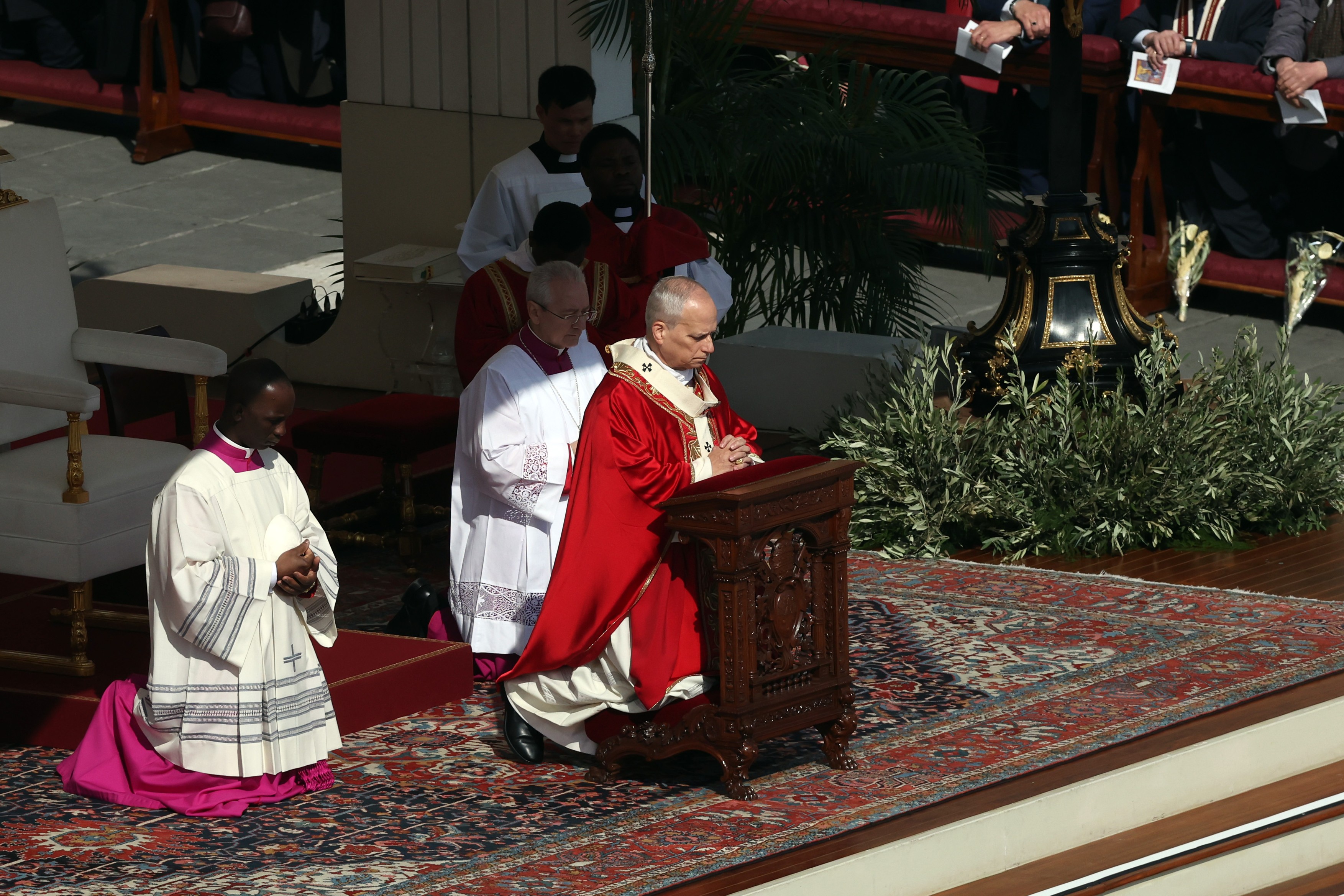
Papa Leon a spus că Dumnezeu respinge rugăciunile liderilor care încep războaie și au „mâinile pătate de sânge”, într-o declarație neobișnuit de dură în contextul în care războiul din Iran a intrat în a doua lună, notează Reuters.
Vorbind către zecile de mii de oameni din Piața Sfântul Petru în Duminica Floriilor, sărbătoarea care deschide cea mai sfântă săptămână a anului în perioada premergătoare Paștelui pentru cei 1,4 miliarde de catolici din lume, suveranul pontif a spus că Iisus nu poate fi folosit pentru a justifica niciun război.
Papa a cerut oprirea imediată a războiului din Iran
„Acesta este Dumnezeul nostru: Iisus, Regele Păcii, care respinge războiul, pe care nimeni nu-l poate folosi pentru a justifica războiul”, a spus Leon, primul papă american, mulțimii adunate sub un soare strălucitor.
„(Iisus) nu ascultă rugăciunile celor care poartă război, ci le respinge, spunând: «Chiar dacă vă rugați mult, nu vă voi asculta: mâinile voastre sunt pline de sânge»”, a spus el, citând un pasaj din Biblie.
Leon nu a pomenit numele niciunui lider mondial, dar în ultimele săptămâni și-a intensificat criticile la adresa războiului din Iran.
Papa, cunoscut pentru faptul că își alege cuvintele cu grijă, a cerut în repetate rânduri un armistițiu imediat în conflict și a declarat luni că loviturile aeriene sunt nediscriminatorii și ar trebui interzise.
„Iisus nu a purtat niciun război”
Unii oficiali americani s-au folosit de motive creștine pentru a justifica atacurile comune ale SUA și Israelului asupra Iranului din 28 februarie.
Secretarul american al Apărării, Pete Hegseth, care a început să conducă slujbe de rugăciune creștine la Pentagon, s-a rugat miercuri pentru „o violență copleșitoare împotriva celor care nu merită milă”.
Duminică, Leon a făcut referire la un pasaj din Biblie în care Iisus, pe punctul de a fi arestat înainte de crucificare, l-a mustrat pe unul dintre discipolii săi pentru că l-a lovit cu sabia pe cel care îl aresta.
„(Iisus) nu s-a înarmat, nu s-a apărat și nu a purtat niciun război. El a revelat chipul blând al lui Dumnezeu, care respinge întotdeauna violența. În loc să se salveze, a permis să fie răstignit pe cruce”, a spus Leon.
Facts Only
Pope Leo spoke to tens of thousands in St. Peter’s Square during Palm Sunday.
He stated that God rejects the prayers of leaders who start wars, citing biblical passages.
The Pope declared that Jesus cannot be used to justify any war.
He called for an immediate ceasefire in the Iran war, which has lasted over two months.
Pope Leo criticized airstrikes as indiscriminate and called for their prohibition.
He referenced a biblical moment where Jesus rebuked a disciple for using a sword.
U.S. Defense Secretary Pete Hegseth led Christian prayer services at the Pentagon and prayed for "overwhelming violence" against enemies.
Some U.S. officials have used Christian justifications for the U.S.-Israel coalition’s attacks on Iran since February 28.
Pope Leo did not name specific leaders but has repeatedly criticized the Iran war.
The Pope is the first American to hold the papacy.
Palm Sunday marks the start of Holy Week for 1.4 billion Catholics worldwide.
The Pope’s remarks were delivered under sunny weather in Vatican City.
Executive Summary
Pope Leo delivered a strong condemnation of war during Palm Sunday, declaring that God rejects the prayers of leaders who initiate conflicts, citing biblical passages to emphasize that Jesus represents peace and cannot be used to justify violence. Speaking to tens of thousands in St. Peter’s Square, he called for an immediate ceasefire in the Iran war, now in its second month, and criticized airstrikes as indiscriminate. While not naming specific leaders, his remarks follow repeated calls for an armistice and critiques of the U.S.-Israel coalition’s military actions, which some American officials have framed in Christian terms. U.S. Defense Secretary Pete Hegseth, for instance, recently prayed for "overwhelming violence" against perceived enemies. Pope Leo contrasted this with Jesus’ rejection of violence, referencing the biblical moment when Jesus rebuked a disciple for using a sword. The Pope’s stance underscores a growing tension between religious justifications for war and the Vatican’s advocacy for peace.
The conflict in Iran has drawn global attention, with Pope Leo’s intervention highlighting the moral dimensions of the war. His comments reflect a broader Vatican effort to position itself as a mediator, though his direct condemnation of war leaders marks a rare escalation in rhetoric. The juxtaposition of religious imagery—such as Palm Sunday’s symbolism of peace—with the realities of modern warfare underscores the Pope’s appeal to both faith and humanitarian principles. However, the effectiveness of such moral appeals remains uncertain, as geopolitical and military dynamics often override ethical considerations.
Full Take
The strongest version of this narrative is Pope Leo’s principled stance against war, framed within a coherent theological and moral argument. By invoking Jesus’ rejection of violence and biblical condemnations of bloodshed, he grounds his critique in a tradition that transcends partisan politics. His call for an immediate ceasefire in Iran is consistent with the Vatican’s historical role as a moral authority, and his refusal to name specific leaders avoids unnecessary polarization while still targeting the broader issue of war. The contrast with U.S. officials like Hegseth, who explicitly blend religious rhetoric with calls for violence, sharpens the moral clarity of the Pope’s message. This is a rare moment where religious leadership directly challenges the weaponization of faith for geopolitical ends.
However, the narrative also exhibits patterns of emotional exploitation (ARC-0012) and moral framing (ARC-0031). The Pope’s use of Palm Sunday—a symbol of peace and sacrifice—to condemn war is strategically timed to maximize emotional resonance. The juxtaposition of Jesus’ pacifism with modern warfare creates a powerful but potentially oversimplified binary: peace as divine, war as inherently sinful. This risks dismissing complex just-war theories or the nuanced debates within Christian ethics about self-defense and intervention. Additionally, the framing of the Iran war as a moral failing without deeper geopolitical context could be seen as a form of semantic manipulation (ARC-0024), where the focus on individual leaders’ sins obscures systemic causes like resource conflicts or regional power struggles.
The root cause here is the tension between religious moral authority and state power. The Pope’s narrative assumes that spiritual appeals can—or should—override geopolitical realities, an assumption that may underestimate the entrenched interests driving conflict. Historically, this echoes the Catholic Church’s shifting role from justifying crusades to advocating for peace, reflecting broader societal moves toward secular humanism. The implications for human agency are significant: if moral leadership can sway public opinion, it might pressure governments to reconsider military actions. But the cost is borne by those in war zones, where abstract theological debates offer little immediate relief.
Bridge questions: How might the Pope’s message be received in Iran or among those directly affected by the war? Would his critique carry the same weight if applied to other conflicts, such as Ukraine or Gaza? What would it take for religious moral authority to translate into tangible policy changes?
Counterstrike scan: A coordinated influence campaign would likely amplify the Pope’s moral condemnation to undermine U.S. or Israeli legitimacy, framing the war as a religiously unjustified aggression. The actual content aligns with this pattern in its selective focus on the U.S.-Israel coalition’s actions while omitting broader context (e.g., Iran’s role in regional conflicts). However, the Pope’s consistent pacifist stance and lack of partisan targeting suggest this is not a deliberate manipulation but a genuine moral appeal. The risk lies in how adversarial actors might weaponize his words for their own ends.