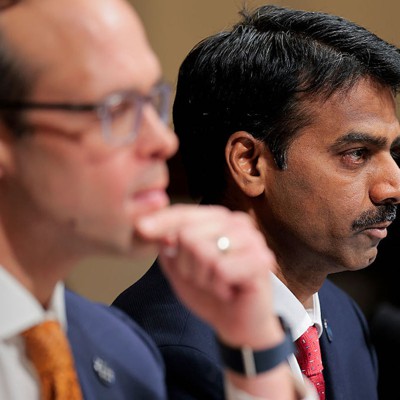
“We are pleased that the CISA personnel punished by previous DHS and CISA leadership for doing their jobs have been cleared of wrongdoing and invited back to work, as we demanded three months ago,” said a joint statement from Democratic Reps. Bennie Thompson and Eric Swalwell.
The Department of Homeland Security has dropped a probe into seven Cybersecurity and Infrastructure Security Agency staffers who were placed on leave after arranging a counterintelligence polygraph exam that the agency’s former acting director failed, according to two DHS officials familiar with the matter.
The investigation was closed about a week ago and the staffers were cleared, one of the officials said. Both spoke on the condition of anonymity because they weren’t authorized to communicate details of the non-public investigation.
The move is a major reprieve for CISA staff who arranged the counterintelligence polygraph for then-acting director Madhu Gottumukkala. Gottumukkala failed the polygraph in July 2025, which was needed for access to a highly sensitive intelligence program.
The staff involved were subsequently placed on leave. At least five career CISA staff members and one contractor involved in scheduling or approving the polygraph examinations were impacted, and received letters from DHS Acting Chief Security Officer Michael Boyajian informing them their security clearances were suspended.
The news of the investigation being dropped was first reported by Politico, which also first reported the initial story about the polygraph incident late last year.
“The investigation has concluded, and this matter has been handled internally,” a DHS spokesperson said.
Nextgov/FCW has also asked Gottumukkala for comment.
“We are pleased that the CISA personnel punished by previous DHS and CISA leadership for doing their jobs have been cleared of wrongdoing and invited back to work, as we demanded three months ago,” said a joint statement from Reps. Bennie Thompson, D-Miss., and Eric Swalwell, D-Calif., top lawmakers on the House Homeland Security Committee that has jurisdiction over CISA.
“We cannot, and will not, tolerate political leadership punishing career employees for faithfully executing their security mission,” they added. “We thank the career employees for their continued service and express our sincere regrets for the turmoil they experienced over the past several months.”
“Nonpartisan civil servants should never be targeted for political reasons,” Rep. James Walkinshaw, D-Va., said in an X post responding to news of the probe’s dismissal.
The polygraph incident was among a smattering of other matters reported in recent months by Politico about Gottumukkala’s tenure. Last month, Gottumukkala was moved into a strategic implementation role in DHS, and executive assistant director for cybersecurity Nick Andersen took his place leading CISA in an acting capacity.
Nextgov/FCW could not determine if all affected staffers would choose to return to CISA. It’s also possible that some of them resigned in full and would not go back to public service.
CISA remains without permanent leadership. Earlier this month, CISA director nominee Sean Plankey told Nextgov/FCW that he left a role in the Coast Guard to address concerns from a Republican senator with a hold on his nomination, but the status of that hold is unclear.
DHS, which houses CISA, got new leadership last week after Oklahoma Republican Senator Markwayne Mullin was confirmed to the post in a 54-45 vote.
Facts Only
The Department of Homeland Security (DHS) dropped an investigation into seven CISA staffers who were placed on leave after arranging a counterintelligence polygraph exam.
The exam was failed by former acting CISA director Madhu Gottumukkala in July 2025.
The polygraph was required for access to a highly sensitive intelligence program.
At least five career CISA employees and one contractor were impacted, with their security clearances suspended.
The investigation concluded about a week ago, clearing the staffers of wrongdoing.
DHS Acting Chief Security Officer Michael Boyajian issued letters suspending the staffers' clearances.
Democratic Reps. Bennie Thompson and Eric Swalwell issued a joint statement praising the decision to clear the staffers.
The staffers were invited to return to work, though it is unclear if all will choose to do so.
Gottumukkala was reassigned to a strategic implementation role within DHS, with Nick Andersen taking over as acting CISA director.
CISA remains without permanent leadership, with nominee Sean Plankey’s confirmation status uncertain.
DHS confirmed Oklahoma Republican Senator Markwayne Mullin as the new DHS leader in a 54-45 vote.
Executive Summary
The Department of Homeland Security (DHS) has concluded an investigation into seven Cybersecurity and Infrastructure Security Agency (CISA) staffers who were placed on administrative leave after arranging a counterintelligence polygraph exam for former acting CISA director Madhu Gottumukkala. The exam, which Gottumukkala failed in July 2025, was required for access to a highly sensitive intelligence program. The staffers, including at least five career employees and one contractor, had their security clearances suspended pending the investigation. The probe was closed about a week ago, with the staffers cleared of wrongdoing and invited to return to work. Democratic lawmakers, including Reps. Bennie Thompson and Eric Swalwell, praised the decision, emphasizing that career employees should not face retaliation for performing their duties. The incident is part of broader scrutiny surrounding Gottumukkala’s tenure, which included his reassignment to a strategic role within DHS. CISA remains without permanent leadership, with Nick Andersen currently serving as acting director. The status of the affected staffers' return remains uncertain, as some may have resigned or chosen not to return to public service.
The situation highlights tensions between political appointees and career civil servants, particularly in sensitive national security roles. While DHS has framed the matter as resolved internally, questions linger about the initial decision to suspend the staffers and the broader implications for whistleblower protections and institutional accountability. The political response underscores bipartisan concerns about the treatment of nonpartisan employees, though the long-term impact on CISA’s operational stability remains unclear.
Full Take
The strongest version of this narrative centers on institutional accountability and the protection of career civil servants from political retaliation. The DHS investigation’s conclusion validates the staffers’ actions, reinforcing the principle that nonpartisan employees should not be punished for fulfilling their duties. The political response, particularly from Democratic lawmakers, frames this as a victory for institutional integrity, contrasting it with what they imply was politically motivated discipline under previous leadership. The narrative gains credibility from the explicit acknowledgment of the staffers’ reinstatement and the bipartisan concern over their treatment.
However, the pattern scan reveals potential elements of **ARC-0024 Ambiguity** and **ARC-0043 Motte-and-Bailey**. The ambiguity lies in the lack of clarity around why the staffers were initially suspended—was it procedural, retaliatory, or a genuine counterintelligence concern? The "motte-and-bailey" dynamic emerges in how the narrative oscillates between a narrow focus on the polygraph incident and broader implications about political interference in national security agencies. The article does not explore whether the polygraph failure itself raised legitimate concerns or if the suspension was purely punitive.
The root cause appears to be the tension between political appointees and career bureaucrats, a recurring theme in U.S. governance. The unstated assumption is that the staffers were acting in good faith, but the article does not delve into whether the polygraph process was followed correctly or if Gottumukkala’s failure warranted further scrutiny. Historically, this echoes past conflicts where civil servants clash with leadership over security protocols, often framed as whistleblowing versus insubordination.
The implications for human agency are significant: career employees may feel emboldened to resist political pressure, but the episode also risks chilling proactive security measures if staff fear retaliation. The beneficiaries here are the reinstated staffers and advocates for civil service protections, while the costs are borne by institutional trust—both in DHS’s handling of the matter and in the polygraph process itself. Second-order consequences could include heightened scrutiny of CISA’s leadership transitions and potential reluctance among staff to engage in sensitive security procedures.
Bridge questions: What safeguards exist to prevent similar incidents in the future? How should agencies balance accountability with protecting employees who follow protocol? Would the narrative change if evidence emerged that the polygraph process was flawed or misapplied?
Counterstrike scan: A coordinated influence campaign would likely amplify the "persecuted civil servant" angle while downplaying any legitimate counterintelligence concerns. The actual content aligns partially with this pattern but includes enough procedural detail (e.g., the polygraph’s purpose, the staffers’ reinstatement) to avoid outright manipulation. No structural alignment with a hypothetical attack playbook is detected.
Sentinel — Human
The article exhibits strong human-authored traits, including natural stylistic variation, specific sourcing, and contextual nuance, with minimal stylometric or coherence red flags.