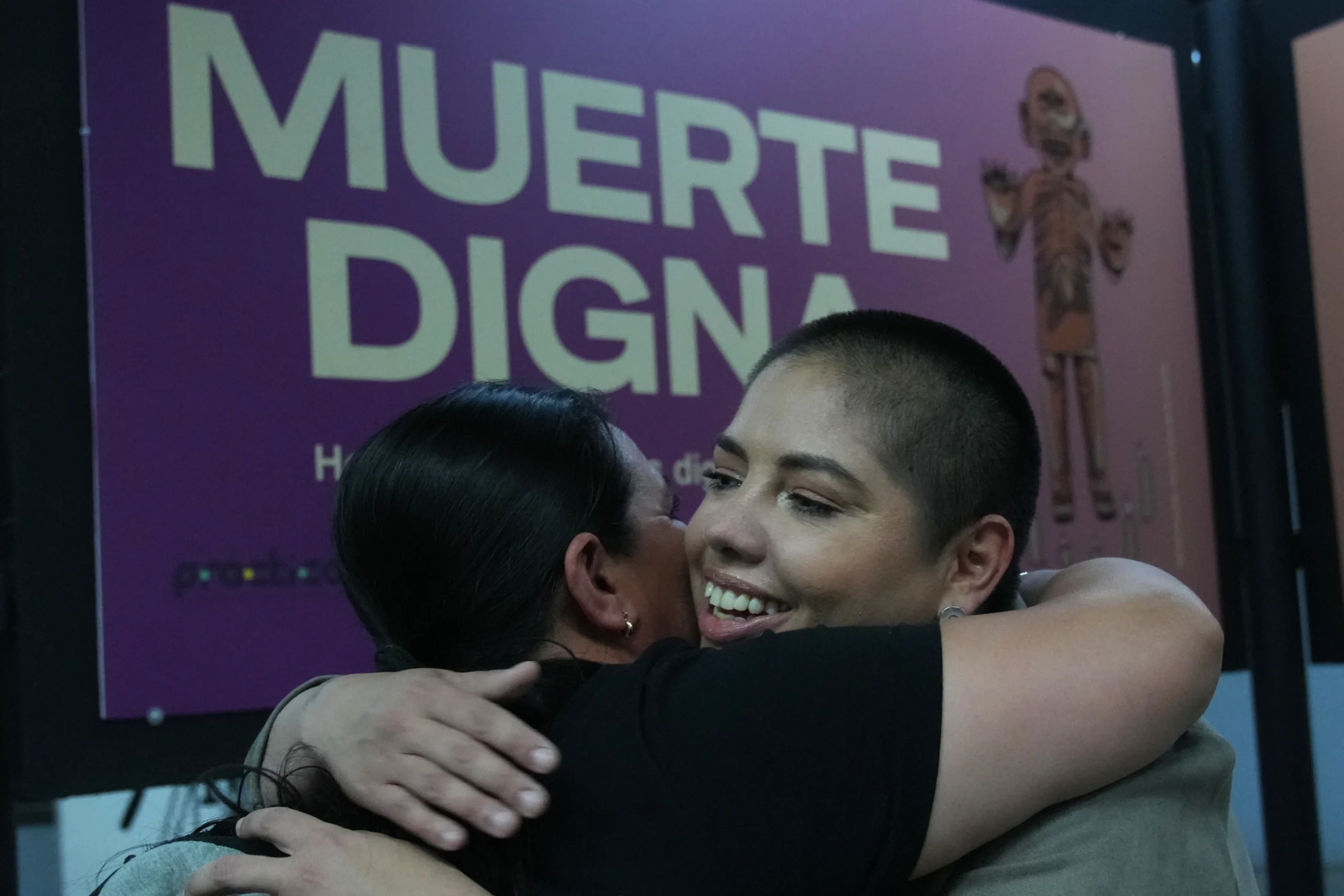
SÃO PAULO, Brazil – As a bill to decriminalize euthanasia in Mexico appears to be gaining momentum, the Church is seeking to mobilize Catholics to defend life, betting that most Mexicans still believe it is their responsibility to care for their elderly and sick relatives.
On Apr. 25, at least 2,000 demonstrators took part in the 15th edition of the Mexican March for Life in Mexico City, protesting the decriminalization of abortion in the nation’s capital 19 years ago and the potential legalization of euthanasia.
The Archdiocese of Mexico City had invited Catholics to join the demonstration in an editorial published in its house organ, Desde la Fe (“From the Faith”).
In the article, the archdiocese said that “abortion, euthanasia and suicide are plagues that strike our humanity under the guise of being valid alternatives in the face of suffering.”
“We do not judge those who resort to any of these options, because suffering exists, and it is extremely important to support the pregnant woman who feels alone or emotionally distressed, the sick person who feels they have no way out, and anyone experiencing some form of depression,” the editorial read.
Activist Samara Martinez, 31, introduced the bill — known as Ley Trasciende por una muerte digna en México (Transcend Law for a Dignified Death in Mexico) — in the Senate last year.
Suffering from several incurable diseases, she has undergone two failed kidney transplants and now must undergo 10-hour hemodialysis sessions every day to remain alive.
Her initiative received support from 128,000 citizens and 2,000 healthcare professionals. At a Senate conference on Apr. 23, Martinez and several experts debated the bill with lawmakers and members of civil society.
Senator Emmanuel Reyes Carmona, of the left-wing Morena party — the same party as President Claudia Sheinbaum — said during the event that most of his colleagues support the measure and that “quantitative and qualitative research” shows that 70 percent of Mexicans support the idea as well.
A request for euthanasia would need to be submitted by the patient and their family, and a bioethics committee would be responsible for evaluating each case before allowing the process to proceed. According to the bill, euthanasia would not exclude parallel approaches, including palliative care.
In 2023, Mexican legislators attempted to legalize euthanasia but were unsuccessful. In other parts of Latin America, however, pro-euthanasia activists and politicians have had more success: in 2022, assisted suicide became legal in Colombia; in 2024, Ecuador approved euthanasia.
Father Alejandro Alvarez, a member of the National Life Pastoral Ministry team, told Crux Now that he does not believe most of Mexico’s population supports euthanasia.
“The atmosphere in the country is not favorable to it. We are people who care about our elders, about our sick relatives. Unlike in other parts of the world, we still have the custom here of taking care of our family members,” Alvarez said.
The Church has several groups and organizations dedicated to defending life and promoting palliative care, and they should be heard during the sessions debating the bill, he added.
“The Church will always advocate for life. In the case of chronically ill patients, we defend palliative care. We believe every person in need must receive special attention for their pain,” Alvarez told Crux Now.
He said patients who ask for euthanasia are people who no longer feel loved.
“People who have been left alone in the hospital or even at home often feel unimportant to anyone. They ask themselves: ‘Why am I living?’” Alvarez said.
The priest also questioned the idea of a “dignified death” currently promoted by supporters of euthanasia.
“They say a dignified death is one without suffering. But who said suffering is evil? Suffering is part of living. We have been failing as a society to teach certain values,” he added.
Sister Susana Lúa, who is also a doctor and an expert in palliative care in Guadalajara, has been closely following the debate over the bill.
She is a founding member of Juntos Contra el Dolor (“Together Against Pain”), a Catholic nongovernmental organization that has treated 12,000 patients over its 13-year history.
Unfortunately, palliative care remains very limited in Mexico, she said.
“Only 1.5 percent of Mexicans in need currently have access to palliative care,” she told Crux Now.
Public services also often lack the resources needed to provide palliative care, Lúa said.
“We see medical offices here and there claiming to offer palliative care, but in fact they are worthless,” she said.
At the same time, palliative care is neither especially complex nor expensive, she said. Establishing new services would not take much for the government and civic institutions.
“But what we see is a general lack of a palliative care culture,” she said, adding that most people are still dying at home in subhuman conditions.
“If palliative care is widely seen as a failure, the ‘solution’ becomes euthanasia,” Lúa said.
She said pain is the key factor in that scenario. Over the years, many of her patients have requested euthanasia. But as soon as they began taking pain medication, they stopped requesting death and expressed a desire to live each moment until the end.
“The absence of palliative care is the worst imposition on suffering people,” Lúa said.
On the other hand, a broader ideology of utilitarianism, fueled by the media, has fostered a culture of death.
“If a baby disturbs you, you can abort it. If the elderly are a problem for you, you can subject them to euthanasia. Many people think only about the utility of others now, unfortunately,” she told Crux Now.
Facts Only
A bill to decriminalize euthanasia in Mexico, titled the Transcend Law for a Dignified Death, was introduced in the Senate by activist Samara Martinez.
Martinez suffers from multiple incurable diseases and undergoes daily 10-hour hemodialysis sessions.
The bill has received support from 128,000 citizens and 2,000 healthcare professionals.
On April 25, 2024, at least 2,000 demonstrators participated in the 15th Mexican March for Life in Mexico City, organized by the Archdiocese of Mexico City.
The march protested the decriminalization of abortion in Mexico City 19 years ago and the potential legalization of euthanasia.
The Archdiocese of Mexico City published an editorial in *Desde la Fe* opposing abortion, euthanasia, and suicide.
Senator Emmanuel Reyes Carmona of the Morena party stated that most of his colleagues support the euthanasia bill.
Reyes Carmona cited research suggesting 70% of Mexicans support the idea of euthanasia.
The bill requires patient and family consent, with evaluation by a bioethics committee before euthanasia can proceed.
In 2023, Mexican legislators attempted but failed to legalize euthanasia.
Colombia legalized assisted suicide in 2022, and Ecuador approved euthanasia in 2024.
Only 1.5% of Mexicans in need currently have access to palliative care, according to Sister Susana Lúa, a palliative care expert.
Executive Summary
A bill to decriminalize euthanasia in Mexico, known as the Transcend Law for a Dignified Death, is gaining traction in the Senate. The proposal, introduced by activist Samara Martinez, who suffers from multiple incurable diseases, has garnered support from 128,000 citizens and 2,000 healthcare professionals. Meanwhile, the Catholic Church is mobilizing opposition, with the Archdiocese of Mexico City organizing a March for Life protest attended by at least 2,000 demonstrators. The Church argues that euthanasia undermines societal values of caring for the elderly and sick, while proponents cite public opinion polls suggesting 70% support for the measure. The bill would require patient and family consent, with oversight by a bioethics committee, and would not exclude palliative care. However, palliative care remains severely underdeveloped in Mexico, with only 1.5% of those in need having access. Critics, including Catholic medical professionals, argue that the lack of palliative care is driving demand for euthanasia, while supporters frame it as a matter of personal autonomy and dignity in death.
The debate reflects broader regional trends, with Colombia and Ecuador recently legalizing euthanasia or assisted suicide. In Mexico, previous attempts to legalize euthanasia failed in 2023, but the current political climate, with left-wing President Claudia Sheinbaum’s party supporting the bill, may shift the outcome. The Church’s opposition centers on moral and cultural grounds, emphasizing Mexico’s tradition of familial care, while proponents highlight the suffering of patients like Martinez, who endure daily medical treatments to stay alive. The discussion also touches on societal attitudes toward suffering, with religious leaders questioning the framing of a "dignified death" as one without pain, arguing that suffering is an inherent part of life.
Full Take
The strongest version of this narrative presents euthanasia as a compassionate response to unbearable suffering, framed as a matter of personal autonomy and dignity. Proponents like Samara Martinez, whose daily medical ordeal underscores the human cost of prolonged illness, argue that legalizing euthanasia would provide relief for those facing incurable conditions. The bill’s supporters also cite public opinion data and regional precedents, positioning Mexico as potentially joining a growing Latin American trend toward legalization. The Church’s counter-narrative, however, appeals to cultural values, emphasizing Mexico’s tradition of familial care and framing euthanasia as a societal failure to uphold the sanctity of life. This tension reveals deeper ideological divides: between individual rights and communal responsibility, and between medical intervention and moral absolutes.
Patterns detected: ARC-0024 Ambiguity (in the framing of "dignified death" as either a medical or moral concept), ARC-0043 Motte-and-Bailey (shifting between "compassion for suffering" and "personal autonomy" as justifications).
The root cause of this debate lies in competing visions of human dignity—whether it is defined by the absence of suffering or by the intrinsic value of life, regardless of condition. The lack of palliative care in Mexico (only 1.5% access) suggests systemic neglect, where euthanasia may appear as a "solution" to a problem that could be addressed through better healthcare infrastructure. The Church’s argument hinges on the idea that suffering, while painful, is not inherently undignified—a claim that challenges modern utilitarian ethics. Meanwhile, the bill’s proponents leverage emotional narratives (e.g., Martinez’s plight) to bypass broader questions about societal obligations to the sick.
Second-order implications include the potential normalization of euthanasia as a cost-saving measure in underfunded healthcare systems, as well as the erosion of trust in medical institutions if palliative care remains inadequate. Who benefits? Politicians gain progressive credentials; activists achieve policy wins. Who bears costs? Vulnerable patients who may feel pressured into euthanasia due to lack of alternatives.
Bridge questions: How might improved palliative care change public support for euthanasia? What safeguards would prevent coercion in end-of-life decisions? If dignity is subjective, whose definition should prevail—individuals, families, or the state?
Counterstrike scan: A coordinated influence campaign would exploit emotional narratives (e.g., Martinez’s suffering) while downplaying systemic failures in palliative care. The actual content aligns partially with this pattern, as the bill’s framing emphasizes personal stories over structural solutions. However, the inclusion of Church opposition and palliative care critiques suggests a balanced rather than manipulative presentation.
Sentinel — Human
This is a well-contextualized report synthesizing complex political, religious, and medical arguments surrounding euthanasia in Mexico, showing strong evidence of human journalistic structure and synthesis.