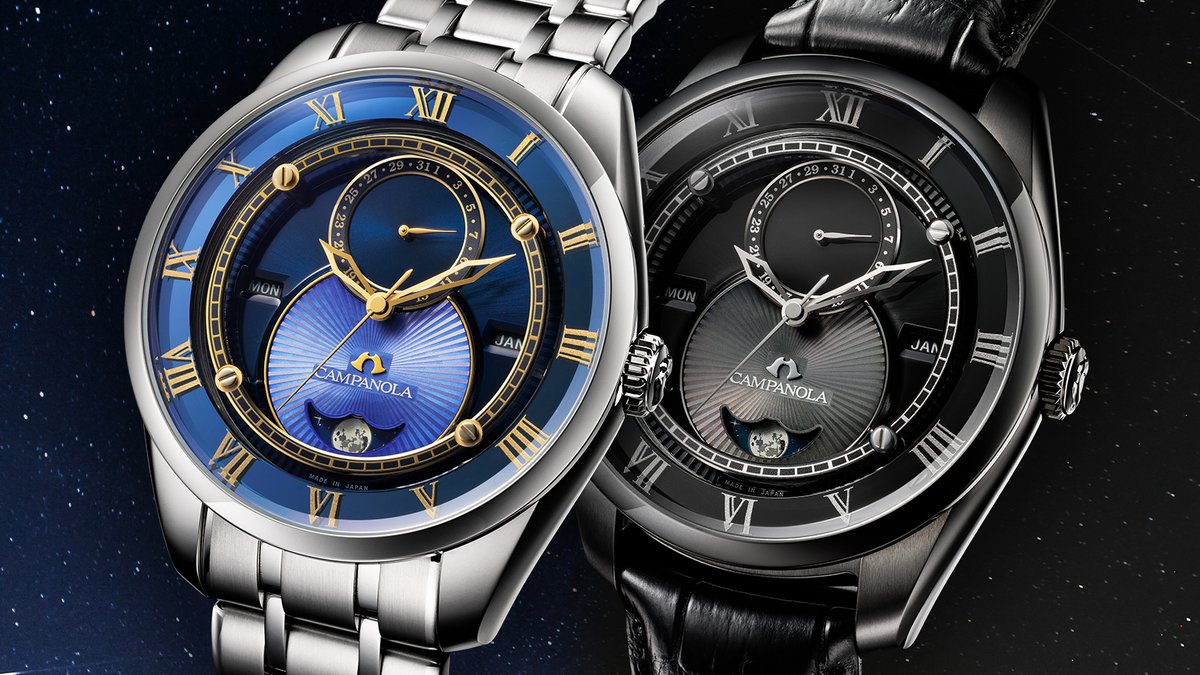
Triple calendar with high-end tech.Citizen’s quirky high-end marque back with a pair of limited edition Eco-Drive complications — the Campanola Kōjō ref. BU0020-71N in stainless steel with blue dial, and the blacked-out ref. BU0024-02N, inspired by shooting stars.
Campanola’s sculptural approach to dials is alive and well, proving Citizen’s ongoing technical leadership in the field of solar-powered watches.
Initial thoughts
Launched in the year 2000, Campanola is an astronomically inclined sub-brand of Citizen Watch Co. combining usual features, the movements are typically solar powered, but the watches are hand assembled and often decorated with traditional artisanal techniques like maki-e lacquer.
In the last decade, the brand has branched out into mechanical watches which maintained the Campanola design language and external quality — the Kasanekyo 20th Anniversary limited edition features one of my favourite raden lacquer dials.
However, some of the brand’s mechanical watches were arguably diminished by the use of generic Swiss automatic movements like the Sellita SW300-1, which was paired with a Jaquet big-date module in the aforementioned Kasanekyo 20th Anniversary limited edition. While such watches will appeal more to mechanical watch fans, they lack the distinctly Japanese character of Campanola’s traditional offerings.
This limited edition duo is a return to form for the brand, with complicated Eco-Drive calibres that offer the full Campanola experience, as well as better value. Of course, that comes with the usual tradeoffs, namely a 14.8 mm case height. That is mitigated by the rather wide 43.5 mm case diameter, which makes the height proportionally reasonable for those who have the wrists for it.
That said, considering the Kōjō’s obvious merits in construction and technology — specifically its solar-powered movement and lengthy power save mode — the simple triple calendar complication feels like a step down from the brand’s earlier quartz perpetual calendar watches, including in the first Campanola offerings from 2000.
Dark and darker
The Kōjō offers the choice between two flavours: a bracelet-borne bare stainless steel case with blue dial or a Duratect DLC-coated stainless steel case on a crocodile leather strap. The former is limited to 250 pieces, and 170 for the latter. While the price difference between the two references is negligible — both cost the equivalent of about US$2,430 — the black model is more limited.
The smaller edition size and Duratect coating explain its higher price, despite the lack of a bracelet. It is worth noting that the DLC coating adds considerable scratch resistance, but also makes damage more visible.
This cavernous face — contained by a double-domed sapphire crystal — contributes significantly to the watch’s height, but also its character. A quartet of pillars, topped by the four signature Campanola screws, supports the minute track, allowing more light to reach the solar cells secreted away below. Outside of that is a sapphire chapter ring with Roman numerals printed on the underside.
These electro-formed blue and black dials are inspired by “Kōjō”, which Citizen defines as “the radiant streaks of light that appear when gazing at stars in the night sky”.
Part of this effect comes from the celestial-coded colour choices — blue and black — as well as the radial mother-of-pearl disc that surrounds the moon phase display. More interesting is the subtle tint applied to the underside of the sapphire crystal chapter ring, meant to change colour slightly when viewed from different angles.
While the hands are not especially remarkable by the (very high) standards of Japanese luxury watches, the sweep seconds hand is slightly vaulted and capped.
A proper Campanola calibre
Inside is Citizen’s Eco-Drive cal. 8730. Solar panels concealed in the dial supply a rechargeable lithium battery — often (erroneously) called a capacitor. In this particular watch, light reaches the solar cells through a gap between the dial and chapter ring, instead of passing though a translucent dial. Citizen debuted this technique in in 2012 to allow for more flexibility in dial designs and materials.
The watch can feed on any visible light — not just sunlight — and will keep time for six months on a full charge, thanks to a power-saving mode found on many solar and Kinetic watches, as well as FP Journe’s Élégante. The triple calendar complication includes a moon phase display, and all functions are set from just the crown and a single pusher in the case band.
Key facts and price
Campanola Kōjō Limited Edition
Ref. BU0020-71N
Ref. BU0024-02N (black DLC)
Diameter: 43.5 mm
Height: 14.8 mm
Material: Stainless steel (optional black Duratect DLC coating)
Crystal: Sapphire
Water resistance: 30 m
Movement: Cal. 8730
Features: Hours, minutes, seconds, day, date, month, moon phase.
Frequency: 32,768 Hz
Power Source: Solar
Power reserve: 6 months in power save mode
Strap: Stainless steel bracelet (BU0020-71N), crocodile leather strap (BU0024-02N)
Limited edition: 250 pieces (BU0020-71N) or 170 pieces (BU0024-02N)
Availability: At Citizen boutiques and retailers starting August 2026
Price: JPY385,000 (BU0020-71N) or JPY396,000 (BU0024-02N), excluding taxes
For more, visit Citizenwatch-global.com.
Back to top.
Facts Only
* The watch features a triple calendar complication.
* It is powered by a solar-powered Eco-Drive movement (Cal. 8730).
* The limited edition references are BU0020-71N and BU0024-02N.
* Case diameter is 43.5 mm and height is 14.8 mm.
* Materials include stainless steel, with an option for black Duratect DLC coating.
* The movement has a power reserve of six months in power save mode.
* Power source is solar.
* The watch displays hours, minutes, seconds, day, date, month, and moon phase.
* The limited edition quantities are 250 for BU0020-71N and 170 for BU0024-02N.
* The price is JPY385,000 for BU0020-71N and JPY396,000 for BU0024-02N (excluding taxes).
Executive Summary
Full Take
Sentinel — Human
The text reads as a detailed critical review blending subjective assessment with verifiable product specifications, characteristic of human editorial analysis rather than pure automated generation.