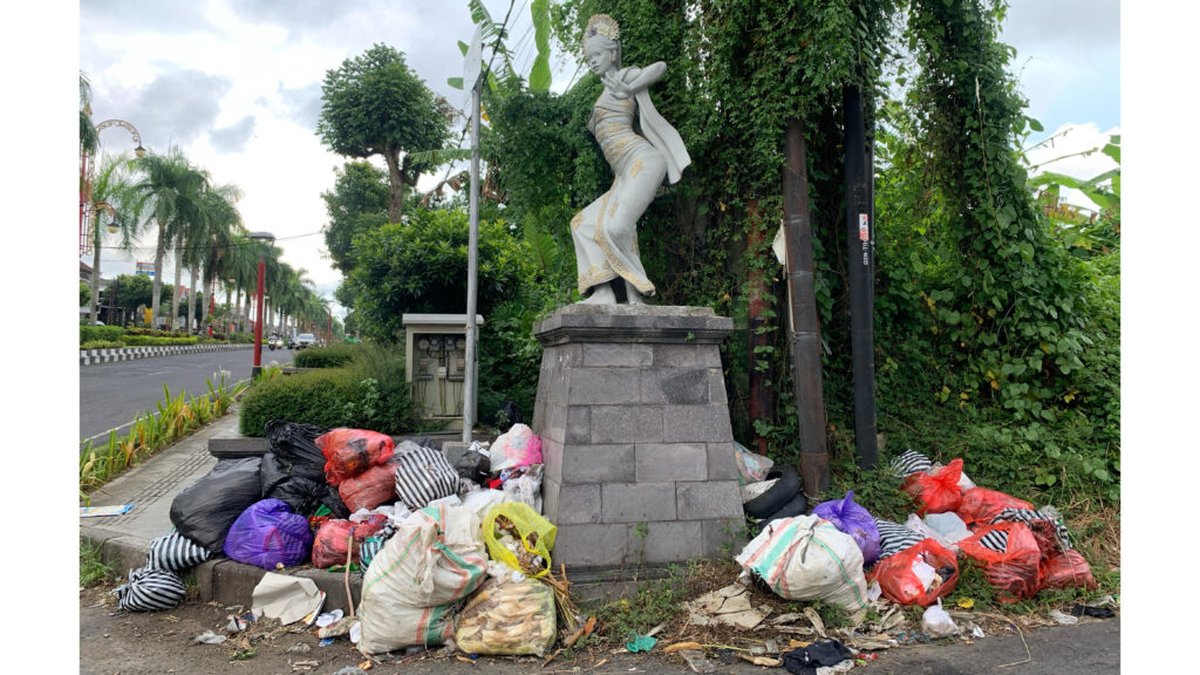
BALI, Indonesia —Piles of trash line the roadsides, plastic floats in rivers and toxic fumes fill the air.
Bali is in the midst of a severe waste crisis. Although the popular tourist destination has struggled with waste management for years, the crisis has escalated in recent months due to tightened restrictions on landfills.
The Indonesian government prohibited open dumping over 15 years ago, but enforcement remained weak. It was not until 2025 that the Ministry of Environment and Forestry ordered an end to open-dumping at the Suwung TPA, Bali’s biggest landfill.
On April 1, the site stopped accepting organic waste, which accounts for 65 percent of all waste produced on the island. The landfill is set to close by November, but the facility meant to take its place is not yet complete.
As a result, illegal dumping and open burning have soared, impacting Balinese residents, expatriates and tourists alike.
“When the government tightened restrictions on the Suwung landfill, they failed to provide a viable alternative system. Local communities were suddenly left scrambling — they didn’t know what to do,” said Dinda Prasetiyani, marketing and communication officer at the Merah Putih Hijau (MPH), a nonprofit organization that empowers Balinese villages to achieve a circular economy.
Without significant improvements to Bali’s waste management system, experts expect the crisis to worsen as other landfills across the island also approach capacity.
Two Balis
Komang Wirana Putra, a local resident of a village called Desa Signapudu Tengah, said the government dismantled the trash collection services he depended on. Now, his waste management options are limited.
“Where can we throw the garbage?” he asked.
Wirana Putra said he now dumps his organic waste in a hole in his yard. Sometimes he sells his plastic to a “garbage bank” that accepts clean recyclable materials, and sometimes he burns it, seeing no other option.
Other people in his village, he said, have resorted to illegal dumping.
“The community does not really realize… the effect from the garbage, and then sometimes they throw [it] anywhere,” he said.
An expatriate who has lived in Bali for 15 years and requested anonymity due to concerns about her visa status said she sees two very different realities on the island: one for tourists and one for locals.
“There is really a clean side for the tourists,” she said. “The areas that are fully developed for tourism… don’t really see the waste crisis.”
By comparison, she said the crisis is impossible to ignore in Dalung, a local village near the larger resort city of Canggu.
“You can notice piles of trash on the sides of the road. At the corner of every neighborhood, you can see trash burning, and you can smell it when you pass,” she said. At night, the smoke forms a “gigantic haze” over the area, she added.
The expatriate explained that tourism businesses, including restaurants and hotels, often pay for private waste collection services, but many locals do not or cannot pay for those services.
“They rely on the local system — the government system — and since the system is collapsing, they have no way to manage their trash,” she said.
The Root Cause: Government Failure
For Nur Azizah, a political scientist who studies waste management in Indonesia, politics lies at the heart of the crisis.
She explained that the national government transferred responsibility for waste management to local governments without adequate financial support. At the same time, she said, local governments prioritize sectors such as health and education over waste management, leaving communities without the infrastructure to manage waste at the source.
“The government infrastructure is inadequate to help the citizens to treat their own waste at the household level,” she said. “Even simply providing the citizen with a proper waste bin — the government does not do that.”
Like Azizah, Hermitianta Prasetya Putra, program director of the nonprofit MPH, cited financial constraints. He said recent budget cuts have forced some villages to scale back management programs or eliminate them entirely.
He offered one example: a village that MPH assists lost 1.2 billion rupiah—about $70,000—in government funding. As a result, the village canceled its waste management program for this year, and likely the next four.
Sugi Lanus, a writer and content creator who has raised awareness about the waste crisis on social media, pointed to yet another factor: government corruption. He suggested that public funds are often diverted from infrastructure projects into the pockets of government officials.
According to Transparency International’s Corruption Perceptions Index, Indonesia ranks 109 out of 182 countries, with 92 percent of citizens believing government corruption is a big problem.
Putra’s colleague, Prasetiyani, said these deep-rooted issues are largely underreported by the international media.
“Because cleanups and polluted beaches are visually compelling, they dominate the narrative,” Prasetiyani said. “This systemic failure lacks visible impact… making the core of the crisis much harder to report and far less understood by the general public.”
Environment Minister Hanif Faisol Nurofiq acknowledged the severity of the issue earlier this year, telling Agence France-Presse (AFP) that the government “has not been managing waste properly, resulting in an emergency in all cities and regencies.” He has since been replaced.
The Indonesian Embassy in Washington, D.C. did not respond to a request to comment.
New Waste, Old Habits
Experts disagree over how much responsibility falls solely on the government, however.
Lanus said the crisis is not only political but cultural.
“[The] Balinese have a real problem shifting to the modern world,” he said. “We don’t scale up our society to manage waste properly.”
Plastic has broken traditional systems, he continued. The Balinese have burned their waste for generations, but it was once completely organic. Today, 36 percent of the 1,500 tons of waste produced on the island daily is plastic.
“The quantity and the chemistry of the garbage are totally different, but our habits haven’t changed,” Lanus said.
He admitted that he used to live “in denial” about the way the local population treats the environment.
“I didn’t want to think Balinese people were polluting,” he said. “But now I realize some people think burning and throwing waste into the river is the answer.”
In his view, the Balinese value environmental balance but struggle to translate this value into their daily lives — especially when it comes in tension with rapid population growth and tourism development.
“Philosophically we respect the water, we respect the land, Mother Earth, and nature,” he said. “But the way we treat nature is the opposite.”
To address this contradiction between values and actions, Wirana Putra advocated for improved public education on waste management techniques — not just for youth, but older generations.
A Health Crisis
Beyond environmental damage, residents say the crisis is increasingly affecting public health. Air pollution has increased dramatically as more people burn their trash.
According to the World Health Organization (WHO), open burning can cause adverse health effects such as skin irritation, difficulty breathing, coughing, headaches and respiratory infections.
Previously, the expatriate spent most of her time outside. Now, because of the smoke in her neighborhood, she rarely leaves her house.
“I have to close all the doors, all the windows and lock myself inside,” she said. “I cannot breathe outside anymore. The air quality is totally [toxic].”
She expressed concern about potential health consequences. One of her local friends, she said, recently learned she has lung cancer despite never smoking—although there is no way to attribute the disease to air pollution on the island.
“If that was happening in the West, in Europe or in the U.S., it would be all over the news as a serious health crisis,” the expatriate said. “But here, nobody talks about that.”
Although she purchased an air purifier for her home, she noted that many locals cannot afford similar protections.
Solutions, Good and Misguided
Experts agree that Bali’s waste crisis demands immediate action but disagree over what form solutions should take.
Tourism is central to the debate. According to the National Research and Innovation Agency (BRIN), tourism activities in Bali produce three to five times more waste than households.
On this basis, Lanus called for a temporary moratorium on tourism growth and a more selective visa system to reduce pressure on the island’s infrastructure.
The MPH staff, however, argued that tourism can be channeled toward positive outcomes.
“The hospitality sector relies entirely on Bali’s beauty, but we see tourism not only as a contributor to the crisis — we also see it as having the capital and potential to drive the solution,” Prasetiyani said.
The nonprofit organization partners with hotels, restaurants, cafés, and other hospitality businesses to help finance village waste management systems near their operational areas.
In contrast to MPH, Lanus said he places more faith in technological solutions than community initiatives.
This story is funded by readers like you.
Our nonprofit newsroom provides award-winning climate coverage free of charge and advertising. We rely on donations from readers like you to keep going. Please donate now to support our work.
Donate Now“I’m waiting for technology, not the skill of local people to process their own waste,” he said, naming waste-to-energy plants as one such technology.
The Indonesian government plans to build these incinerators across the country, including in Bali.
Prasetiyani warned that purely technological solutions miss the need to fix the overall system. Incinerators, she noted, sit just one tier above landfills on the international waste hierarchy, ranking as major air polluters in the regions where they operate.
“Prioritizing this waste-to-energy technology as the main solution just ignores the essential three Rs principal: reduce, reuse, recycle,” she said.
Despite their differing views on the best path forward, both Lanus and the MPH team agreed the island’s waste management problems will continue to grow without major structural reform.
Bali is “suffocating,” Lanus wrote in an Instagram post in April. “We are at a breaking point, and we ask for your understanding and your voice,” he wrote. “Our island needs a real, systemic solution to this waste crisis before it can truly be the ‘Island of the Gods’ once again.”
About This Story
Perhaps you noticed: This story, like all the news we publish, is free to read. That’s because Inside Climate News is a 501c3 nonprofit organization. We do not charge a subscription fee, lock our news behind a paywall, or clutter our website with ads. We make our news on climate and the environment freely available to you and anyone who wants it.
That’s not all. We also share our news for free with scores of other media organizations around the country. Many of them can’t afford to do environmental journalism of their own. We’ve built bureaus from coast to coast to report local stories, collaborate with local newsrooms and co-publish articles so that this vital work is shared as widely as possible.
Two of us launched ICN in 2007. Six years later we earned a Pulitzer Prize for National Reporting, and now we run the oldest and largest dedicated climate newsroom in the nation. We tell the story in all its complexity. We hold polluters accountable. We expose environmental injustice. We debunk misinformation. We scrutinize solutions and inspire action.
Donations from readers like you fund every aspect of what we do. If you don’t already, will you support our ongoing work, our reporting on the biggest crisis facing our planet, and help us reach even more readers in more places?
Please take a moment to make a tax-deductible donation. Every one of them makes a difference.
Thank you,