Professor Anne-Marie Brady is a specialist on Chinese, Pacific, and polar politics and New Zealand foreign policy at the University of Canterbury in Ōtautahi Christchurch, Aotearoa New Zealand.
On Monday this week, a Chinese People’s Liberation Army-Navy (PLA-N) Naval submarine launched a long-range nuclear-capable ballistic missile with a dummy warhead into the South Pacific. The missile appears to have landed in international waters near the EEZ of Taiwan ally Tuvalu. The United States recorded a path of space debris from Japan to the central Pacific.
China’s missile test is a display of military force, signalling that the PLA now has a second-strike nuclear deterrent. The splashdown was in the South Pacific Nuclear Free Zone, established by the Treaty of Rarotonga, which China signed in 1987.
China’s provocative act is a message in a missile to the countries of the wider Pacific. Beijing is asserting sea power across the Pacific and normalising a visible PLA presence there.
China wants to rule the waves in the Pacific, and to force Pacific nations to accept the new normal. The Chinese foreign ministry said the test was a ”routine arrangement” of the PLA military training.
The launch had been planned for some time. Three PLA-N missile-tracking vessels were positioned weeks before the test, two in waters near the Federated States of Micronesia, one in Fiji. The timing of the launch was highly sensitive, occurring within minutes before Australia and Fiji announced their new mutual-defense partnership.
China informed Australia, Fiji, Japan, and New Zealand that it would launch the test a few hours before. It is not known whether China informed Tuvalu, Nauru or Kiribati, whose waters were closest to the splashdown. Australia, Fiji, Japan, New Zealand, PNG, and Solomon Islands and Tuvalu governments have made strong statements opposing the missile test, and collectively Pacific Island Forum leaders are consulting on making a joint statement.
In February last year, a PLA air force and navy flotilla, which included a submarine, conducted live-fire “blue-water drills” in the Tasman Sea, without any warning to the Australian or New Zealand governments who are joined by this sea. The exercises were directly under the flight path of one of the busiest routes across the Tasman. Chinese media sources said that the live fire exercises were intended to signal the beginning of the “normalisation of the deployment” of PLA forces in the South Pacific.
China is rapidly expanding its nuclear arsenal on land and sea. Over the last ten years, China has built up hydrographic data on the Arctic, Antarctic, Pacific, and Indian Oceans to facilitate submarine transits. China has also been developing a web of undersea surveillance detectors to monitor the passage of other nation’s submarines in of the Pacific and Indian oceans.
There is no international law that regulates submarines conducting missile launches in international waters. As with the live fire exercises in the Tasman Sea in February last year, China is using international rules, or lack of them, as a shield for an act of intimidation and show of force.
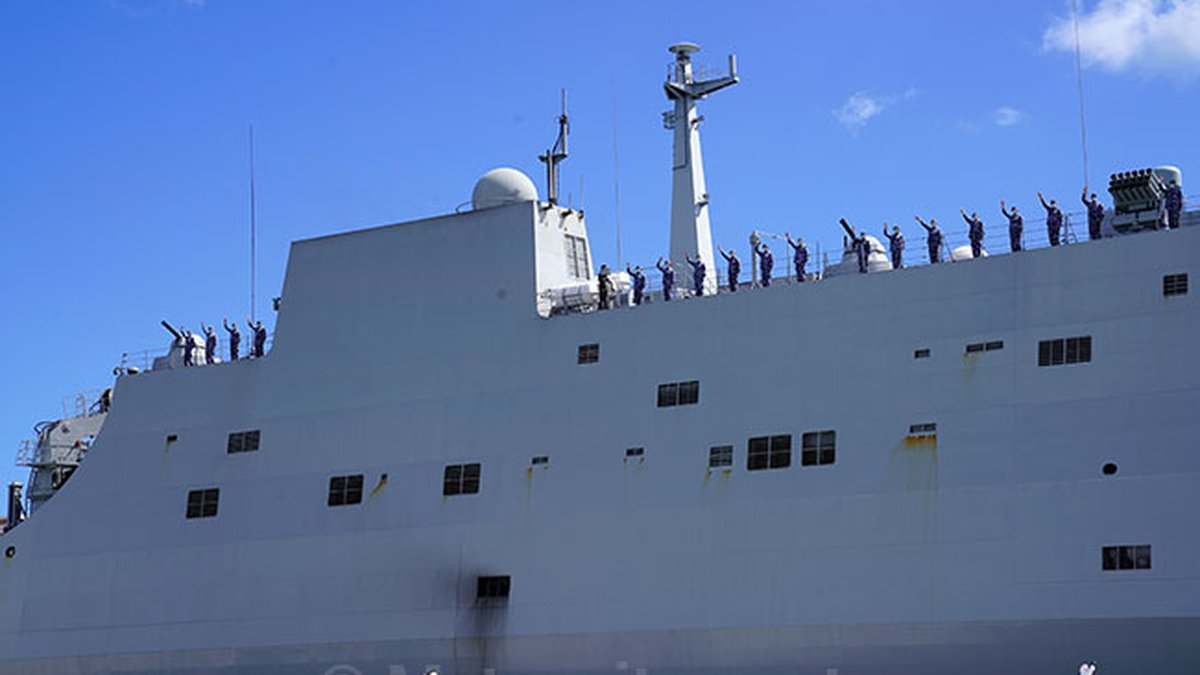
China has the world’s largest navy, with 234 vessels to the U.S. Navy’s 219. China operates six SSBNs. China now has the capacity to rival U.S. military supremacy in the Pacific. China is preparing to station a permanent presence in the South West Pacific and wants the other military powers of the Pacific to know there is nothing they can do about it. China has built dual-use port and airport facilities across the Pacific.
The 18 members of the Pacific Island Forum (PIF) will meet next month in Palau. The current chair of the forum, Prime Minister Mathew Wale, has proposed a new security agreement which would link all the Pacific nations. In the last two years, Australia and New Zealand have signed a series of bilateral security agreements with Pacific partners, but a single-region wide agreement has long been considered too difficult. PIF leaders were warned about the risks of China’s expanding military presence in the Pacific in a recent report circulated ahead of the PIF meeting. Will China’s latest provocative action be the tipping point that convinces Pacific leaders to stand together to protect collective security? Whatever they decide, the message has been received: China’s military presence in the Pacific is not going away.
This Op-ed was first published in The Post (Wellington), on 7 July 2026, and it was updated to include the response from Pacific leaders.
--
Editor's footnote - An SSBN is a Nuclear-Powered Ballistic Missile Submarine. In the context of military strategy, "SSBN defense" primarily refers to the concept of nuclear deterrence—where the submarine hides deep underwater to threaten a retaliatory nuclear strike, thereby deterring enemy attacks.
The Second-Strike Guarantee: Because they can remain hidden underwater for months at a time, SSBNs are virtually immune to a surprise first strike. If a country's land-based forces are destroyed, its SSBNs survive to launch a retaliatory strike. This capability underpins the doctrine of Mutually Assured Destruction (MAD), ensuring no adversary will ever initiate a nuclear war.
Stealth and Patrols: SSBNs prioritize extreme stealth and acoustic quieting so they can remain undetected by enemy anti-submarine forces. They routinely conduct patrols that last 70-90 days before returning to port for maintenance and crew swaps
Weaponry: They are armed with massive, intercontinental-range ballistic missiles, which can carry multiple nuclear warheads and hit targets thousands of miles away.
Sentinel — Human
The text reads like an analysis built around factual reporting but framed by expert geopolitical commentary, exhibiting a high degree of narrative synthesis rather than pure data presentation.