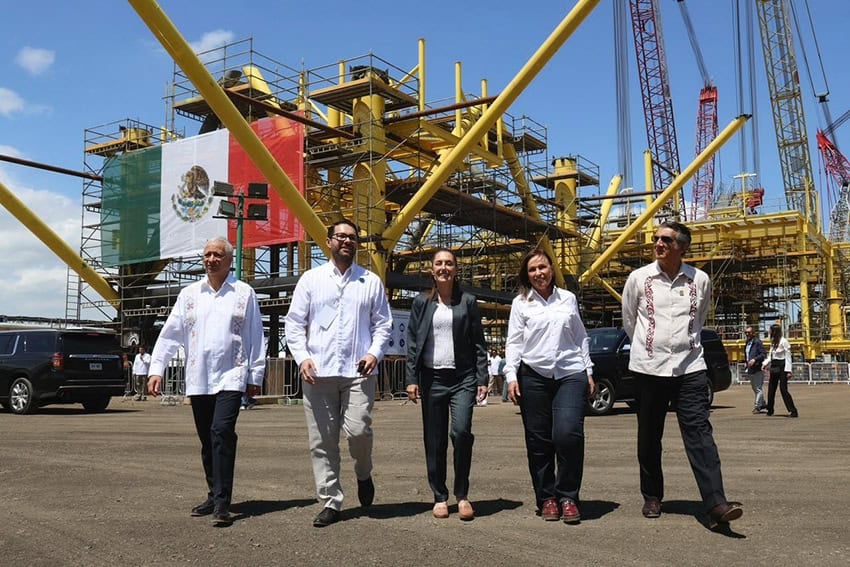
Speaking at a Pemex industrial complex on the banks of the Pánuco River in Veracruz on Wednesday, President Claudia Sheinbaum used the 88th anniversary of Mexico’s oil expropriation to set her government’s next energy goal: sharply reducing the country’s dependence on imported natural gas.
While Mexico has made significant progress reducing gasoline imports — thanks to the Olmeca refinery in Dos Bocas, the acquisition of the Deer Park refinery in Texas and the rehabilitation of six other refineries — Sheinbaum acknowledged a stubborn vulnerability remains. Mexico still imports 75% of the natural gas it consumes, a fuel that powers the country’s electricity plants and factories.
“The call to advance in energy sovereignty acquires enormous relevance every day,” she told Pemex workers at the event. “It means advancing in energy sovereignty, increasing domestic natural gas production — that is the next objective.”
Alongside natural gas, Sheinbaum said her government would continue expanding renewable energy capacity, including solar, wind and geothermal, while maintaining oil and fertilizer production.
The natural gas challenge is significant. As previously reported by Mexico News Daily, virtually all of Mexico’s gas imports arrive via pipeline from the United States, creating a dependence that some energy analysts describe as a national security risk.
Sheinbaum’s government is currently studying whether what it describes as sustainable fracking could help unlock domestic reserves, though no final decision has been made.
Opinion: Could Mexico make America great again? The energy equation
Sheinbaum drew a direct line between the 1938 expropriation — in which former President Lázaro Cárdenas seized the assets of 17 foreign oil companies in 1938 and founded the state oil company Pemex — and her government’s push to reduce gas imports. She presented both as responses to the same underlying challenge: ensuring that Mexico’s energy resources remain under national control rather than dependent on foreign suppliers. Pemex’s debt has fallen 13% in the past year to its lowest level in over a decade, she noted, as evidence the state oil company’s recovery is on track.
“Mexico will not be sold. Mexico will not be surrendered. Mexico will be defended,” she told the crowd.
With reports from La Jornada and El Economista
Portions of this story were drafted with assistance from Claude. The article has been revised and fact-checked by a Mexico News Daily staff editor.
Facts Only
* President Claudia Sheinbaum spoke at a Pemex industrial complex in Veracruz.
* The event marked the 88th anniversary of Mexico’s oil expropriation.
* The government’s next energy goal is to sharply reduce dependence on imported natural gas.
* Mexico currently imports 75% of its natural gas consumption.
* The government intends to expand renewable energy capacity (solar, wind, geothermal) alongside continued oil and fertilizer production.
* Mexico relies on pipeline imports of natural gas from the United States.
* Sheinbaum drew a connection between the 1938 expropriation and the current push for energy sovereignty.
* Pemex’s debt has decreased by 13% in the past year.
* The government is studying sustainable fracking to potentially unlock domestic natural gas reserves, but no final decision has been made.
* La Jornada and El Economista reported on the event.
Executive Summary
Full Take
Sentinel — Likely Human
The article presents President Sheinbaum's strategy for reducing natural gas imports, drawing parallels to Mexico's historical nationalization efforts. While exhibiting some stylistic characteristics potentially indicative of AI assistance (balanced framing, hedging), the inclusion of specific details and sourcing suggests a primarily human origin.