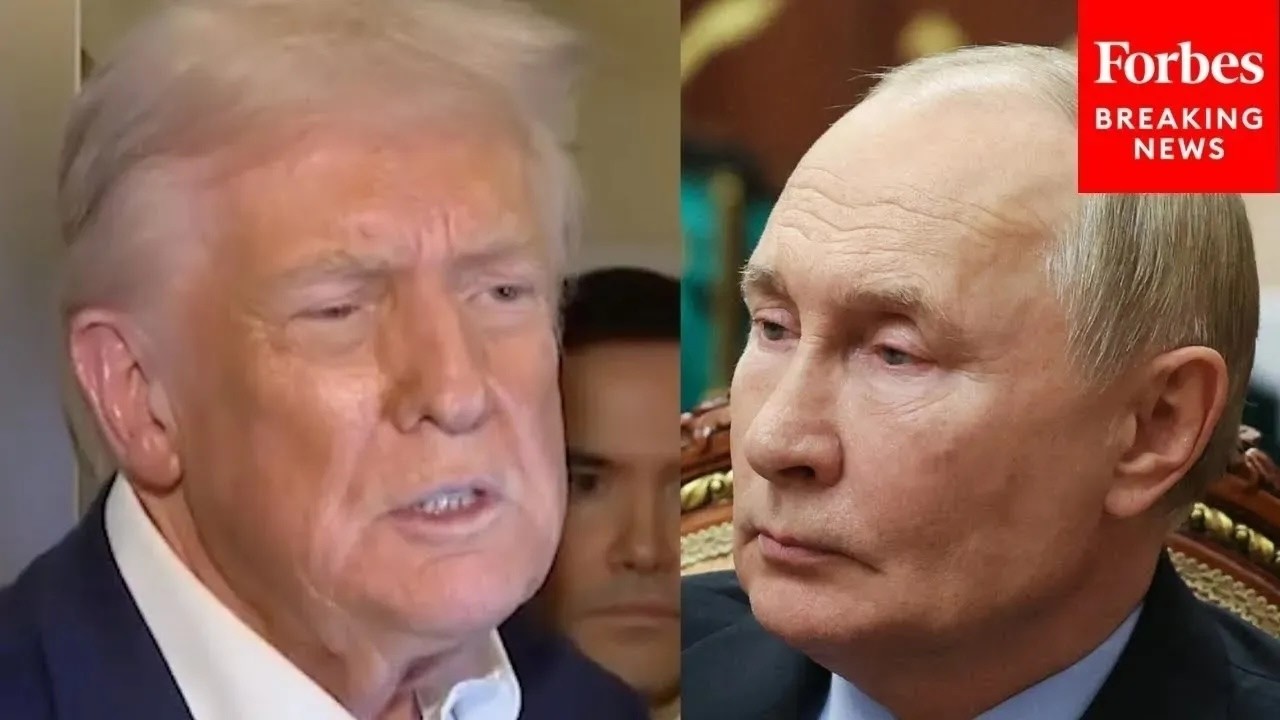
Title: Warning To Trump: If You Let Putin Win Russia-Ukraine War, It Would Be A Catastrophe
Channel: Forbes Breaking News
Published: 2026-03-12
Duration: 4:15
Views: 15,507
Description:
Steve Forbes warns President Trump not to allow Russian President Vladimir Putin to win the Russia-Ukraine War.
Stay Connected
Forbes Breaking News on X: https://x.com/ForbesTVNews
Forbes Breaking News on TikTok: https://www.tiktok.com/@forbestvnews
More From Forbes: http://forbes.com
Facts Only
Steve Forbes issues a warning to President Donald Trump.
The warning pertains to the Russia-Ukraine War.
The video was published by Forbes Breaking News on March 12, 2026.
The duration of the video is 4 minutes and 15 seconds.
The video has received 15,507 views.
The channel is Forbes Breaking News.
The description states that Steve Forbes warns Trump not to allow Putin to win the war.
The video is shared on platforms including X (formerly Twitter) and TikTok.
The Forbes website is linked for additional content.
The title frames a Russian victory as a "catastrophe."
The warning is directed at Trump’s potential policy decisions regarding the conflict.
No specific policy actions or alternatives are detailed in the provided information.
Executive Summary
Full Take
**STEELMAN:** The strongest version of this narrative is that allowing Putin to win in Ukraine would embolden authoritarian aggression, destabilize global security, and undermine democratic alliances. Forbes leverages his credibility as a media figure to frame this as a moral and strategic imperative, appealing to a U.S. audience that may be fatigued by prolonged conflict but still values American leadership. The warning is concise, leveraging urgency and high-stakes language to cut through noise—a classic call to vigilance.
**PATTERN SCAN:** The framing leans heavily on fear appeals ("catastrophe") and binary choices (win/lose), which can simplify complex geopolitical dynamics into a moral crusade. There’s no engagement with trade-offs—e.g., the costs of escalation, risks of direct confrontation, or Ukrainian agency in negotiations. The absence of counterarguments or nuance could reinforce an "us vs. them" paradigm, where dissent is framed as complicity. The use of a high-profile figure like Forbes also borrows credibility to amplify the message, a common authority-game tactic.
*Patterns detected: ARC-0024 Ambiguity (undefined "catastrophe"), ARC-0043 Motte-and-Bailey (vague stakes allow retreat to "security concerns" if challenged), ARC-0011 Fear Appeals (catastrophic framing without specificity).*
**ROOT CAUSE:** The narrative assumes that U.S. intervention is the primary variable determining the war’s outcome, sidelining Ukrainian sovereignty and regional actors. It echoes Cold War-era containment logic, where any Russian gain is an existential threat to the "free world." The unstated assumption is that American power must perpetually counterbalance authoritarianism, with little room for diplomatic off-ramps or multipolar solutions.
**IMPLICATIONS:** For human agency, this framing risks reducing Ukrainians to passive beneficiaries of U.S. policy rather than active decision-makers. The costs—economic, military, and diplomatic—are externalized onto taxpayers and future generations, while benefits accrue to defense industries and political elites who champion "toughness." Second-order consequences could include entrenching a permanent adversarial posture with Russia, limiting space for de-escalation, or normalizing endless proxy wars as the default U.S. foreign policy.
**BRIDGE QUESTIONS:**
If the goal is Ukrainian self-determination, how do we measure success beyond "not letting Putin win"? What metrics would indicate a durable peace?
What historical examples show that military support alone resolves conflicts, and where has it prolonged suffering? How does this case differ?
Who stands to gain from framing this conflict as an apocalyptic struggle rather than a negotiable dispute? What perspectives are excluded when the debate is reduced to "win or catastrophe"?
**COUNTERSTRIKE SCAN:** A coordinated influence campaign would likely amplify this narrative by flooding zones with emotional triggers (e.g., "Putin will invade NATO next"), suppressing dissent through patriotism shaming, and using trusted figures to launder partisan talking points as neutral expertise. The actual content here is lighter—it’s a single figure’s warning without a broader echo chamber or disinformation tactics. However, the lack of counterarguments and the catastrophic framing align with early-stage messaging designed to polarize audiences. No evidence suggests this is part of a larger operation, but the structure is primed for exploitation by bad actors seeking to weaponize fear.
Sentinel — Human
The text exhibits strong human signals, including direct attribution and an opinionated tone, with minimal stylometric or coherence red flags.