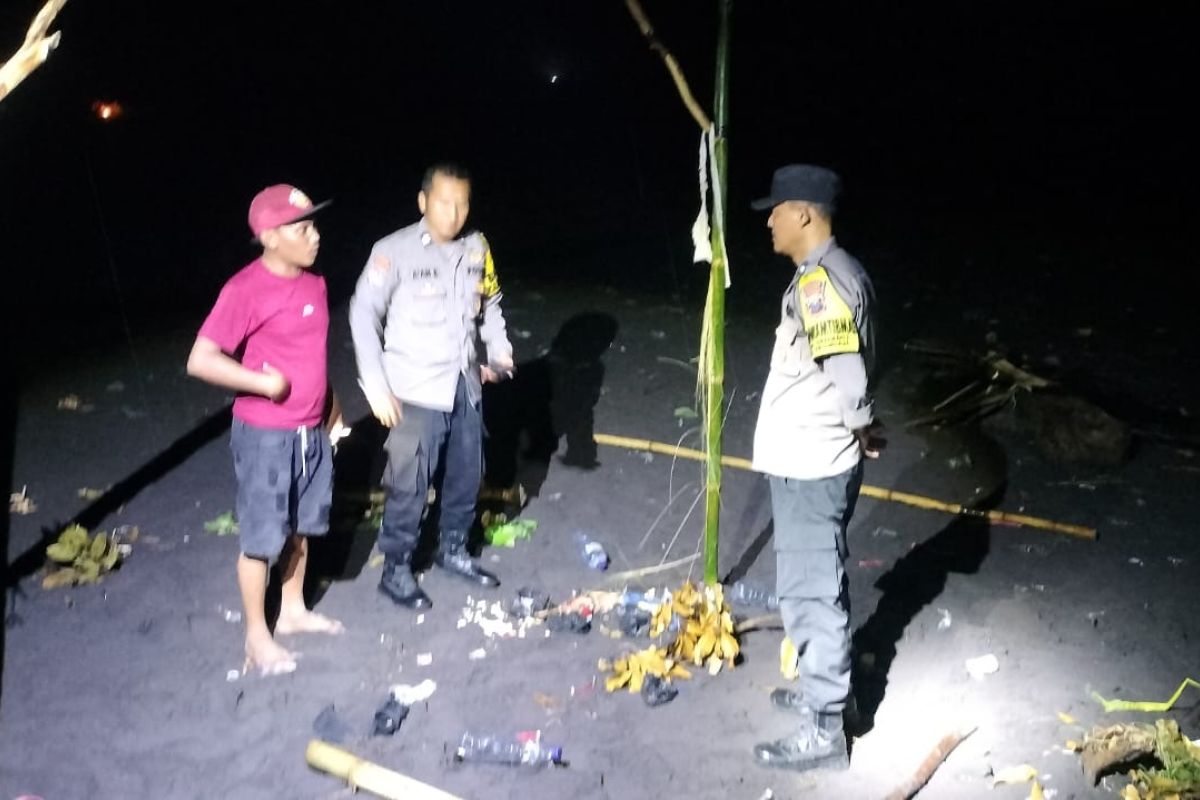
"Information we received from the Pasirian Sector Police suggested that two persons were struck by lightning at Watu Pecak Beach, along with eight others at Bambang Beach. Both tourist sites are within Pasirian Sub-district," said Second Inspector Suprapto, spokesperson for the Lumajang Resort Police.
Speaking in Lumajang on Sunday, he explained that the incident occurred during stormy rain on Saturday afternoon, which drove many visitors away from the area. However, several individuals opted to take shelter nearby.
"At Bambang Beach, eight tourists were vacationing and decided to erect a makeshift tent from tarpaulin to take shelter from the thunderstorm," he said.
Suprapto added that lightning soon struck the tent, leaving the visitors injured, with several falling unconscious. Security personnel then rushed them to nearby medical facilities for immediate treatment.
"Of the eight victims, one was pronounced dead, while another remains in a coma at Pasirian Regional General Hospital (RSUD). The six others sustained minor injuries and received treatment at Pasirian Community Health Center," he stated.
The police officer noted that the deceased was a 23-year-old man from Candipuro Village, while the other victims were aged between 22 and 25.
Shifting to Watu Pecak Beach, Suprapto reported that lightning struck near a grandfather and grandchild who operated a stall in the western area of the tourist site. The strike left them both unconscious due to shock. They were rushed to Pasirian RSUD as well.
He then called on tourists and residents to remain alert to weather risks and promptly seek safety in the event of extreme conditions.
Related news: BMKG warns of potential rain with lightning in major cities
Related news: Beware of torrential rains, lightning in some Indonesian regions: BMKG
Related news: Mt. Ibu eruption triggers volcanic thunderstorm: official
Translator: Zumrotun S, Tegar Nurfitra
Editor: Azis Kurmala
Copyright © ANTARA 2026
Facts Only
Two persons were struck by lightning at Watu Pecak Beach in Pasirian Sub-district, Lumajang.
Eight others were struck by lightning at Bambang Beach in the same sub-district.
The incident occurred during a thunderstorm on Saturday afternoon.
At Bambang Beach, eight tourists erected a makeshift tarpaulin tent for shelter.
Lightning struck the tent, injuring all eight individuals.
One victim, a 23-year-old man from Candipuro Village, was pronounced dead.
Another victim remains in a coma at Pasirian Regional General Hospital (RSUD).
Six others sustained minor injuries and were treated at Pasirian Community Health Center.
At Watu Pecak Beach, lightning struck near a grandfather and grandchild operating a stall.
Both individuals fell unconscious and were rushed to Pasirian RSUD.
The victims at Watu Pecak Beach were treated for shock.
Second Inspector Suprapto, spokesperson for the Lumajang Resort Police, provided the details.
Authorities have advised tourists and residents to seek safety during extreme weather.
The BMKG has issued warnings about potential rain and lightning in major Indonesian cities.
Executive Summary
Full Take
The strongest version of this narrative underscores the immediate and tangible risks of lightning strikes in tourist-heavy coastal areas, particularly during sudden thunderstorms. The reporting is factual and avoids sensationalism, focusing on the sequence of events, victim details, and official responses. It also aligns with broader meteorological warnings, reinforcing the credibility of the account. However, the absence of deeper context—such as long-term weather patterns, infrastructure safety measures, or historical data on lightning incidents in the region—leaves room for unanswered questions. For instance, are these beaches known for frequent lightning strikes? Are there established protocols for tourist safety during storms?
The narrative does not exhibit overt manipulation patterns, but it does rely on authority figures (police and BMKG) to frame the event as a cautionary tale. This could subtly reinforce a paradigm where natural disasters are treated as isolated incidents rather than systemic risks requiring preventive action. The focus on individual responsibility ("seek safety") might overshadow broader questions about public infrastructure, emergency preparedness, or climate change impacts on extreme weather.
For human agency, the implications are clear: awareness and quick action can mitigate harm, but structural vulnerabilities—like the lack of designated storm shelters—remain unaddressed. The costs are borne by the victims and their families, while the benefits of heightened vigilance accrue to the broader community. Second-order consequences could include reduced tourism confidence or increased demand for safety measures.
Bridge questions: What systemic changes could reduce lightning risks in tourist areas? How do local authorities balance economic reliance on tourism with safety imperatives? Would historical data on lightning strikes in Lumajang alter the perception of this event as an anomaly?
Counterstrike scan: A coordinated influence campaign might exploit this event to push a narrative of governmental negligence or climate alarmism, depending on the agenda. However, the actual content sticks to factual reporting without exaggeration or emotional appeals, making it unlikely to serve as a vector for manipulation. The focus remains on public safety, not political or ideological framing.
Patterns detected: none