Support CleanTechnica's work through a Substack subscription or on Stripe.
The balcony solar movement is running hot in Germany, and now it is spreading into the US like gangbusters, just in time for US President Donald Trump’s war in Iran to send the cost of coal through the roof alongside oil and natural gas. Come to think of it, if coal is so great, why are so many people so eager to festoon their homes with plug-in solar panels? After all, solar panels are not particularly attractive, whereas coal power plants … oh, never mind!
The Balcony Solar Rush Begins
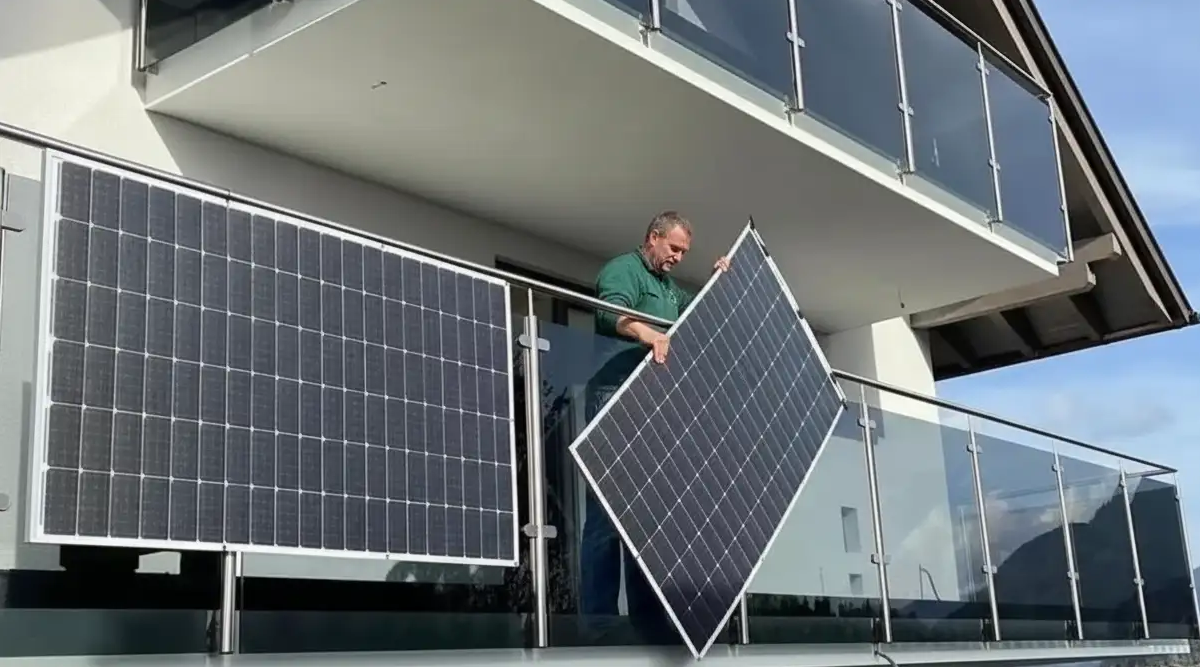
Balcony solar systems are hang-able solar panels that simply plug into a household outlet, enabling the ratepayer to offset some of their electricity costs. When a ratepayer moves, the solar panel goes with them, just like any other transportable appliance.
The balcony solar movement began taking noticeable form about four years ago, when households in Ukraine adopted hang-able, plug-in solar panels to work around Russia’s attacks on their power plants. The idea quickly spread to Germany, where members of the public rushed to take advantage of government subsidies. As reported by SolarPower Europe, German households registered 276,000 balcony panels in 2023. They added another 435,000 units in 2024 and passed the one million mark last year.
The market in Germany has attracted interest from US solar stakeholders, including the California firm Enphase. Last year, the company launched its new “Enphase® IQ® Balcony Solar System” for German households. “Designed for plug-and-play installation, the new system empowers apartment dwellers and homeowners with limited roof space to generate their own clean energy from balconies, patios, and small outdoor areas,” Enphase explained in a press statement last May.
Illinois Catches Balcony Solar Fever
Here in the US, balcony solar has faced two significant hurdles. One is the absence of state-based enabling legislation for devices that inject electricity into a household system without the need for authorization from their utility company. The other obstacle involves property owner restrictions on tenants, and homeowner association restrictions on members.
Both of those obstacles are beginning to crumble, with Illinois providing the latest example. The state legislature is currently considering Senate Bill 3104, a proposal to remove the state’s existing pre-authorization requirement and replace it with a simple form notifying the utility company of the installation. The bill would also prohibit any other fees or installation expenses, and it would prevent property owners and homeowner associations from raising unreasonable obstacles of their own.
“Illinois has been a leader in renewable energy, and this legislation keeps us moving forward by making solar more available, more affordable, and more achievable for everyone,” explained the sponsor of the bill in the Illinois House, Rep. Daniel Didech (D-Buffalo Grove), as cited by Capitol News Illinois.
“Plug-in solar is exactly what it sounds like: small, low-cost solar panels that plug directly into a standard outlet and help offset the energy use,” emphasized the lead sponsor, Sen. Rachel Ventura (D-Joliet).
“No expensive installation, no major construction, no waiting months for approval,” Sen. Ventura added.
Safety First
Bill 3104 would establish the most relaxed rules for small balcony solar systems, generally covering those in the 300–400 watt category. The legislation also provides for additional restrictions on larger systems of up to 1,200 watts.
The new rules also require balcony solar systems to be certified by a nationally recognized laboratory. As if on cue, in January, the Illinois-based, globally oriented certification laboratory UL Solutions announced that it has launched a new certification program focusing on balcony solar systems.
“The new program is an evaluation based on UL 3700, the Outline of Investigation for Interactive Plug-In Photovoltaic Equipment and Systems,” UL explained.
“It defines construction, performance and labeling criteria tailored to plug-in solar systems, also referred to as balcony solar, offering manufacturers a reliable foundation for designing products that consistently meet safety and performance requirements,” the company elaborated.
In a press statement, Ken Boyce — UL’s VP of Principal Engineering, Industrial Testing, Inspection and Certification — underscored the end goal. “By defining how these systems must be built, evaluated for safety and safely installed, UL 3700 helps mitigate potential risks, and opens a path for more people to access resilient solar power,” Boyce said.
He must have had a crystal ball. UL announced the new 3700 program on January 6, and barely two months later the resiliency of solar power is on full display as a result of Trump’s war on Iran.
For all the bleating and braying over fossil fuels by Trump and his administration, events on the other side of the world have disrupted global commodities markets, taking the US down along with them. Meanwhile, the wind blows and sun shines right here in the US, ripe for the taking.
So far, Utah is the only state to have passed a comprehensive balcony solar law for systems up to 1200 watts. UL notes that Maryland, Minnesota, New Hampshire, New York, Pennsylvania, Vermont, and Virginia are among the states considering legislation, in addition to Illinois.
Trump’s War On Iran Is Making Coal Not Great, Again
As for why Trump chose February 28 to launch operation “Epic Fury” against Iran, the Epstein files explain everything. After all, there is no other explanation. Trump has yet to articulate why he launched a full-on war in the Middle East at this moment in time, leaving pundits to lob alternative titles such as “operation Epstein Fury” or simply “the Epstein war.”
Absent any other meaningful explanation, there only remains Trump’s fear of the Epstein files, a fear that runs so deep he reached for the handy go-to solution put in motion by both Republican presidents who preceded him — namely, launch a war in the Middle East (that was Bush I and Bush II, for those of you keeping score at home) to distract public attention from your own shortcomings.
Somewhat ironically, the war has also upset the apple cart on Trump’s efforts to glorify the US coal industry. Convincing the public to love coal power was always going to be a tough sell, and now Trump has just guaranteed that coal will be even less accessible and less economical than it already is.
Global coal prices have spiked on the heels of Trump’s war, partly due to a knock-on effect resulting from the sudden disruption of natural gas supplies from the Middle East. The problem is not necessarily limited to an increase in the cost of coal imported to the US, though. Domestically produced coal is also impacted. As of 2022, transportation accounted for more than 41% of the cost of coal delivered from domestic coal mines to power plants in the US, and those costs are rising alongside the spike in diesel fuel.
“Most coal is transported by train, barge, truck, or a combination of these modes. All of these transportation modes use diesel fuel. Increases in oil and diesel fuel prices can significantly affect the cost of transportation, which affects the final delivered price of coal,” the US Energy Information Agency emphasizes.
Photo: The Chinese firm HIITO is among the global PV manufacturers feeding the balcony solar frenzy, providing ratepayers with simple, easy access to clean power (cropped, courtesy of HIITO).
Sign up for CleanTechnica's Weekly Substack for Zach and Scott's in-depth analyses and high level summaries, sign up for our daily newsletter, and follow us on Google News!
Have a tip for CleanTechnica? Want to advertise? Want to suggest a guest for our CleanTech Talk podcast? Contact us here.
Sign up for our daily newsletter for 15 new cleantech stories a day. Or sign up for our weekly one on top stories of the week if daily is too frequent.
CleanTechnica uses affiliate links. See our policy here.
CleanTechnica's Comment Policy
Facts Only
Balcony solar systems are plug-in solar panels that can be hung on balconies or small outdoor spaces and connected to household outlets.
The movement began in Ukraine around four years ago as a response to attacks on power plants, then spread to Germany.
Germany registered 276,000 balcony solar panels in 2023 and over one million by 2024.
U.S. company Enphase launched the "Enphase® IQ® Balcony Solar System" for German households in May 2023.
Illinois is considering Senate Bill 3104 to remove pre-authorization requirements for balcony solar installations, replacing them with a notification system.
The bill would prohibit additional fees, installation expenses, and unreasonable restrictions from property owners or homeowner associations.
The legislation covers systems up to 1,200 watts, with stricter rules for larger systems.
UL Solutions announced a new certification program for balcony solar systems in January 2024, based on UL 3700 standards.
Utah is the only U.S. state with a comprehensive balcony solar law for systems up to 1,200 watts.
Maryland, Minnesota, New Hampshire, New York, Pennsylvania, Vermont, and Virginia are considering similar legislation.
Global coal prices have spiked due to geopolitical disruptions, including a U.S. military operation in Iran launched on February 28, 2024.
Transportation costs for domestic coal in the U.S. have risen due to increased diesel fuel prices, affecting overall coal costs.
Executive Summary
Balcony solar systems, which are plug-in solar panels that can be hung on balconies or small outdoor spaces, are gaining traction in the U.S. after seeing significant adoption in Germany and Ukraine. These systems allow households to offset electricity costs by generating their own clean energy without complex installations. In Germany, over one million balcony solar panels have been registered since 2023, driven by government subsidies and public demand. U.S. companies like Enphase have entered the market, launching products tailored for European consumers.
In the U.S., legislative barriers have slowed adoption, including utility pre-authorization requirements and restrictions from property owners or homeowner associations. Illinois is now considering Senate Bill 3104, which would simplify the installation process by replacing pre-authorization with a notification system and prohibiting unreasonable fees or obstacles. The bill also includes safety standards, requiring certification by nationally recognized laboratories like UL Solutions, which recently introduced a new certification program for balcony solar systems.
The push for balcony solar comes amid broader energy market disruptions, including rising coal and natural gas prices linked to geopolitical tensions. While Utah has already passed comprehensive balcony solar legislation, other states like Maryland, Minnesota, and New York are exploring similar measures. The trend reflects growing consumer interest in accessible, low-cost renewable energy solutions, even as traditional energy markets face volatility.
Full Take
The strongest version of this narrative highlights a grassroots shift toward decentralized, consumer-driven renewable energy, framed as a pragmatic response to both geopolitical instability and legislative inertia. The article credibly documents the rapid adoption of balcony solar in Germany and its potential to reshape U.S. energy policy, particularly in states like Illinois where legislative barriers are being dismantled. It also effectively ties the trend to broader energy market disruptions, such as rising coal prices linked to geopolitical conflicts, reinforcing the case for local, resilient energy solutions.
However, the piece employs several patterns that warrant scrutiny. The repeated references to "Trump’s war in Iran" and its impact on coal prices veer into speculative territory, lacking direct evidence of causation. The phrasing—"Trump’s war on Iran Is Making Coal Not Great, Again"—employs emotional framing, leveraging political polarization to amplify the urgency of renewable energy adoption. Additionally, the article’s dismissive tone toward coal ("After all, there is no other explanation") risks strawmanning opponents of renewable energy by reducing their arguments to bad faith or ignorance. The sudden pivot to geopolitical conspiracy theories ("the Epstein files explain everything") further undermines the piece’s credibility, introducing a distraction that feels disjointed from the core discussion of solar policy.
At its root, this narrative taps into a paradigm of energy democratization, where individuals bypass traditional utility structures to gain autonomy over their power supply. The unstated assumption is that centralized energy systems are inherently vulnerable—whether to geopolitical shocks, corporate control, or bureaucratic red tape—and that decentralized solutions offer both resilience and empowerment. Historically, this echoes past movements where technological innovation (e.g., rooftop solar, microgrids) disrupted incumbent industries, often meeting resistance before eventual normalization.
The implications for human agency are significant: balcony solar could lower financial barriers to renewable energy, particularly for renters and urban dwellers. However, the benefits may accrue unevenly—those with sunny balconies and supportive landlords will gain, while others remain excluded. Second-order consequences could include utility pushback, as reduced grid reliance threatens their revenue models, or unintended safety risks if uncertified systems proliferate.
Bridge questions to consider: How might utilities adapt their business models to accommodate decentralized energy without stifling innovation? What safeguards are needed to ensure balcony solar systems don’t create new inequities in energy access? And if geopolitical instability is driving interest in renewable energy, what other systemic vulnerabilities might similar disruptions expose?
Counterstrike scan: If this were part of a coordinated influence campaign, the playbook would likely emphasize emotional triggers (e.g., fear of war, frustration with utilities) while downplaying technical or economic limitations of balcony solar. The actual content partially aligns with this pattern—particularly in its politicized framing of energy policy—but stops short of outright manipulation. The inclusion of concrete legislative details and safety standards anchors the piece in reality, even as its rhetorical flourishes risk overreach.
Patterns detected: ARC-0024 Ambiguity (speculative geopolitical claims), ARC-0043 Motte-and-Bailey (dismissing coal advocates without engagement), ARC-0018 Emotional Exploitation (leveraging political polarization).