Table of Contents
As threat actors increasingly use automation to breach systems, organizations must adopt faster, smarter defenses. Lumu integrates Artificial Intelligence (AI) across its entire security operations platform to identify, correlate, and manage cyber threats in real time.
Too many companies have implemented AI for the sake of AI, in recent years. Lumu, on the other hand, uses it to fundamentally improve your organization’s cybersecurity defenses. Our AI not only makes detecting and reacting to attacks faster and more accurate, it also slashes alert fatigue.
Traditional security tools, like SIEMs, hoard data. Lumu puts your existing data to work with Machine Learning, Deep Learning, and AI, mapping adversary movements and detecting malicious intent.
This guide breaks down exactly how Lumu uses AI to secure your network at machine speed.
Quick Facts: How Does Lumu Use Artificial Intelligence (AI)?
|
How Does the Illumination Process Use Machine Learning?
The Illumination Process is the core engine behind Lumu. It uses Machine Learning (ML) to process massive volumes of network data and establish behavioral baselines. Because it relies on the ultimate source of truth, the network itself, it easily flags anomalies that point to malware or targeted attacks.
What is the difference between AI and Machine Learning in Lumu? | |
Artificial Intelligence are systems that mimic human thought and behavior and automate complex decision making. How AI is used in Lumu:
| Machine Learning is where computers learn from massive datasets to find patterns. How ML is used in Lumu:
|
The Illumination Process uses collective defense and Deep Learning to pool threat data, analyse it, and protect all networks simultaneously. Deep Learning is a subset of ML that thrives on huge volumes of unstructured data. It is inspired by the human brain’s neural networks.
Lumu’s Deep Learning relies on two learning methods, called transfer learning and online learning.
Transfer learning means new clients do not wait for the system to learn their network from scratch. The Illumination Process uses pre-trained models built on collective historical threat data from all existing Lumu deployments.
Online learning ensures these models update incrementally as new data arrives. The system continuously fine-tunes its algorithms to understand the unique characteristics of your specific network.
Lumu then pools this network behavior data across all clients to constantly train the central machine learning models. The goal is a digital immune system. A novel threat detected at one enterprise instantly upgrades the AI defense mechanisms for the entire Lumu ecosystem.
How Do Lumu Defender and Autopilot Revolutionize Security?
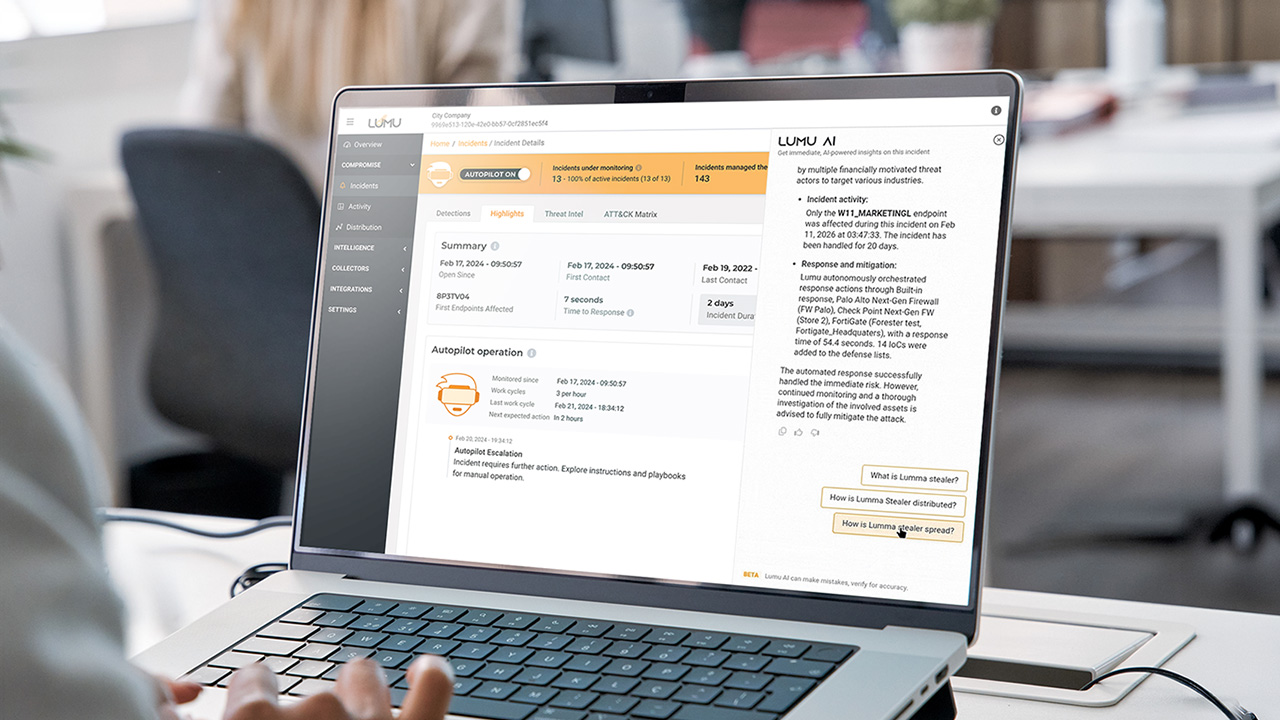
Lumu Defender and Autopilot revolutionize security by functioning together as a fully autonomous Security Operations Center (SOC).
Lumu Defender provides your core threat detection and automated response capabilities. Lumu Autopilot takes this technology further by acting as the intelligent operator. It manages the entire incident lifecycle without human intervention.
This system provides a level of speed and precision that traditional teams cannot match, ensuring your organization remains protected 24/7.
How Does Autopilot Function as an Autonomous SOC?
Lumu Autopilot replaces the need for a manual security operations team by managing incidents autonomously. Attackers use AI to breach systems at record speed, but Lumu stops suspicious activity in milliseconds. The system ingests and correlates vast amounts of data to make instant decisions. It decides whether to monitor, mute, close, or escalate an incident without waiting for a human.
How Does This SOC Orchestrate Across Your Stack?
The autonomous SOC orchestrates your environment by using advanced playbooks trained on years of threat metadata. These playbooks blend human-like ethical judgment with massive processing power. Lumu Defender coordinates these actions with your stack through seamless orchestration with over 180 third-party tools. This creates a unified response across your entire environment. The result is a consistent defense that never blinks.
What Does This Orchestration Mean for Your Security Team?
For your security team, this orchestration means the freedom to focus on high-level strategic tasks instead of manual triage. Analysts retain the flexibility to override or augment decisions, but they no longer handle the burden of high-volume triage. This automation ensures compliance with strict mandates like GDPR, HIPAA, and CMMC by documenting every action. Most importantly, it prevents analyst burnout. Your team can finally shift their focus from reactive firefighting to proactive threat hunting.
How Does the Natural Language Filter Improve Efficiency?
The LumuAI Filter is available on the Lumu Portal. When you open the Incidents tab it allows you to filter the incidents you want to see using natural language.
increases your SOC efficiency by allowing security analysts to query complex incident data using everyday natural language. The LumuAI Filter is your compass that leads you straight to what you need to know.
It eliminates the need to click through multiple complex menus manually. Analysts can query phrases like, “Phishing incidents detected last week”.
Analysts can even execute complex filtering through natural language. They can combine parameters like incident types, time periods, and impact metrics.
This is not a static tool. It continuously learns and evolves based on user input and feedback. It becomes more accurate and attuned to the specific needs of the SOC team over time.
By drastically reducing the time spent searching for data, the AI filter minimizes the Mean Time to Understand (MTTU) and significantly boosts overall Security Operations Center efficiency.
What Is the LumuAI Assistant?
LumuAI is now available as standard for all Lumu Defender customers. When you select an incident all you need to do is select the AI Summary button on the top. It then instantly transforms complex network telemetry into clear, actionable intelligence.
This clear summary means security teams do not waste time deciphering raw data. It instantly identifies the specific threat, explains exactly what it does, and correlates attack patterns to profile the adversary.
It highlights affected endpoints without requiring the analyst to query the system manually. LumuAI confirms if an automated response has already been executed across the security stack and clearly outlines the exact next steps for incident responders.
What Is the Future of AI in Cybersecurity?
The future of cybersecurity relies on speed. Lumu leverages Artificial Intelligence to remove bottlenecks from the threat-hunting process. With Lumu’s Deep Learning, automated playbooks, and conversational AI tools organizations can detect anomalies faster and more effectively.
With a functional approach to AI, your security team can step away from manual data sorting and chasing alerts to focus on strategic defense.
To see how Lumu’s autonomous security works in the real world, book a live demo today.
Facts Only
Lumu integrates Artificial Intelligence (AI) into its security operations platform.
The Illumination Process is the core engine using Machine Learning (ML) to analyze network data.
The system establishes behavioral baselines to detect anomalies indicating malware or attacks.
Lumu uses transfer learning and online learning to refine AI models continuously.
Transfer learning allows new clients to benefit from pre-trained models based on historical threat data.
Online learning updates models incrementally as new data arrives.
Lumu Defender and Autopilot function as an autonomous Security Operations Center (SOC).
The autonomous SOC automates threat detection, response, and incident management.
The system orchestrates responses across over 180 third-party tools.
The LumuAI Filter allows natural language queries to filter and analyze incidents.
The LumuAI Assistant provides automated summaries of incidents for security teams.
The platform aims to reduce alert fatigue and improve response times.
Executive Summary
Lumu integrates Artificial Intelligence (AI) across its security operations platform to enhance cybersecurity defenses by identifying, correlating, and managing threats in real time. The core engine, called the Illumination Process, uses Machine Learning (ML) and Deep Learning to analyze network data, establish behavioral baselines, and detect anomalies indicative of malware or targeted attacks. Unlike traditional tools like SIEMs, Lumu leverages existing data with AI to map adversary movements and flag malicious intent. The system employs transfer learning and online learning to continuously refine its models, ensuring rapid adaptation to new threats across all client networks. Lumu Defender and Autopilot function as an autonomous Security Operations Center (SOC), automating threat detection, response, and incident management without human intervention. The platform orchestrates responses across over 180 third-party tools, reducing alert fatigue and allowing security teams to focus on strategic tasks. Additional features like the LumuAI Filter and LumuAI Assistant streamline incident analysis through natural language queries and automated summaries, improving efficiency and reducing response times. The future of cybersecurity, as presented, hinges on AI-driven speed and automation to outpace evolving threats.
The article positions Lumu as a solution to the growing sophistication of cyber threats, emphasizing its AI-driven approach to real-time threat detection and response. While the claims about automation and efficiency are compelling, the effectiveness of such systems depends on the quality of data, the adaptability of AI models, and the integration with existing security infrastructure. The narrative assumes that AI can replace or significantly reduce human involvement in cybersecurity, which may not account for the nuanced judgment required in complex threat scenarios. The focus on speed and automation as primary advantages aligns with broader industry trends but raises questions about the balance between machine-driven decisions and human oversight.
Full Take
The narrative presented by Lumu positions AI as a transformative force in cybersecurity, capable of outpacing human-driven threat detection and response. The strongest version of this argument highlights the efficiency gains from automation, the reduction of alert fatigue, and the ability to correlate vast amounts of data in real time. These claims are supported by the described use of Machine Learning, Deep Learning, and autonomous SOC capabilities, which align with broader industry trends toward AI-driven security solutions.
However, the pattern scan reveals potential elements of **ARC-0024 Ambiguity** and **ARC-0043 Motte-and-Bailey**. The ambiguity lies in the broad claims about AI's effectiveness without detailed evidence or case studies demonstrating real-world outcomes. The "Motte-and-Bailey" pattern emerges in the way the narrative oscillates between the modest claim of AI as a tool to assist security teams and the bolder claim of AI as a near-autonomous replacement for human judgment. The article does not fully address the limitations of AI in cybersecurity, such as the potential for false positives, the need for human oversight in complex threat scenarios, or the risks of over-reliance on automated systems.
The root cause of this narrative is the paradigm of technological solutionism—the assumption that AI can solve inherently human problems, such as cybersecurity, through automation and speed. This paradigm often overlooks the nuanced, adaptive nature of cyber threats and the critical role of human expertise in interpreting context and intent. The implications for human agency are significant: while AI can augment security operations, the narrative risks undermining the value of human analysts by framing their role as secondary to machine-driven processes.
Bridge questions to consider: What are the specific limitations of Lumu's AI in detecting novel or highly sophisticated threats? How does the platform ensure transparency and accountability in its automated decision-making? What would it take to falsify the claim that AI can replace human judgment in cybersecurity?
Counterstrike scan: If this narrative were part of a coordinated influence campaign, the playbook would likely emphasize the inevitability of AI dominance in cybersecurity, downplaying the risks and limitations to drive adoption. The actual content does not fully match this pattern, as it acknowledges the role of human analysts in overseeing and augmenting AI decisions. However, the framing leans heavily toward AI as a panacea, which could be exploited to push a more extreme version of the narrative.
Sentinel — Likely Synthetic
This text functions as a high-level marketing explanation of a security platform, demonstrating strong, predictable, and polished language typical of AI generation focused on persuasion rather than original journalistic inquiry.