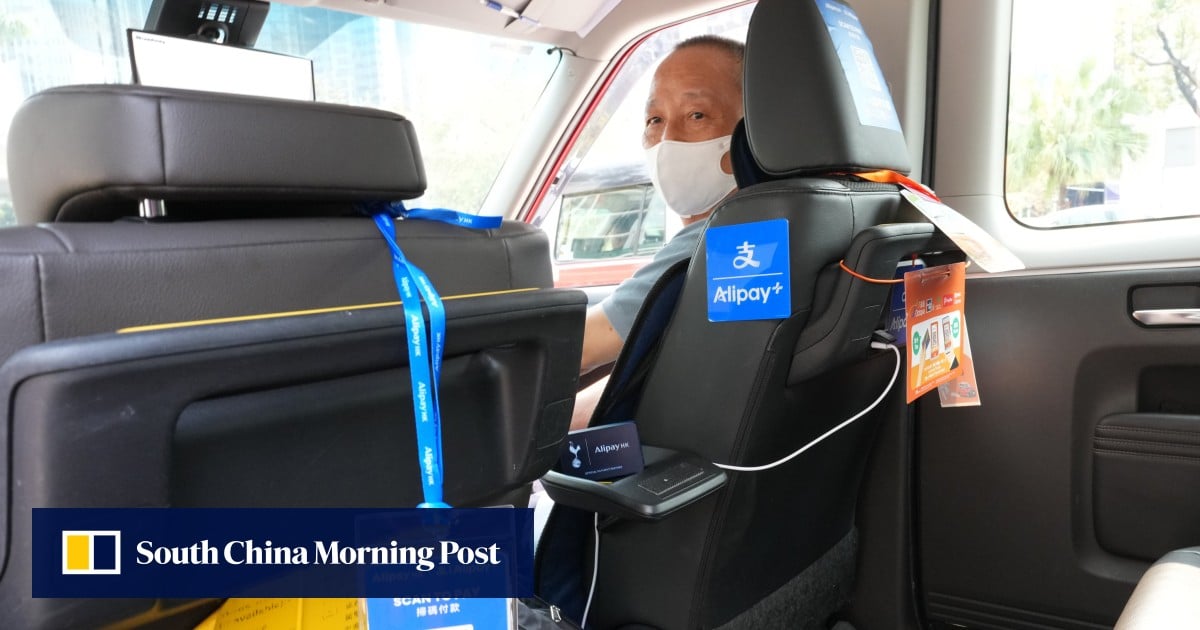
Widespread coverage is good news ahead of coming holiday for mainland visitors who have solely been using e-wallets for years
AlipayHK, a joint venture of Ant Group, an affiliate of Alibaba Group Holding, which owns the South China Morning Post, said on Thursday that its e-payment system was available to 46,000 taxi drivers. WeChat Pay HK said it had more than 40,000.
This suggests widespread coverage, with Hong Kong having about 18,000 taxis and 46,000 active drivers based on Transport Department statistics.
The companies’ disclosure of their figures came a day after Hong Kong mandated that taxi drivers provide at least two digital payment options – one QR-based type such as AlipayHK, WeChat Pay HK or BoC Pay, and one contactless alternative capable of reading Octopus or credit cards.
The e-payment systems will provide convenience to mainland visitors who have been solely using e-wallets for years.
The Immigration Department said it expected 6.44 million trips to be made by Hong Kong residents and visitors via air, land and sea checkpoints between Friday and Tuesday, which covers the Easter long weekend and the Ching Ming Festival.
Facts Only
Actors: AlipayHK, WeChat Pay HK, taxi drivers in Hong Kong, mainland visitors
Events: expansion of e-payment systems to taxi drivers, upcoming holiday period
Dates: April 15 (disclosure of figures), upcoming holiday period covers Easter long weekend and Ching Ming Festival
Locations: Hong Kong
Executive Summary
Full Take
Steelman: The e-payment providers, recognizing the growing trend towards digital payments among mainland visitors to Hong Kong, have expanded their services to taxi drivers to offer greater convenience for these travelers.
Patterns detected: ARC-0043 Motte-and-Bailey (the companies present their reach as near-universal coverage while providing specific numbers that are slightly less than this), ARC-0024 Ambiguity (it is not explicitly stated whether all taxi drivers have signed up for these e-payment systems or if they will be mandatory)
Root Cause: The shift towards digital payments reflects broader global trends, driven by increasing smartphone usage and the convenience offered by contactless transactions.
Implications: This move benefits both the e-payment providers (who gain more users and potentially increased transaction fees) and mainland visitors (who can now use their preferred payment method in taxis). It also signals a greater integration of Hong Kong's taxi industry with China's digital payment ecosystem.
Bridge Questions: What proportion of taxi drivers have actually adopted these e-payment systems? How will this impact smaller, independent taxi operators who may not have the infrastructure to support such services? Will other digital payment providers also expand their reach in response to this trend?
Counterstrike Scan: It is unlikely that this development is part of a coordinated influence campaign as it appears to be a business expansion move by two major e-payment providers.
Sentinel — Human
This analysis suggests that the article is likely human-written. The stylometric signals exhibit inconsistencies with machine generation, while the coherence and fabrication indicators show no signs of artificial origin.