Share & more
At home in southeastern Gaza, Ammouna Ahmad Abu Irjila used to begin her days at dawn, checking on her fields after the morning prayer.
Before her family was forcibly displaced, Abu Irjila farmed four dunams – about 4,000 square metres, or one acre – inherited from her father in Khuza’a, a small agricultural town near the border with Israel.
“I didn’t even know what it meant to sleep after sunrise,” said Abu Irjila, 73. She grew up in Khuza’a and raised six children there. Some also became farmers, renting land nearby and selling their produce in local markets.
The homes and landscape where all of this life took place have now been entirely wiped out.
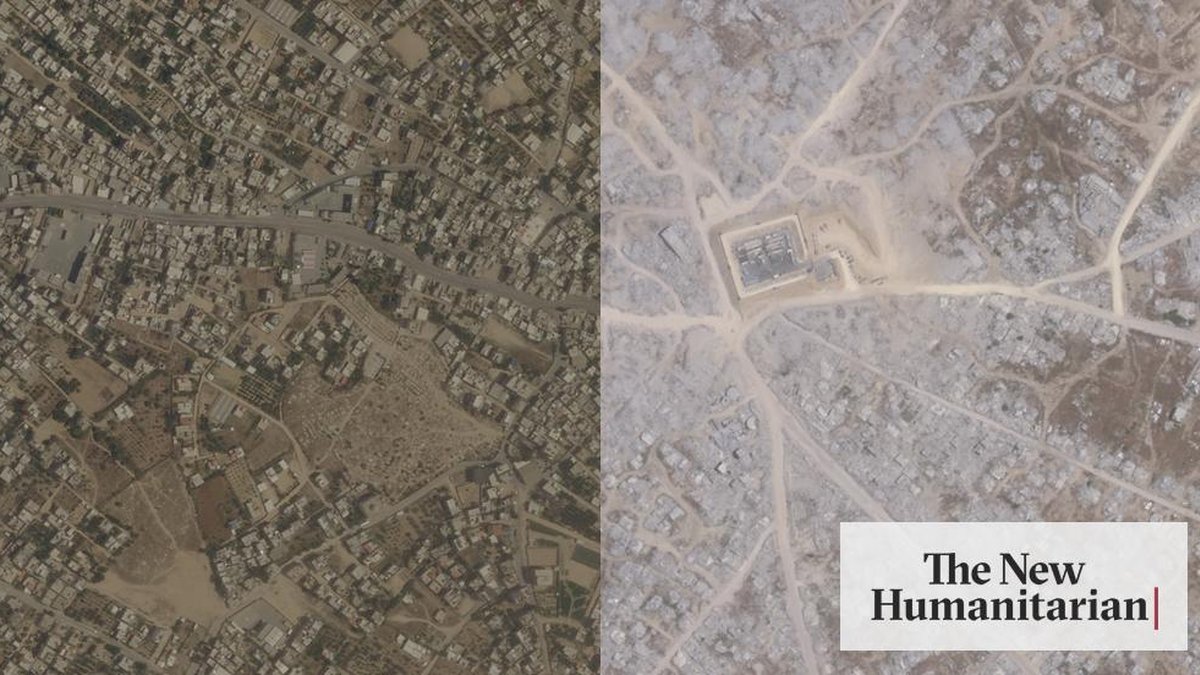
Since the October 2025 US-brokered ceasefire agreement between Israel and Hamas, Israeli forces have stepped up a systematic campaign of erasure in the area of Gaza directly under their control, which they have expanded from 54% when the deal was signed to now about 65%. In this almost entirely depopulated zone, Israel has been tearing down whatever remains, setting fire to fields, and bulldozing towns and once-green agricultural communities into the ground.
The New Humanitarian has spent more than six months monitoring and analysing satellite imagery to document Israel’s clearing of land and subsequent construction activities, focusing on some of the most-affected areas in eastern Gaza, and speaking to Palestinians who lived in the communities being erased.
The pattern of activity suggests Israel is creating a blank slate and establishing infrastructure to maintain a long-term presence in the areas of eastern Gaza it controls – what senior aid workers say could be the groundwork for annexation.
Rhetoric from Israel’s political leadership points in that direction as well. Prime Minister Benjamin Netanyahu has ordered the military to expand its control of Gaza to 70% of the Strip, and his defence minister has said Israeli troops will remain indefinitely. Other government ministers are pushing to re-establish Israeli settlements there.
In the process, the property rights of Palestinians who lived on and owned the land, like Abu Irjila, are being neglected and usurped.
Such extensive demolition is abnormal in modern warfare – especially during what is supposed to be a cessation of hostilities – according to Adil Haque, an expert in international law at Rutgers University in the US. “I can’t think of another example of it,” said Haque.
Destroying civilian homes in this way is illegal under international law, which allows property destruction only where the military can show it was necessary, and then only to an extent proportional to the military advantage gained – which is plainly not the case here, Haque added.
The destruction implicates Israel in multiple potential war crimes and crimes against humanity, according to several legal experts The New Humanitarian consulted. It is also evidence for the legal argument that Israel is committing genocide in Gaza, according to Muna Haddad, a lawyer with Adalah, a Palestinian-run legal rights centre based in Israel.
“It is part of the genocide, part of deliberately inflicting conditions of life calculated to bring about physical destruction,” Haddad said, echoing language from the definition of genocide in the UN convention codifying the crime.
Neither the Israeli military nor the Israeli government responded to The New Humanitarian’s request for comment on the legality of these demolitions, Israel’s plans for the future of Gaza, or on other details of this investigation.
The Israeli military has previously said extensive demolitions in Gaza are necessary for Israel’s security “to prevent the enemy from carrying out offensive terrorist activities, such as those seen in the October 7 massacre, or launching fire towards Israeli settlements”. It has claimed it does not target civilian infrastructure and that “all actions are carried out in compliance with international law”.
Brad Klapper, a spokesperson for the Board of Peace, the US-backed entity authorised by the UN to oversee the administration of Gaza during the ceasefire, told The New Humanitarian in a statement that the Board is “deeply concerned by continued reports of destruction of civilian property, damage to agricultural land, and the displacement of Palestinian families in Gaza”, and that “the protection of civilians, civilian infrastructure, and property rights is central to any credible stabilisation and reconstruction effort”.
Aid workers familiar with conversations about reconstruction, however, describe deeply frustrating efforts to convince US officials to consider the rights of people in Gaza. At the same time, they say the US-led redevelopment plans on the table are not remotely viable, and are being torpedoed by Israeli officials who they believe would prefer to see Gaza in ruins, with rebuilding only where it suits their interests.
The Palestinians whose property and land is being demolished say they are being entirely left out of these conversations.
“You can’t take my land and do what you want without asking me, without giving me any kind of [compensation], or giving me another place or another piece of land. It’s forbidden under international law, and even [Palestinian] local law,” said Samir Zaqout, the Gaza-based deputy director of the Al Mezan Center for Human Rights.
“No one cares about this. And I don’t know what they are thinking – because no one will tolerate this when it comes to the land in future. Even the people themselves, they will try to do something to defend their rights, to defend themselves. And it means that you open this place up to be in a circle of violence forever,” Zaqout said.
The reconstruction mirage
Two years of Israeli bombardment up until October 2025 had already created unprecedented destruction throughout Gaza. Behind the front line, troops and contractors armed with explosives and US-made Caterpillar bulldozers had been working relentlessly to erase the physical traces of Palestinian life, obliterating towns from Rafah in the south to Beit Hanoun in the north.
By the time the ceasefire went into effect, about 1.2 million people (60% of Gaza’s population) had been made homeless, according to a UN, EU, and World Bank assessment. Around 77% of housing units had been affected, with nearly 86% of those destroyed. The assessment estimated the cost of housing damage at around $18 billion.
Since then, Israeli forces have continued to systematically flatten eastern Gaza, while also setting kilometres-wide fires across cropland in the Strip’s centre and north – razing and burning its agricultural heartland, key to its long-term viability as a place where people can live. In many of the cleared areas, Israeli military bases and roads are being constructed.
Israel does not allow Palestinians to access these areas of Gaza – with the exception of a few people affiliated with Israeli-backed militias. The rest of Gaza’s population of around 2.1 million are squeezed into the western third of the enclave, and Israeli forces routinely kill Palestinians near the poorly marked boundary, known as the yellow line, dividing the territory.
Establishing a long-term Israeli presence would contravene the roadmap laid out by US President Donald Trump’s 20-point peace plan for Gaza. That plan is the backbone of the October 2025 ceasefire agreement and explicitly states that “Israel will not occupy or annex Gaza”, and that Gaza will be redeveloped for the benefit of its people.
Going on nine months since the agreement was signed, implementation of the deal and progress towards reconstruction have floundered: The US-backed International Stabilization Force (ISF) that was supposed to oversee security in Gaza has yet to get off the ground; the $17 billion pledged to the Board of Peace for reconstruction has not materialised; Hamas remains a political and military force in Gaza; and Israel continues to expand the territory under its control and carry out attacks, killing more than 1,000 Palestinians in Gaza since October 2025 – including more than 265 children.
“This house of cards is going to collapse,” said one senior aid worker familiar with conversations about reconstruction at the US-led Civil-Military Coordination Center (CMCC), which is tasked with overseeing the ceasefire’s implementation. They and others who spoke with The New Humanitarian asked for anonymity because of concerns Israeli authorities would retaliate against their organisation.
“It serves Israel perfectly well to leave Palestinians in want and in need, in absolute desperation,” they added.
Meanwhile, the discussion of reconstruction plans at the international level and at the CMCC – much of it already fanciful – appears increasingly disconnected from reality, according to aid workers.
“All of these glossy presentations with very little substance, assumptions that are entirely false – none of this has moved… I don't think any of this is ever going to come to pass. None of this,” the aid worker said. “It’s all a mirage.”
Not even ruins
As the implementation of the ceasefire agreement has faltered, Israel’s campaign of erasure has gathered pace, with some of the most severe damage inflicted on Khan Younis governorate.
Abu Irjila’s community of Khuza’a, in Khan Younis, is just one example of a pattern seen throughout areas under direct Israeli control. The town was home to about 13,500 people before October 2023. It was heavily damaged early in Israel’s military campaign, and then razed in May 2025 – destruction Amnesty International has described as evidence of genocide.
Satellite photos show Israeli bulldozers returned in 2026: first in March to cut a 300-metre-wide, nearly three-kilometre-long corridor through Khuza’a, and again in May to flatten rubble and build new roads over the destroyed town.
Bani Suheila, northwest of Khuza’a, was home to an estimated 50,000 people. It has been entirely levelled except for the remnants of one small orchard surrounded by rubble and around 80 partially standing buildings, nearly all with significant damage, an analysis of recent satellite images and UN satellite monitoring data shows.
The campaign of destruction has radiated outward in stages from the town, picking up speed in recent months. Troops entirely demolished about a third of what was left of the neighbouring agricultural communities of Abasan al-Kabira and Abasan al-Jadida between February and the end of May.
Severely damaged already before the October 2025 ceasefire, both towns have now been almost entirely erased. Only about 7% of Abasan al-Kabira still has recognisable buildings and fields or orchards. In Abasan al-Jadida, a single building appears to remain – an elementary school. Everything else in the town, which was home to about 11,000 people, has been flattened.
Israeli troops have also begun systematically setting fires across central and northern Gaza, burning about 16 square kilometres of mostly agricultural land since the beginning of May, satellite images show.
This wholesale destruction has left nothing – not even ruins – to which people might return, if Israel ever allows them.
After Abu Irjila’s family was forcibly displaced in October 2023, they were able to go back several times to the three-storey, six-apartment home they shared. Each time, the building had new damage but remained standing.
After the October 2025 ceasefire, some of Abu Irjila’s children went to check on their home for the last time, risking their lives to cross the shifting yellow line marking the Israeli military’s territory of control. Terrified, they crept through what they described as a “ghost city”, and found their home completely destroyed.
“There’s nothing left… Not even two stones on top of each other,” Abu Irjila said.
From their tent in al-Mawasi – the coastal strip in southern Gaza where Israel has pushed much of the population – the family regularly hears more demolition to the east.
Sitting in the tent, Abu Irjila remembered the smell of herbs that blew over her fields, and described her ornamented style of planting: wide patches of vegetables framed by orange and olive trees, with bright flowers dotting the edges – an old trick to distract the evil eye and keep bad luck from her crops. She used to send guests home laden with boxes of gifted tomatoes.
“From four dunams to a tent… you feel suffocated,” Abu Irjila said. “We just want our land… even if there’s nothing on it; just to sit there.”
From land and homes to tents
In public comments, Israeli officials justify the unprecedented demolition as necessary for their country’s security. But in an interview with the newspaper Makor Rishon, Israeli military officer Gil Werner, who oversaw much of the demolition as commander of the Gaza Division’s Southern Brigade, suggested another motive: collective punishment of communities in eastern Gaza where Israeli officials say some of those who attacked Israel on 7 October 2023 originated.
“There is no more Abasan and no more Bani Suheila. That’s where the people who attacked Nir Oz and Nirim came from,” Werner said, naming two of the Israeli communities where Hamas fighters massacred residents and took hostages.
“[Khuza’a] is an entire neighbourhood of people who did terrible things. We occupied all of this area, and now it’s hard to imagine what it looked like before. There are no people here; there is nothing.” Werner added.
Collective punishment is a war crime, and two legal experts told The New Humanitarian Werner’s statements could be used as evidence in a potential case. The Israeli military did not respond to a request for comment on Werner’s statements.
Ahmad Abu Nseira, 58, has spent his life farming and caring for parcels of land inherited from his father and grandfather around Bani Suheila and near Gaza’s eastern border – the exact area Werner described demolishing.
The family raised sheep and chickens, and grew spinach, onions, cabbage, zucchini, okra, and palm trees. “We planted everything,” Abu Nseira recalled. At the olive harvest, he would haul a ton and a half to the press. “We were living… truly living,” he said.
With the stability the farm provided, Abu Nseira fed his family, saved money, and built a three-storey home where seven children grew up, went to school, and began their own lives.
The family was displaced in October 2023. A month later, during the first brief ceasefire, Abu Nseira went to check on one of his parcels of land. Everything had been destroyed – fields torn up, tools and equipment gone, sheep and chickens dead. “I found nothing,” he said.
The family’s home in Bani Suheila has also since been flattened, along with the rest of the town. He hasn’t been able to see the home in person, but Abu Nseira described looking at satellite images and seeing only rubble. When they first left their home, he took nothing, thinking they would return in a few days. The family has lived in a tent ever since.
On 8 August 2025, Abu Nseira was standing next to one of his sons, Mohammad, when an Israeli drone dropped a bomb that killed Mohammad and four others nearby. “He fell beside me,” Abu Nseira said, recalling how he lay still for hours, pretending to be dead until the drone left.
Mohammad was an ambitious young lawyer, just getting started in his career. Abu Nseira buried him in al-Qarara, a small town south of Deir al-Balah, next to the yellow line. Al-Qarara is too far from the family’s tent to visit often, he said. For the moment, most of the town is still accessible, just inside the Palestinian-controlled side.
In recent weeks, though, satellite images show Israeli demolition creeping closer, swallowing up the eastern half of al-Qarara and pushing the yellow line’s radius of destruction towards the town, now nearly a kilometre past where it exists on paper. If Israel’s demolition continues to advance, Mohammad’s grave – and everything around it – could meet the same fate as the family’s home.
A wasteland under Israeli control
Amidst this accelerating campaign of destruction, US officials continue to insist their vision of redevelopment through the Board of Peace is viable, despite increasing evidence the plan is collapsing. But aid workers familiar with the situation described a second scenario as far more likely: a growing wasteland under indefinite Israeli control, with any reconstruction used to reinforce Israeli interests.
Israel’s construction of new infrastructure, including bases along the yellow line and a network of roads on top of demolished Palestinian communities, appears to support the second scenario.
Several bases are near ruined schools; one is on top of a cemetery, with military vehicles parked on top of demolished graves. Another is next to a block that previously contained municipal buildings, a school, and a small park – called Human Rights Park – all flattened in January.
Since mid-April, Israeli forces have increasingly focused on razing wide sections along the yellow line and Gaza’s eastern border, and on building or expanding roads connecting some newly cleared areas in central Gaza to the border.
Satellite images also show recent land clearing and construction – including caravan-style housing units and a small school – near undemolished islands in devastated Rafah and Khan Younis governorates. These compounds are controlled by Israeli-backed Palestinian militias, the only Palestinians still living in areas directly controlled by Israeli troops.
This activity may offer a preview of how Israeli-permitted reconstruction might look. Multiple aid workers said that if Israeli authorities allow rebuilding, they will try to weaponise it to reinforce control of Gaza, as they have with the delivery of aid – what one senior aid worker described as “selective reconstruction as a tool of dispossession”, done when and where Israeli authorities choose, and only for selected Palestinians.
Aid workers monitoring the ongoing demolition and construction told The New Humanitarian that it points to Israeli plans not just to control but effectively to annex parts of Gaza, and possibly to build new communities on top of destroyed Palestinian villages and farmland – either for selected Palestinians or eventually for Israeli settlers.
“If you’re there temporarily, you don’t destroy it. You maintain it; you repair it. You have an obligation to restore public life, restore public order, and allow people – once hostilities have subsided and there’s a ceasefire – to return,” said the senior aid worker.
“Everything that Israel does tells the opposite story… It doesn't speak the language of temporariness; it speaks the language of permanence,” they added.
Aid workers see it drawing on the well-worn playbook Israel has used for years in the West Bank – most recently in Jenin, where Israeli troops have pushed people from their homes, bulldozed them, and built roads and infrastructure atop the ruins.
“Israel rarely begins with formal annexation. It begins with military control or closure and demolitions, and then movement control, and then permit denial, and then infrastructure redesign, and then prevented return – and only later does the political, legal language catch up to the facts created on the ground,” said another senior aid worker.
“I think the yellow line should be read less as a ceasefire boundary, and more as a planning instrument, a line around which Israel can create a depopulated, controlled zone, and then make reconstruction, return, and property claims conditional on that new geography,” they said.
Visions of US-led redevelopment
Other visions for the future of the area currently being cleared have primarily been articulated in pitch decks prepared by US officials and private interests aiming to redevelop Gaza.
Dozens of schemes have been floated since Trump first pitched his “Gaza Riviera” concept in February 2025, but US officials have broadly described a plan to rebuild Gaza as a high-tech utopia – a process they have said would involve the “voluntary” relocation of civilians, or the surrender of their land and property rights in exchange for cash and “digital tokens”.
Left out of the rooms where these conversations are taking place are the people whose property has been demolished. “There’s no discussion or no involvement with the people there, who own these houses,” said a second aid worker.
For example, the area in eastern Khan Younis with some of the most active recent demolition fits within the footprint of a mega-development proposed as part of “Project Sunrise”, the redevelopment plan being pitched by US officials Jared Kushner (Trump’s son-in-law) and Steve Witkoff.
If Project Sunrise goes ahead, the development map shows a yellow-green blob atop the orchards and beehives that 78-year-old farmer Abdullah Qudaih has tended for decades, marking where a housing development will swallow the fields passed down through generations of his family in eastern Khan Younis.
“Someone who destroyed your home is now going to rebuild it? Impossible,” said Qudaih.
Since the family was forcibly displaced in October 2023, he has been able to visit only once, during the brief ceasefire in November 2023. Where dozens of varieties of fruits and vegetables had grown, he found unexploded ordnance. Returning now seems unlikely, he said.
When he was younger, Qudaih left Gaza and worked for more than two decades in the Gulf. But he constantly felt pulled back. “Farming was always in my blood,” he said. Working on the family’s 15 dunams of land felt like “I was tending to my home”, he recalled.
Growing up in Gaza in the 1950s, he remembers seeing refugees settling in Gaza after being forcibly displaced from elsewhere in Palestine during the creation of the state of Israel. “Now, we are here… still separated from our land,” he said.
No rights-based approach in sight
Earlier this year, UN special rapporteurs made recommendations for reconstruction guided by human rights and a legal framework, as an alternative to the current system of politically connected firms pitching opaque deals to the Board of Peace.
“You destroy a place illegally – you can't just walk away from it. Or, in fact, worse, try to benefit from your own destruction,” said Balakrishnan Rajagopal, the former UN Special Rapporteur on the Right to Housing, who worked on the recommendations before his term ended in April.
Rajagopal has also argued for a register of damages, similar to a process for Ukraine supported by European Union members. This could be a first step towards reparation claims, he said – if countries ever mount the political will to demand them.
“You have two options right now: one is the Board of Peace approach to rebuilding Gaza, and the other is to do something based on a rights-based approach,” he added. “It is possible to do it… But for that, you need collective action at the state level, and that is not coming yet.”
When aid workers in one CMCC meeting argued that planning needed to consider the rights of people displaced from the land slated for development, US and Israeli representatives said something like: “It’s super complicated and it takes time, and we don’t have time and we need to just go for it,” recalled the second aid worker.
These issues are complicated, aid workers agree, but respecting the rights of affected people is required by international law, and necessary for any redevelopment that would benefit the people of Gaza.
Many whole families have been killed. In others, only infants survive, leaving uncertainty about inheritance. Some families have returned home to find displaced people living on their land. Many have lost documents proving ownership. Paper records going back to the Ottoman period were destroyed when Israeli forces levelled Gaza’s main courthouse in late 2023.
Aid workers, lawyers, and other experts are working intensively through all of these issues, but those efforts have been met with indifference by US and Israeli officials, aid workers said.
“‘Let’s be practical.’ This is what we hear most. ‘Be more practical; be more realistic,’” said the senior aid worker. “And I say, ‘Okay, I want to be practical. I want practical solutions for people that have been affected by hostilities – and they want their rights respected, and they want reparations.’ That’s obviously not politically realistic, in their view.”
“Everyone involved in this… They see this, I think, not through the legal lens of preserving the rights of the people that have been displaced and affected by this, but as an opportunity to capitalise on this politically, or capitalise on this financially. It’s not altruistic, it’s not impartial, it’s not lawful. It’s exactly what you think it is: opportunistic,” the senior aid worker said.
Klapper, the Board of Peace spokesperson, wrote in a statement responding to the findings of this investigation: “We reject the suggestion that the rights of displaced Palestinians or property owners are not being taken seriously.” He said the board has “maintained regular engagement with Palestinian stakeholders”, adding: “Any sustainable recovery framework will need to address ownership, documentation, return, compensation, and legal remedies in a manner consistent with Palestinian rights and applicable legal standards.”
On reconstruction, he said: “The Board’s position is clear: reconstruction cannot succeed through Palestinian obligations alone. It requires full implementation of the agreed framework”. This, he said, includes “sustained humanitarian access, cessation of military actions that deepen civilian suffering”, the entry into Gaza of the Board of Peace-supervised transitional governing committee and the proposed ISF peacekeeping force, and a phased withdrawal of Israeli forces.
Asked to provide evidence of progress towards reconstruction, Klapper wrote simply: “the Board continues to work with partners to move from planning to implementation”.
Getting away with it
Regardless of what happens in the future, the demolition of large areas of Gaza has already involved countless violations of international law, experts told The New Humanitarian. But Palestinians seeking legal restitution for their destroyed homes and property in the past have had no success appealing through Israeli courts, while possible pathways via the international justice system are limited and politically complicated.
The physical erasure of Gaza’s towns and cities is relevant to war crimes and crimes against humanity charges filed against Netanyahu and former defence minister Yoav Gallant by the International Criminal Court, and it is part of the body of evidence for the case at the International Court of Justice (ICJ) brought by South Africa accusing Israel of committing genocide, legal experts said.
In theory, if either court rules against Israel or its leaders, they could be ordered to pay reparations, according to Haque. But enforcement of those rulings would rely on the intervention of Western governments that have either provided Israel arms or diplomatic support, or refused to use their leverage to pressure Israel to meaningfully change its conduct.
Several other pathways exist through the ICJ or a potential ad hoc claims commission, but either avenue would require Israel’s consent or an order by the UN Security Council – where the US veto shields Israel – coupled with tangible enforcement measures.
“None of those paths seem very likely to succeed,” Haque said. “From a material perspective, it’s possible that at some point there will be some reconstruction effort, and so people will have a home to go to, but not the home that they left behind. The dignitary harm, the harm to their rights, will go without reparation.”
“I think that the one thing that we can do is try to uphold the rules themselves, to recognise their violation, and to recognise the wrongs that have been committed against individuals. That recognition is the recognition of their humanity and their dignity, and that is something that people deserve,” he added. “They deserve much more, but at least that much is something that we can give to them now, and hopefully create the basis for a more complete justice later.”
Meanwhile, with each passing week, Israel’s widening campaign of erasure grinds more Palestinian homes and land into dust, paving the way for a vision of a land where its past inhabitants have no say in its future.
“They’re getting away with everything,” said Rajagopal, the former UN special rapporteur. “There are no rules, and there are no laws. Nothing constrains the actions of this government and this state at this point.”
Edited by Eric Reidy.