-
Click here to listen to this article - Share via
See more from the L.A. Times in Google Search. Set us as preferred
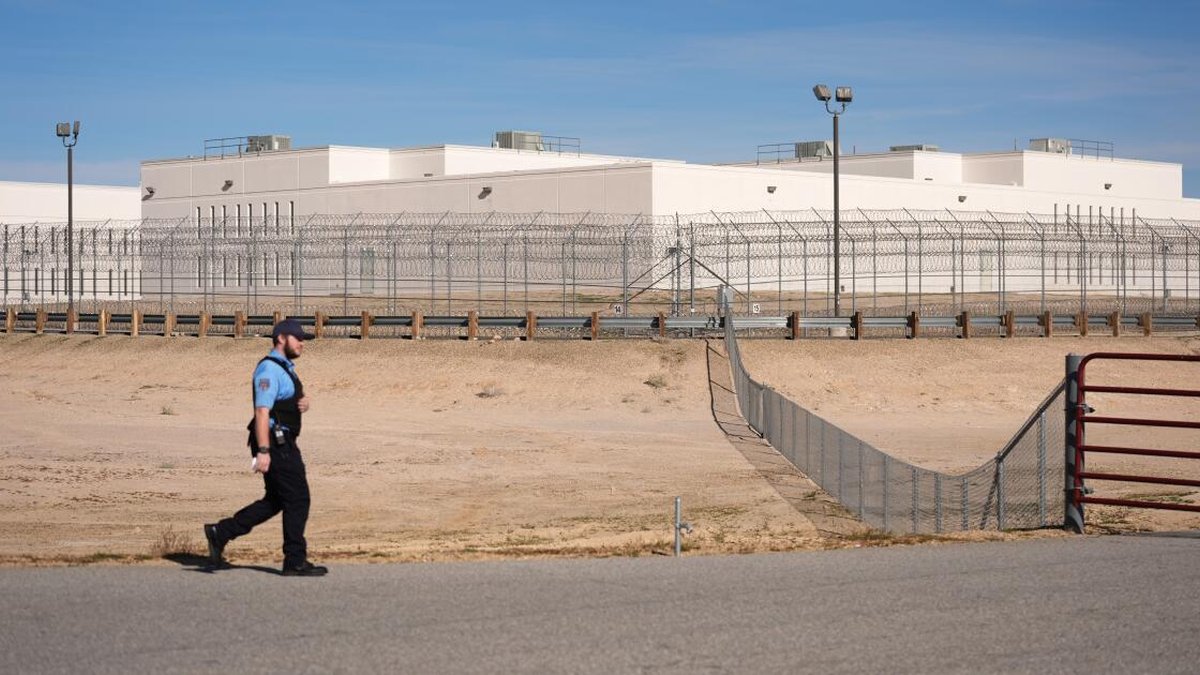
- The facilities in California City and Otay Mesa are the two largest immigrant detention centers in California.
- The purchases mark a shift toward federal ownership that critics say attempts to sidestep state efforts to monitor the facilities.
- The sale doesn’t signal major changes at the facilities. CoreCivic expects to continue managing them under existing contracts with the government.
WASHINGTON — The Department of Homeland Security bought two of the largest immigrant detention facilities in California for $1.5 billion, according to the private prison company that sold them.
The purchase comes as the department — flush with cash after President Trump’s One Big Beautiful Bill Act infused the agency with $170 billion — has moved to scale up its capacity to detain immigrants without relying as heavily on private prison corporations.
In the announcement Monday, Tennessee-based CoreCivic said the sale of the 2,560-bed California City Detention Facility and the 1,994-bed Otay Mesa Detention Center in San Diego closed on July 2.
The company said it expects net proceeds of about $1.1 billion after income taxes and transaction expenses.
Ryan Gustin, public affairs director for CoreCivic, said that such sales are not uncommon and that “the process was marked with rigor and integrity.” He added that the valuations were established through the federal government’s required appraisal process, using independent appraisers who determined objective fair market value.
The sale doesn’t immediately change anything at the facilities — CoreCivic expects to continue managing them under existing contracts with U.S. Immigration and Customs Enforcement, according to the company and a filing with the Securities and Exchange Commission.
But the terms of those contracts could be modified given the change in ownership, the filing states. The California City facility contract expires in August 2027 and the Otay Mesa facility contract expires in December 2029, with the option to extend for five more years.
“We are pleased with the sales of these two mission-critical facilities for the Company’s government partner, which demonstrates the value of the Company’s underlying real estate portfolio, while reflecting our role as a long-term, flexible solutions provider to government,” CoreCivic Chief Executive Patrick Swindle said in the announcement.
More than 300 detainees are estimated to have signed grievance letters sent to facility administrators, according to advocates with the California Collaborative for Immigrant Justice.
A Homeland Security spokesperson confirmed that the purchase was made possible because of funding from Trump’s big tax law, which “allowed ICE to expand detention space to fulfill the President’s promise of mass deportations.”
“Unlike in states like Florida and Oklahoma, ICE can not rely on local state and county partners for detention space in California,” said the spokesperson, who did not provide their name in the emailed statement. “The state’s sanctuary politicians continue to push legislation to outlaw or make private prisons financially [unfeasible]. Now, with federal ownership of these detention centers which are crucial to ICE’s detention network on the west coast ICE retains the detention capacity needed to arrest, detain, and remove illegal aliens.”
During a quarterly earnings call in May, George Zoley, CEO of GEO Group, another major private prison corporation, said the company had been in discussions with ICE “regarding the potential sale of multiple facilities.”
Critics of the purchase of detention facilities say the Trump administration is simply looking to avoid state and local oversight by bringing them under federal ownership. That issue was raised during the GEO Group earnings call when a participant later asked why the federal government wants to own the facilities instead of contracting with third parties.
If the facilities are federally owned, Zoley replied, there are “more protections from unwarranted litigation that infringes upon the activities of the ICE processing centers.”
Zoley said federal ownership would bolster the legal defense of the facilities and the argument that “states can only have very limited involvement.”
“There’s been litigation regarding overseeing medical services, food services, general cleanliness, etc.,” Zoley continued. “It’s really unprecedented and I believe it’s fundamentally unconstitutional. As some blue states are considering more active involvement in oversight of facilities, I think the logical solution to much of that is federal ownership of the facilities.”
California tried to kick private detention operators out of the state, but the 2020 law was overturned in the 9th Circuit Court of Appeals. Since then, state leaders have established oversight mechanisms through laws that allow for monitoring and investigation of detention centers by the California Department of Justice and local health authorities.
California enacted a law during the first Trump administration requiring state oversight of immigrant detention facilities. This is the fifth report released by the California Department of Justice since 2019.
Asked to comment about the sale, Sen. Alex Padilla (D-Calif.) said his congressional oversight visits to facilities operated by CoreCivic have shown that immigrants who pose no public safety threat are being held in “unacceptable conditions.”
“Whether these facilities are operated by a private contractor or owned by the federal government, my expectations remain the same,” he said. “I will continue demanding transparency, accountability, and humane conditions that respect the dignity and rights of every person in immigration detention.”
Eight ICE detention facilities now operate in California, with a combined capacity to hold nearly 9,000 people.
The California City and Otay Mesa facilities have both been the subject of lawsuits by detainees alleging mistreatment. CoreCivic calls such allegations unfounded and says it complies with all regulations concerning the treatment of detainees.
In its announcement on Monday, CoreCivic said the company is in discussions with ICE about potentially selling additional detention facilities, though it said those talks are in various stages and it’s unclear whether the sales will go through.
Facts Only
* The Department of Homeland Security bought two immigrant detention facilities in California for $1.5 billion.
* The purchased facilities are the California City Detention Facility (2,560 beds) and the Otay Mesa Detention Center (1,994 beds).
* The sale was announced by CoreCivic, a private prison company.
* CoreCivic expected net proceeds of about $1.1 billion after taxes and expenses.
* The sale closed on July 2.
* CoreCivic expects to continue managing the facilities under existing contracts with ICE.
* Contract terms for the California City facility expire in August 2027, and the Otay Mesa facility contract expires in December 2029, with extension options available.
* Advocates estimate over 300 detainees have signed grievance letters to facility administrators.
* Eight ICE detention facilities operate in California, holding nearly 9,000 people in total across the state.
Executive Summary
Full Take
The transaction highlights a tension between federal expansion of detention capacity and regional efforts for oversight. The shift toward federal ownership is framed by critics as an evasion of state accountability, which contrasts with California's ongoing efforts to establish monitoring mechanisms through state and local authorities. This dynamic forces a consideration of where legitimate checks and balances reside: within the federal structure or in state-level governance. Furthermore, the arguments raised by critics regarding federal ownership—specifically avoiding litigation over facility conditions—suggest a fundamental disagreement on the locus of responsibility for humane detention standards. The narrative suggests that while private entities possess real estate value, the ultimate implication concerns the constitutional and practical implications of transferring control to an agency intended for broad enforcement power, raising questions about sustained accountability regardless of the contractual arrangements.
Bridge Questions: If federal ownership is established, what specific mechanisms are required to ensure continuous, non-partisan oversight beyond the initial transaction? How does the existence of multi-layered contracts affect the ability of state and local bodies to enforce their monitoring mandates when federal agencies hold ultimate control? What accountability framework should supersede contractual agreements concerning detainee conditions?
Sentinel — Human
The analysis is grounded in reported facts and layered context, exhibiting the complexity and focus typical of investigative reporting rather than pure content generation.