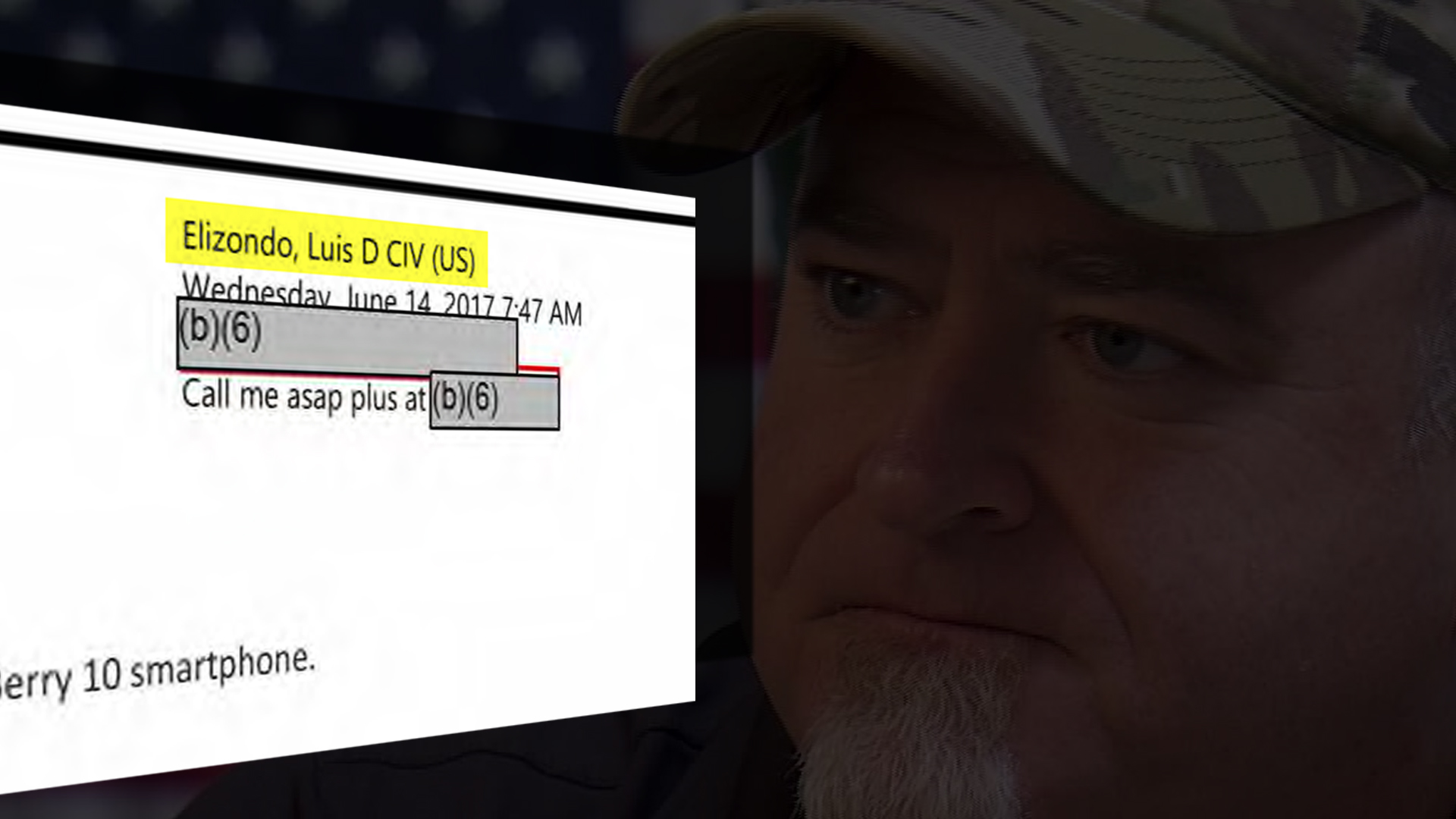
Luis Elizondo has become a central figure in the modern discourse surrounding Unidentified Aerial Phenomena (UAP) due to his alleged involvement with the Pentagon’s Advanced Aerospace Threat Identification Program (AATIP). His revelations and subsequent claims have been both groundbreaking and controversial, fueling numerous debates regarding the U.S. government’s engagement with UAPs.
In an unprecedented revelation, The Black Vault was the first to report that the Department of Defense (DoD) had destroyed Elizondo’s emails, a move that surprised many and intensified the scrutiny surrounding the government’s handling of this sensitive subject. It also hindered efforts to verify many of Elizondo’s claims, with the use of what would likely reside in these emails. Therefore, this presented a significant barrier to the standard Freedom of Information Act (FOIA) process while investigating his claims.
Yet, where one door closed, another opened.
Recognizing that communication is a two-way process, The Black Vault initiated a strategic approach. By targeting FOIA requests on the email archives of DoD personnel who had likely corresponded with Elizondo, it was possible to indirectly recover portions of Elizondo’s email exchanges. This indirect method, albeit unorthodox, proved to be a way to shed light on conversations that would have otherwise remained obscured.
The archive below, which is still being added to due to the fact that numerous FOIA requests are still open, is a collection of emails offering a glimpse into the world of Luis Elizondo and his interactions within the Department of Defense. In addition, it also logs those that may have communicated with Elizondo, but according to the FOIA final response, ‘no records’ were found. That is archived here as the inability to find records can be used to fact check claims in the past made.
Document Archive
| Records Released Archive: |
| Name Withheld [10 Pages, 1MB] – The Black Vault has opted to keep the identity of this particular person anonymous. The name, discovered by The Black Vault, was one that the DoD aimed to not reveal in the FOIA release, and the DoD opted to remove the name in their FOIA case logs that referenced The Black Vault’s request. As a courtesy, and in the interest in privacy, the name is withheld. However, the documents are here for research and reference. This person was likely a subordinate who, as you can see from the emails, did various tasks for Elizondo. Notably, this was the person that got DOPSR’s email address that Elizondo utilized to coordinate a review of the FLIR, Gimbal and GoFast videos for use in an internal DoD database. |
| Marcel Lettre [3 Pages, 1MB] – Marcel Lettre served as the Under Secretary of Defense for Intelligence at the U.S. Department of Defense (DoD) from December 2015 to January 2017. In this role, he was the principal intelligence advisor to the Secretary of Defense. Lettre’s tenure at the DoD intersected with the time frame during which Luis Elizondo claims he was involved with the Advanced Aerospace Threat Identification Program (AATIP). Given the overlapping periods of their service, a request was filed for communications. |
| McKernan, Brennan [28 Pages, 0.8MB] – Brennan McKernan is a U.S. Navy intelligence analyst who served as director of the Pentagon’s Unidentified Aerial Phenomena Task Force (UAPTF), the unit responsible for collecting and analyzing military UFO/UAP sightings prior to its replacement by newer offices like AARO. The request, filed by The Black Vault in June of 2021, asked for all communications between McKernan and Elizondo for all dates available. |
| “No Records” or Other Records Destroyed Archive: |
| James Clapper [3 Pages, 1MB] – James Clapper served as the U.S. Director of National Intelligence (DNI) from 2010 to 2017, overseeing the country’s 17 intelligence agencies. Before his tenure as DNI, Clapper held various key positions within the U.S. intelligence community, including the Director of the Defense Intelligence Agency (DIA) from 1992 to 1995 and the Undersecretary of Defense for Intelligence from 2007 to 2010. During Clapper’s time in the Department of Defense (DoD), particularly his stint as the Undersecretary, Luis Elizondo was also affiliated with the DoD, so their paths in the sprawling DoD apparatus may have intersected. A FOIA request which had combined a few names did not yield communications between Elizondo and Clapper. However, above, you will see the release relating to Marcel Lettre, which was in the same combined request as this one. |
|
Mark Sanders [3 Pages, 1MB] – It is likely that Mr. Mark Sanders was the Director of the Foreign Material Program at the time Luis Elizondo stated he briefed him on AATIP, as claimed by Elizondo’s IG complaint, as published by the NY Post. Although the name was redacted, a DoD resource indicates Sanders was likely in that position. A request was filed, but it was determined through the processing of the FOIA case that Sanders’ emails were destroyed after he left the DoD in 2017. Therefore, a “no records” determination was given. |
| Patrick Shanahan – Patrick Shanahan served as the 33rd Deputy Secretary of Defense from July 2017 until January 2019 and then as the Acting Secretary of Defense from January 2019 to June 2019. Prior to his time in the Pentagon, Shanahan had a distinguished career at Boeing. During his tenure at the Department of Defense (DoD), Luis Elizondo claimed to have headed the Advanced Aerospace Threat Identification Program (AATIP) until he resigned from the DoD in 2017. Given their overlapping time at the Pentagon and the significant attention AATIP and related UAP issues have received, it’s plausible that Shanahan and Elizondo may have had some level of interaction or awareness of each other’s work, however, FOIA case 20-F-0049 showed “no records” were found in regards to communications. |
Follow The Black Vault on Social Media:
Facts Only
Luis Elizondo was involved with the Pentagon’s Advanced Aerospace Threat Identification Program (AATIP).
The Department of Defense (DoD) destroyed Elizondo’s emails, hindering FOIA verification efforts.
The Black Vault obtained partial email exchanges by requesting records from DoD personnel who corresponded with Elizondo.
Released documents include emails from a subordinate who assisted Elizondo, including coordination for reviewing UAP videos (FLIR, Gimbal, GoFast).
Marcel Lettre, Under Secretary of Defense for Intelligence (2015–2017), had overlapping tenure with Elizondo’s claimed AATIP involvement.
Brennan McKernan, a Navy intelligence analyst and former UAP Task Force director, had 28 pages of communications with Elizondo released.
FOIA requests for emails between Elizondo and James Clapper (former DNI) yielded no records.
Mark Sanders, likely Director of the Foreign Material Program, had his emails destroyed after leaving the DoD in 2017.
Patrick Shanahan, former Deputy and Acting Secretary of Defense, had no records of communication with Elizondo.
Some FOIA responses indicated "no records" were found, either due to destruction or lack of communication.
The Black Vault withheld the name of one subordinate in the released documents for privacy reasons.
The archive is ongoing, with additional FOIA requests still pending.
Executive Summary
Luis Elizondo, a former Pentagon official, has been a pivotal figure in discussions about Unidentified Aerial Phenomena (UAP) due to his involvement with the Advanced Aerospace Threat Identification Program (AATIP). The Department of Defense (DoD) destroyed Elizondo’s emails, complicating efforts to verify his claims through Freedom of Information Act (FOIA) requests. In response, The Black Vault pursued an indirect approach by requesting emails from DoD personnel who likely corresponded with Elizondo, uncovering partial exchanges. The released documents include communications with figures like Marcel Lettre, former Under Secretary of Defense for Intelligence, and Brennan McKernan, a Navy intelligence analyst who led the UAP Task Force. However, requests for emails involving other key figures, such as James Clapper and Patrick Shanahan, yielded no records, either due to destruction or lack of communication. This patchwork of recovered and missing records highlights both the challenges of transparency in government UAP investigations and the fragmented nature of available evidence.
The archive reveals some operational details, such as coordination for reviewing UAP videos like FLIR, Gimbal, and GoFast, but also underscores gaps where records were destroyed or never existed. The absence of emails from figures like Mark Sanders, whose role aligned with Elizondo’s claims, raises questions about record-keeping practices and the reliability of historical accounts. While the released documents provide glimpses into Elizondo’s interactions, the broader narrative remains incomplete, leaving room for both skepticism and speculation about the government’s handling of UAP-related information.
Full Take
The strongest version of this narrative is that it exposes systemic barriers to transparency in government UAP investigations. The destruction of Elizondo’s emails and the patchy recovery of related communications underscore a pattern of institutional opacity, whether intentional or bureaucratic. The Black Vault’s indirect FOIA strategy is a clever workaround, but the gaps—such as missing records from key figures like Clapper and Shanahan—leave critical questions unanswered. This aligns with broader concerns about how sensitive programs are documented and whether accountability mechanisms are adequate.
Patterns detected: ARC-0024 Ambiguity (selective transparency), ARC-0043 Motte-and-Bailey (claims of government secrecy used to both justify and obscure narratives).
The root cause here is the tension between national security secrecy and public accountability. The UAP discourse thrives in this ambiguity, where incomplete records fuel both skepticism and conspiracy theories. The paradigm assumes that if records are missing, it must be deliberate—a framing that benefits those who profit from mystery (e.g., media, certain researchers) while disempowering those seeking clarity.
Implications for human agency: Without verifiable records, the public is left to navigate a landscape where trust in institutions erodes, and alternative explanations flourish. The cost is borne by those seeking factual grounding, while the benefits accrue to narratives that exploit uncertainty.
Bridge questions: What would it take for the DoD to implement consistent record-keeping for sensitive programs? How might the UAP community balance skepticism with the risk of overinterpreting gaps in evidence? What institutional reforms could prevent future destruction of potentially historic records?
Counterstrike scan: A bad actor pushing this narrative might amplify the "destroyed emails" angle to imply a cover-up, while ignoring the mundane realities of bureaucratic record-keeping. The actual content doesn’t fully match this pattern—it presents the gaps as part of a broader transparency struggle rather than a smoking gun. However, the framing could still be weaponized by those seeking to undermine trust in government institutions.
Sentinel — Human
The text exhibits strong human characteristics, blending investigative reporting style with factual presentation, suggesting it is based on human research and synthesis rather than purely synthetic generation.