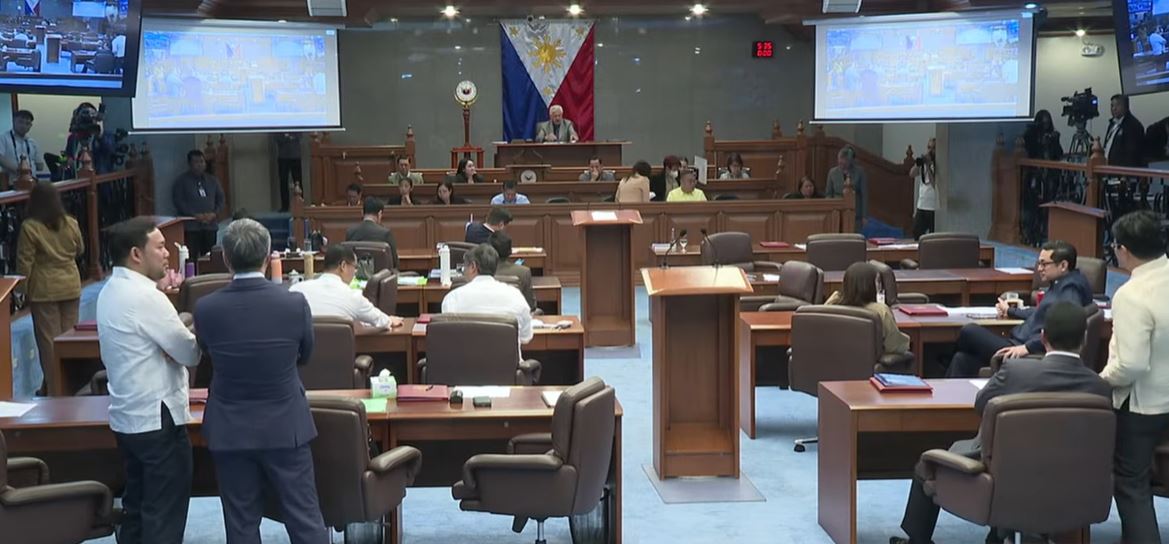
Senate leaders on Monday expressed support for the call to study the possible postponement of the Philippines’ hosting of the 2026 ASEAN Summit and Related Summits to save over P17 billion amid the economic pressures resulting from the Middle East conflict.
Senate President Vicente “Sotto” III said that he agrees that the government should consider the suggestion made by former Finance Secretary Margarito “Gary” Teves.
“The Executive department might consider that,” Sotto said. “The times call for such a possible move.”
Senate President Pro Tempore Panfilo "Ping" Lacson echoed this, believing that the country’s neighbors in Southeast Asia would understand if ever the Philippines were to delay its hosting of the ASEAN Summit.
“Former Secretary Gary Teves’ proposal merits at least serious study and possible reconsideration. I think our ASEAN neighbors would understand,” Lacson said.
The Philippines assumed ASEAN chairmanship in 2026 following Malaysia's term.
Last year, the Marcos government requested approval from Congress to spend a total of P17,495,734,000 on the 2026 ASEAN Summit Meetings in the Philippines.
Senator Imee Marcos, who was earlier replaced as chairperson of the Senate foreign relations committee, also said the government should not be allowed to spend P17 billion for such an event, considering the current situation of the country.
“Pwedeng simpleng meetings na lang at pati mga kapwa nating members sa ASEAN namomroblema rin,” she said.
(It could just be simple meetings because even our fellow ASEAN members are having problems too as of the moment.)
“Kung nakakahiya na i-postpone, ituloy na lang natin as meetings. Simplified ng todo and use the opportunity to meet and ask for support for oil-producing members like Brunei, Indonesia, and Malaysia,” she added.
(If it's embarrassing to postpone the hosting, let's push it through, but only as meetings—everything is simplified. And let’s use the opportunity to meet and ask for the support of oil-producing members like Brunei, Indonesia, and Malaysia.)
Earlier on Monday, Malacañang brushed off concerns of an oil crisis in the country, saying fuel supply remains adequate but acknowledging a prevailing “price disruption.”
National emergency
Senator Bam Aquino, meanwhile, pushed for the declaration of a state of national emergency, stressing that the situation of many Filipino families is already at an “emergency level.”
“Unang-una, ‘pag may state of national emergency, pwede silang maglagay ng price ceiling sa mga essential goods. Pangalawa, iyong ayuda na nilaan namin sa 2026 budget, ilabas na at ibigay na sa transport workers at suporta sa mga MSMEs (micro, small, and medium enterprises),” Aquino said.
(First of all, if there is a state of national emergency, they can put a price ceiling on essential goods. Second, the cash aid that we provided under the 2026 budget will be released and given to transport workers and support the MSMEs.)
Aquino also committed to monitoring the emergency powers set to be given to President Ferdinand “Bongbong” Marcos Jr. so that he may suspend or reduce the fuel excise taxes amid the conflict in the Middle East.
The House of Representatives on Wednesday adopted the Senate version of the bill in a bid to address rising oil prices.
For Deputy Majority Floor Leader Senator JV Ejercito, the government should create an inter-agency task force to prepare for the potential economic and energy impact of the escalating conflict in the Middle East.
“Sana magtatag na ng force para mapag-usapan kung ano ang puwedeng gawin. Halimbawa, kung ano ang plano sa pagtitipid o austerity measures,” Ejercito said.
(I hope a task force can be formed to discuss what can be done. For example, what is the plan for the government to save money or what are the austerity measures?)
Oil storage facility
Senator Francis “Chiz” Escudero, meanwhile, has filed a measure seeking to establish a government-owned crude oil tank storage facility in a bid to address the problem with soaring prices of petroleum products.
Under Escudero’s proposal, the Philippines would build a crude oil tank farm capable of storing 90 days’ worth of national consumption up to 180 days. The bill seeks to allocate an initial funding of P60 billion for the construction of the fuel reserves facility.
The acquisition of fuel inventory for the reserve shall be undertaken by the Department of Energy, or through the Philippine National Oil Company or its subsidiary.
“A strategic crude oil stockpile is our shield. Every time tensions rise in the Middle East, every time shipping lanes are disrupted, our economy absorbs the shock within days. We need a national buffer that protects Filipino families and industries from crises happening thousands of miles away,” Escudero said in a statement.
“By releasing crude during shortages or extreme price spikes, the government would be able to protect essential sectors such as transport, agriculture, and power generation, while also strengthening the country’s negotiating position during global market disruptions,” he added. —LDF, GMA Integrated News
Facts Only
Senate President Vicente Sotto III supports studying the postponement of the Philippines’ hosting of the 2026 ASEAN Summit.
Senate President Pro Tempore Panfilo Lacson believes ASEAN neighbors would understand a delay.
The Philippines assumed ASEAN chairmanship in 2026 after Malaysia’s term.
The Marcos government requested P17,495,734,000 for the 2026 ASEAN Summit.
Senator Imee Marcos opposes spending P17 billion on the event, suggesting simplified meetings instead.
Senator Bam Aquino proposes declaring a state of national emergency to impose price ceilings and release aid.
The House of Representatives adopted a Senate bill to address rising oil prices.
Senator JV Ejercito calls for an inter-agency task force to prepare for economic impacts from the Middle East conflict.
Senator Francis Escudero filed a bill to establish a government-owned crude oil storage facility with P60 billion in initial funding.
The Department of Energy or Philippine National Oil Company would manage the proposed oil reserves.
Malacañang states fuel supply remains adequate but acknowledges price disruptions.
Executive Summary
Senate leaders in the Philippines have expressed support for studying the postponement of the country’s hosting of the 2026 ASEAN Summit, citing economic pressures from the Middle East conflict and the need to save over P17 billion. Senate President Vicente Sotto III and Senate President Pro Tempore Panfilo Lacson both endorsed the proposal, suggesting that ASEAN neighbors would understand the delay. The Marcos government had previously requested P17.5 billion for the event, but Senator Imee Marcos argued for simplified meetings instead, given the financial strain on the Philippines and other ASEAN members. Meanwhile, Senator Bam Aquino called for a state of national emergency to impose price controls on essential goods and release aid to transport workers and small businesses. Other proposals include forming an inter-agency task force to address economic impacts and establishing a government-owned crude oil storage facility to mitigate fuel price volatility. The government has acknowledged fuel price disruptions but maintains that supply remains adequate.
The debate reflects broader concerns about economic stability amid global tensions, with lawmakers advocating for both fiscal prudence and proactive measures to shield vulnerable sectors. While some emphasize cost-saving measures, others push for structural solutions like strategic oil reserves to buffer future crises. The discussion highlights the balancing act between international commitments and domestic economic priorities.
Full Take
The strongest version of this narrative frames the Philippines’ economic challenges as a call for pragmatic leadership—balancing fiscal responsibility with proactive crisis management. Senate leaders are steelmanning the argument for postponing the ASEAN Summit by emphasizing solidarity with regional partners and the need to prioritize domestic stability. The proposals—from price controls to strategic oil reserves—reflect a spectrum of solutions, acknowledging both immediate relief and long-term resilience. However, the debate also reveals tensions between international obligations and national interests, a recurring dilemma for middle-income countries navigating global instability.
Pattern scan: The narrative leans on emotional appeals (e.g., "emergency level" for families) and authority games (e.g., invoking former officials like Teves to lend credibility). The framing of the ASEAN Summit as a "luxury" amid crisis risks oversimplifying its diplomatic value, while the call for a national emergency could be seen as a motte-and-bailey—justifying broad powers under the guise of urgency. That said, the discussion remains largely within bounds of legitimate policy debate.
Root cause: The paradigm here is one of scarcity—both financial and geopolitical. The unstated assumption is that the Philippines must choose between hosting a prestigious event and addressing domestic hardship, a false binary that ignores potential hybrid solutions (e.g., scaled-down summits). Historically, this echoes how developing nations often face pressure to deprioritize soft power investments during crises, reinforcing a reactive rather than strategic posture.
Implications: The push for austerity measures and oil reserves could empower vulnerable sectors but also risks centralizing control over resources. Second-order consequences include potential strain on ASEAN cohesion if the Philippines delays its chairmanship, or unintended market distortions from price ceilings. The focus on oil storage, while pragmatic, may divert attention from broader energy transition needs.
Bridge questions: What alternative formats for the ASEAN Summit could preserve diplomatic goodwill while reducing costs? How might price controls interact with existing market mechanisms, and who would bear unintended consequences? If the Middle East conflict escalates further, would the proposed oil reserves be sufficient, or is this a band-aid for systemic vulnerability?
Counterstrike scan: A coordinated influence campaign might exploit economic anxiety to push for expanded executive powers (e.g., emergency declarations) or frame regional cooperation as a drain on resources. The actual content aligns with legitimate policy discourse, though the emphasis on "embarrassment" over postponement could be leveraged to manufacture urgency. No structural alignment with manipulation detected—this appears to be a genuine debate.
Patterns detected: ARC-0024 Ambiguity (emotional framing of "emergency"), ARC-0043 Motte-and-Bailey (emergency powers as a trojan horse for broader control).
Sentinel — Human
The article shows strong signs of human authorship, including natural language mixing, direct quotes with idiosyncrasies, and context-specific political references. No significant stylometric or coordination red flags were detected.