Insider Brief
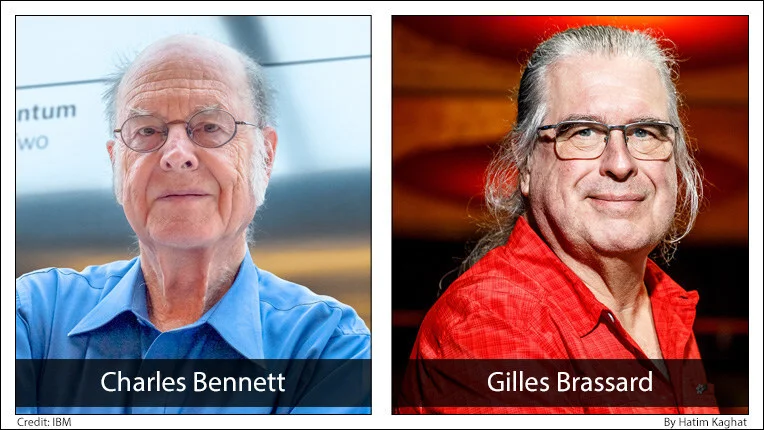
- Charles H. Bennett and Gilles Brassard have been awarded the 2025 ACM A.M. Turing Award for founding quantum information science and enabling secure communication based on quantum principles.
- Their development of the BB84 protocol demonstrated that encryption could be secured by the laws of physics rather than computational assumptions, laying the foundation for quantum cryptography.
- Their broader contributions, including quantum teleportation and entanglement distillation, underpin modern efforts to build quantum networks and large-scale quantum computing systems.
PRESS RELEASE — ACM, the Association for Computing Machinery, today named Charles H. Bennett and Gilles Brassard as the recipients of the 2025 ACM A.M. Turing Award for their essential role in establishing the foundations of quantum information science and transforming secure communication and computing.
The ACM A.M. Turing Award, often referred to as the “Nobel Prize in Computing,” carries a $1 million prize with financial support provided by Google, Inc. The award is named for Alan M. Turing, the British mathematician who articulated the mathematical foundations of computing.
Bennett and Brassard are widely recognized as founders of quantum information science, a field at the intersection of physics and computer science that treats quantum mechanical phenomena not merely as properties of matter, but as resources for processing and transmitting information.
In 1984, inspired by the insights of their late collaborator Stephen Wiesner, Bennett and Brassard introduced the first practical protocol for quantum cryptography, now known as BB84. The paper, “Quantum Cryptography: Public Key Distribution and Coin Tossing,” demonstrated that two parties could establish a secret encryption key with security guaranteed by the laws of physics, even against adversaries with unlimited computational power and technological sophistication such as a quantum computer.
In 1949, mathematician and computer scientist Claude Shannon proved that perfect secrecy in communications is only possible between parties who share ahead of time a secret key that is at least as long as the message itself. Public-key cryptography later provided a powerful workaround by relying on mathematical problems which were believed to be hard to solve—assumptions embedded in modern digital infrastructure but shown by Peter Shor as early as 1994 to become insecure when a full-size quantum computer is available. In sharp contrast, BB84 achieves information-theoretic security without computational assumptions, instead relying on a fundamental property of quantum information: it cannot be copied or measured without disturbance. Any attempt at eavesdropping leaves detectable traces before any information can be compromised.
As research advances toward large-scale quantum computers, governments and industry are reassessing the long-term resilience of widely deployed public-key cryptographic systems. Quantum cryptography, alongside emerging, hopefully quantum-resistant classical approaches for which no proofs of security are known, represents one pathway toward securing digital communications in the decades ahead. Variants of BB84 have already been implemented in operational quantum communication networks around the world, using both landlines via fiber and free space communication through satellites.
Beyond cryptography, Bennett and Brassard’s work reshaped the theoretical foundations of computing. In 1993 and with other collaborators, they introduced quantum teleportation, demonstrating how an arbitrary quantum state could be transmitted between distant parties using quantum entanglement—the surprisingly correlated behavior of particles too far apart to influence one another—and classical communication. This discovery showed that entanglement, once viewed primarily as a philosophical curiosity, could serve as a practical resource. Experimental verification of related phenomena was recognized by the 2022 Nobel Prize in Physics.
Their subsequent work on entanglement distillation in 1996 demonstrated how imperfect entanglement could be strengthened into high-quality entanglement, a critical step toward scalable quantum communication. These ideas underpin ongoing efforts to build quantum networks and ultimately a quantum internet capable of transmitting quantum information across global distances.
Over four decades, Bennett and Brassard’s collaboration bridged two previously distinct disciplines: physics and computer science. By incorporating quantum principles into computational models, their work has influenced cryptography, algorithm design, computational complexity, learning theory, interactive proofs, and mathematical physics. Their research helped catalyze a generation of physicists and computer scientists to work across disciplinary boundaries.
“Bennett and Brassard fundamentally changed our understanding of information itself,” said Yannis Ioannidis, President of ACM. “Their insights expanded the boundaries of computing and set in motion decades of discovery across disciplines. The global momentum behind quantum technologies today underscores the enduring importance of their contributions.”
Their recognition comes on the heels of the United Nations’ designation of 2025 as the International Year of Quantum Science and Technology, reflecting the growing global investment in quantum computing, communication, and sensing. Many of today’s ambitious efforts to build large-scale quantum systems trace their conceptual foundations to the theoretical breakthroughs pioneered by Bennett and Brassard.
Looking ahead, the next chapter of quantum information science includes the pursuit of fault-tolerant quantum computers, new quantum algorithms, and long-distance quantum communication enabled by satellites and quantum repeaters. Teleportation, entanglement swapping, and distillation—once abstract theoretical ideas—are now central components of practical quantum engineering.
“Charles Bennett and Gilles Brassard’s visionary insights laid the groundwork for one of the most exciting frontiers in science and technology,” said Jeff Dean, Chief Scientist, Google DeepMind and Google Research. “Their work continues to influence both fundamental research and real-world innovation. Google is proud to support the ACM A.M. Turing Award and honor the pioneers shaping the future of computing.”
Biographical Background
Charles H. Bennett is an American physicist whose research has shaped the foundations of quantum information science, quantum cryptography, and quantum teleportation, and who has played a central role in establishing quantum information science as a rigorous scientific discipline. After earning his Bachelor’s degree from Brandeis University and his PhD from Harvard University, Bennett joined IBM Research in 1973 (and still works there today), where he has spent his career exploring connections between physics (especially thermodynamics and quantum mechanics) and computer science (cryptography, computability, computational complexity, and information theory), to advance the theoretical and practical understanding of computation and quantum mechanics. He is a recipient of several prominent awards including the Wolf Prize in Physics, the Micius Quantum Prize, the BBVA Foundation Frontiers of Knowledge Award in Basic Sciences, and the Breakthrough Prize in Fundamental Physics. He is also a Member of the US National Academy of Sciences and a Foreign Member of the Royal Society.
Gilles Brassard is a Canadian computer scientist widely recognized as the first in the world to have delved into the uncharted territory of quantum information science. He earned his Bachelor’s and Master’s degrees from the Université de Montréal, and his PhD in theoretical computer science from Cornell University in 1979 under the direction of 1986 Turing Award laureate John E. Hopcroft. He joined the faculty of the Université de Montréal shortly thereafter and was Canada Research Chair in Quantum Information Science from 2001 to 2021. An Officer of the Order of Canada and of the Ordre national du Québec, Brassard has received numerous honors including the Wolf Prize in Physics, the Micius Quantum Prize, the BBVA Foundation Frontiers of Knowledge Award in Basic Sciences, and the Breakthrough Prize in Fundamental Physics. He is a Fellow of the Royal Society and an International Member of the U.S. National Academy of Sciences.
Facts Only
* Charles H. Bennett and Gilles Brassard awarded the 2025 ACM A.M. Turing Award.
* Recognition for founding quantum information science.
* BB84 protocol developed in 1984.
* BB84 provides information-theoretic security.
* Work includes quantum teleportation and entanglement distillation.
* These contribute to quantum networks and computing systems.
* ACM A.M. Turing Award carries a $1 million prize.
* Google, Inc. provides financial support.
* The award is named for Alan M. Turing.
* Bennett and Brassard are widely recognized as founders of quantum information science.
* The UN designated 2025 as the International Year of Quantum Science and Technology.
Executive Summary
Full Take
The narrative presented by this article is fundamentally a celebratory account of foundational breakthroughs, presenting Bennett and Brassard as architects of a new paradigm in information security. The core strength of the piece lies in its factual precision—it meticulously details the technical achievements of BB84 and its downstream consequences. However, the piece operates primarily within a celebratory tone, implicitly reinforcing the notion of quantum information science as a universally positive and inevitable development. A deeper scan reveals a subtle pattern: a framing of "security" as inherently linked to "physics" – a potentially misleading simplification. The article gently steers toward a future where quantum cryptography dominates, with minimal acknowledgement of the substantial engineering challenges (e.g., maintaining quantum coherence, scalability) that still exist. The implicit assumption is a seamless transition to a quantum-secured world, echoing a common technological optimism. Furthermore, the historical context—the shift away from computational assumptions—is presented as a definitively *better* approach, without fully grappling with the historical and ongoing debates within cryptography regarding the vulnerabilities of current systems. The framing implicitly positions classical cryptography as "insecure," a tactic that, while accurate in the long term, risks downplaying the existing, mature infrastructure and the ongoing efforts to enhance its resilience. Patterns detected: ARC-0024 Ambiguity, ARC-0043 Motte-and-Bailey.
The root cause driving this narrative is a desire to create a compelling, inspiring story of scientific progress—a narrative of “revolution” – that emphasizes innovation and the power of fundamental physics. The unspoken assumption is that technological progress inevitably leads to positive outcomes. The impact of this narrative extends beyond simply acknowledging the achievements of two scientists; it subtly promotes a belief in the ultimate triumph of quantum information science, potentially minimizing the complexities and risks associated with its deployment. It’s a narrative designed to generate excitement and investment.
Questions for independent inquiry: What are the long-term implications of a world increasingly reliant on a technology that, at present, is incredibly fragile and difficult to scale? How might differing philosophical viewpoints on security and privacy influence the adoption of quantum cryptography?
Sentinel — Human
This article provides a factual overview of Charles H. Bennett and Gilles Brassard’s contributions to quantum information science, highlighting their key innovations and the impact of their work. While the writing style leans towards a neutral, almost textbook-like tone, the inclusion of detailed biographical information suggests human authorship.