Tenzin Nyidon
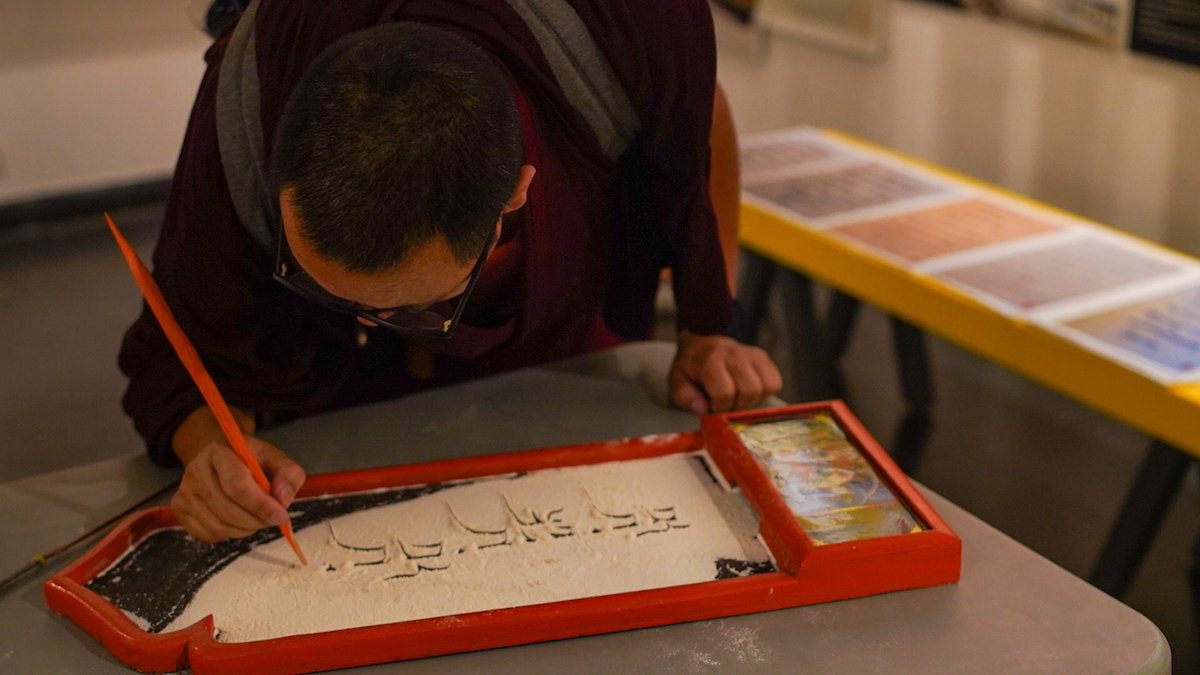
DHARAMSHALA, April 30: The exile Tibetan government, officially known as the Central Tibetan Administration, and its Tibet Museum, in collaboration with Palbung Sherabling Monastery, marked ‘Tibetan Calligraphy Day’ on Thursday with a special exhibition.
The observance of ‘Tibetan Calligraphy Day’ in exile draws its origins from within Tibet itself. Speaking on the occasion, Tenzin Topden, Director of the Tibet Museum, noted that the inaugural Tibetan Calligraphy Conference was convened inside Tibet on April 16, 2017. The gathering brought together over 130 calligraphers, teachers, and students, including both monastic and lay individuals. It was during this landmark meeting that April 30 was formally designated as ‘Tibetan Calligraphy Day,’ symbolically reflecting the fourth month (April) for the four vowels and the 30th day for the thirty consonants of the Tibetan alphabet.
The jointly organised exhibition showcased the history, various styles, and distinctive features of Tibetan script, along with exemplary works from past scholars. Topden said that the exhibition aims to help preserve, revive, and further promote the rich tradition of Tibetan calligraphy.
Karma Wangdak, a calligrapher from Sherabling Monastery speaking to media representatives, stated that the monastery in exile, particular under the guidance of the 12th Tai Situ Rinpoche, has undertaken numerous initiatives aimed at preserving and promoting the Tibetan language. Among these efforts, significant emphasis has been placed on sustaining and advancing the tradition of Tibetan calligraphy.
He further noted that, in accordance with His Holiness’s 90th birthday, a similar exhibition on Tibetan calligraphy was also organized last year at the monastery, and expressed great pride in being able to hold such a calligraphy exhibition again this year to mark ‘Tibetan Calligraphy Day.’
“Through such exhibitions, Tibetans should develop a deep sense of pride in the rich and profound history of their language, while also recognizing the vital importance of actively contributing to the preservation and protection of Tibetan linguistic and cultural heritage,” he stated.
This initiative has since organically inspired Tibetans in exile to adopt and celebrate the day with equal enthusiasm and cultural pride. In a similar spirit, the Students for a Free Tibet India chapter, in collaboration with Wasur Circle, a literary group on reading and writing, also marked ‘Tibetan Calligraphy Day’ at the Dekyi Tsering Hall. The programme featured calligraphy workshops led by two master practitioners, offering students hands-on training.
The event also included presentations addressing the ongoing challenges faced by the Tibetan language and education inside Tibet. Speakers highlighted concerns over Chinese state policies, including the reported curbs on Tibetan language instruction in state-run boarding schools and the recently adopted Law on the Promotion of Ethnic Unity and Progress. Emphasis was placed on the responsibility of Tibetan students in exile to continue preserving and strengthening their linguistic and cultural heritage in the face of such pressures.
The celebrations were not confined to exile communities alone. Videos and images that emerged from inside Tibet also showed Tibetans marking ‘Tibetan Calligraphy Day’ in their own ways, despite prevailing constraints. One widely shared clip on social media captured a particularly moving moment where a Tibetan man named Pema Wangchen, purchasing three calligraphy pieces at an event for RMB 78,000 (approximately ₹1.07 crore), described the occasion as one of the happiest moments of his life. His gesture stood as a powerful expression of pride and devotion to the Tibetan language and culture, highlighting the enduring bond that continues to unite Tibetans across borders.
Facts Only
The Central Tibetan Administration, Tibet Museum, and Palbung Sherabling Monastery jointly organized a Tibetan Calligraphy Day exhibition in Dharamsala on April 30.
The inaugural Tibetan Calligraphy Conference was held in Tibet on April 16, 2017, with over 130 participants, including calligraphers, teachers, and students.
April 30 was designated as Tibetan Calligraphy Day to represent the four vowels and thirty consonants of the Tibetan alphabet.
The exhibition showcased the history, styles, and features of Tibetan script, along with works from past scholars.
Karma Wangdak, a calligrapher from Sherabling Monastery, stated that the monastery has undertaken initiatives to preserve and promote Tibetan calligraphy.
A similar exhibition was organized at Sherabling Monastery in 2023 to mark His Holiness the Dalai Lama’s 90th birthday.
Students for a Free Tibet India and Wasur Circle held a calligraphy workshop in Dekyi Tsering Hall, featuring master practitioners.
Speakers at the event discussed challenges to Tibetan language education in Tibet, including Chinese state policies and the Law on the Promotion of Ethnic Unity and Progress.
Videos from Tibet showed Tibetans celebrating Tibetan Calligraphy Day, including a man named Pema Wangchen who purchased three calligraphy pieces for RMB 78,000.
Pema Wangchen described the purchase as one of the happiest moments of his life.
Executive Summary
Full Take
The observance of Tibetan Calligraphy Day reflects a deliberate effort to reinforce cultural identity and linguistic heritage in the face of systemic pressures. The designation of April 30 as a symbolic date ties the celebration to the foundational elements of the Tibetan script, grounding it in tradition while adapting to contemporary challenges. The involvement of both exile and in-Tibet communities suggests a coordinated, grassroots movement to preserve Tibetan culture, despite constraints imposed by Chinese policies. The emotional and financial investment demonstrated by individuals like Pema Wangchen underscores the deep personal and collective significance of these efforts.
The narrative highlights a tension between cultural preservation and political suppression, framing Tibetan calligraphy as both an artistic tradition and a form of resistance. The emphasis on education and language rights aligns with broader concerns about the erosion of Tibetan identity under state policies. However, the article does not delve into the potential risks faced by those participating in such celebrations within Tibet, nor does it explore counter-narratives from Chinese authorities regarding language policies.
Patterns detected: none
Root cause: The narrative is driven by a paradigm of cultural resilience, where language and art serve as tools for maintaining identity amid political marginalization. The unstated assumption is that cultural preservation is inherently tied to political autonomy, a perspective that may not be universally shared but is central to the Tibetan exile community’s worldview.
Implications: For human agency, this represents a reclaiming of narrative control, where Tibetans assert their cultural sovereignty despite external pressures. The costs are borne by those within Tibet who may face repercussions for such displays, while the benefits accrue to the broader community in terms of solidarity and continuity.
Bridge questions: How might Chinese authorities respond to the growing visibility of such cultural celebrations within Tibet? What role do digital platforms play in amplifying these movements, and what risks do they pose to participants? Would a shift in Chinese language policies alter the symbolic importance of Tibetan Calligraphy Day?
Counterstrike scan: If this were part of a coordinated influence campaign, the playbook would involve amplifying cultural pride to galvanize resistance while framing Chinese policies as existential threats to Tibetan identity. The actual content aligns with this pattern but does so organically, reflecting genuine community-driven efforts rather than orchestrated manipulation.
Sentinel — Human
The text reads like human-authored cultural reporting that effectively synthesizes institutional history, community efforts, and contemporary political challenges.