Five years ago, the gates around “Name, Image, Likeness” (NIL) contracts came down, and spending on college athletes took off. For the first time, student athletes could receive money or goods in exchange for endorsements. First through collectives, then schools, then tax breaks—and soon through sponsored uniforms—the multiplying avenues for revenue are making college athletics more lucrative than many professional sports.
For fans, this hasn’t necessarily been a bad thing. NIL has kept good players in college longer and sharpened competition.
“The basketball at the top is better than it’s ever been,” college basketball analyst Ken Pomeroy told ESPN just ahead of March Madness this year.
But the worries of many fans, coaches, and sports analysts weren’t wrong either. They predicted that paying collegiate athletes would widen the competitive gap between wealthy and less-wealthy schools, weaken team unity, and add professional pressure to young people who were, after all, supposed to be going to class and doing their homework.
“People are trying to figure out the landscape of what NIL could be,” said Dordt University athletic director Darin Keizer. “More people have become more vocal about how much they’re spending in sports. The D1 sector is becoming even more money-driven. Student athletes are transferring more than ever because of the dollar.”
Some of that is trickling down into smaller divisions like the NAIA, where about 65 percent of the 250 schools are faith-based. (You can see faith’s influence in their rule that every athlete must have one day off a week and in their early and unanimous banning of transgender athletes from women’s sports.)
“In our landscape, there’s still a purity around education-based athletics,” Keizer said. “The first thing D1 athletes are typically asking now is, ‘How much money are you going to give me?’ But our recruits are still asking me about faith fit and how we achieve competitive excellence.”
The Gospel Coalition asked Keizer how Dordt attracts student athletes, how they fight off the noise of NIL, and how they keep athletes from transferring long enough to disciple them.
Dordt is a small school. How do you attract athletes when they could get paid more at a bigger school?
What you’re offering has to be at least close to what the other schools you’re playing can offer. For a while, Dordt’s athletic scholarships were so low that it was hard to get some students in the door. We couldn’t compete with schools that had stronger athletic programs. So we started fundraising for scholarships.
Since then, we have been able to get to a reasonable spot, where most of our athletes don’t have to make a decision based solely on money.
It’s tricky, because you need to be competitive. But also, you cannot try to keep up with the Joneses. Rutgers tried to do that, and has lost more than $500 million since joining the Big Ten Conference in 2014.
And for us, money is a smaller part of the equation for attracting athletes. Students want to come to Dordt for reasons beyond just basketball, hockey, or soccer. The best thing we can do to attract the type of students we want is to stay focused on our mission of providing faith-based athletics.
I’m always asking my coaches, “Where is your arrow pointing? Is your arrow pointing toward faith-integrated athletics, with the center being Christ?” Then we’re pointing in the right direction.
But if we’re a degree off, and we’re pointing toward a by-product of what we’re trying to accomplish—that wins column—we need to adjust.
We always tell parents, “Winning is a by-product of what we are and what we’re trying to do. It is not our product.”
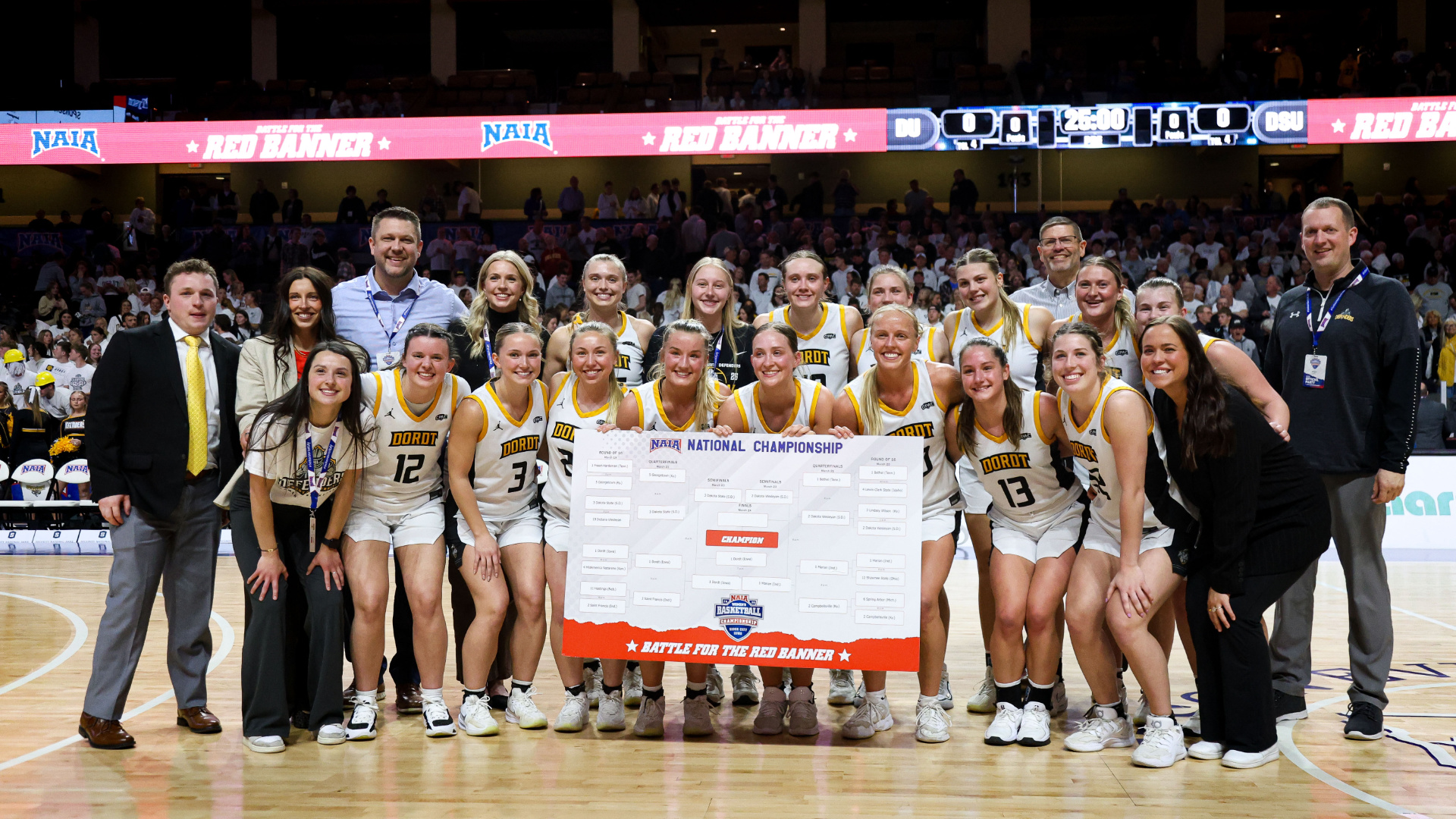
You are winning—the Dordt women’s basketball team just finished second in the NAIA tournament. Senior Macy Sievers has won a host of awards, including NAIA tournament MVP twice and NAIA Player of the Year once. She could be playing at a higher level. Why is she at Dordt?
Macy is growing a lot in her faith and learning to become a fantastic grade school teacher. She understands what we’re doing here with the Defender Way—we are committed to the Great Commission and the cultural mandate, equipping students to be servant leaders, academically developing our students, and winning championships.
That means we make different choices. For example, we are all about institution-building. We tell our athletes they need to represent the name on the front of their jersey rather than the name on the back.
That also means we don’t do things that isolate or elevate one student above another. That would negate the message we’re giving to athletes, that they need to die to themselves, and that we want everybody to be seen, known, and loved. Macy, who is consistently humble and always gives credit to her teammates, is a wonderful example of this.
I love what you’re trying to do. But how can you make yourself heard by athletes who are constantly hearing about the financial windfalls they could be getting?
We talk to them all the time.
This past fall, we led a leadership academy with our athletes about identity. We asked, “Why are you doing this?” And then, “How are you using your platform? Are you playing sports to glorify yourself and gain recognition, which is what the world says, or are you doing it to honor God?”
We always tell them their purpose is to live in community, and they have great opportunities to live in community here at Dordt. We use sports as a way to teach good leadership.
We also talk about facing adversity. I was talking to one of our baseball players the other day. We’d upset the number three team in the nation. And he told me the other team was so rattled, because they always win. When they were put in the face of adversity, it was really hard for them.
For our kids to even recognize that is great. Then we can say, “Well, what do we do when we are faced with adversity? How did you handle that on the field? And how will you handle that as a father or a husband?”
We want the Bible—not financial success or fame or feelings—to lead their principles and guide their decisions.
In order for that to take hold, you need a lot of time with students.
Yes, which is something else NIL is changing. With so many transfers, the coaching relationship is now really nine months instead of four years. Is that enough time to really make an impact on a student’s life?
We don’t want short-term, transactional coaching. Our goal is to walk alongside athletes, teaching them to be disciples of Christ and kingdom-builders. When we are recruiting, we’re telling student athletes, “We don’t want to be a two-year stepping stone. We want you here for four years.”
President Erik Hoekstra asks us all the time, “What is your Babylon?” He’s referring to Jeremiah 29:7, where God says, “But seek the welfare of the city where I have sent you into exile, and pray to the LORD on its behalf, for in its welfare you will find your welfare.”
How can we fight for the good of college football, basketball, track, volleyball, or swimming? We are fighting to be excellent and win championships. But another part of that is fighting to keep it in its right place, underneath the lordship of Christ and the priority of discipling our students.
This article was published in partnership with Dordt University.
Facts Only
NIL contracts allow college athletes to receive money or goods in exchange for endorsements (five years ago)
Collectives, schools, and tax breaks are contributing to the financialization of college sports
D1 sector is becoming more money-driven due to NIL
Student athletes are transferring more frequently because of the potential for financial gain
About 65% of NAIA (National Association of Intercollegiate Athletics) schools are faith-based
Dordt University has a rule requiring every athlete to have one day off per week
Transgender athletes have been banned from women's sports in the NAIA
Executive Summary
In a post-NIL (Name, Image, Likeness) era, college athletes can now receive compensation for endorsements, changing the landscape of American collegiate sports. While this development has led to improved competition in top-tier sports, concerns have arisen about increased competitive gaps between wealthier and less wealthy schools, team unity, and professional pressure on young athletes.
Dordt University, a small faith-based institution in Iowa, is striving to maintain its focus on education-based athletics amidst the financialization of college sports. The university has been successful in attracting athletes by emphasizing faith fit and competitive excellence rather than solely offering higher monetary compensation.
The article highlights Dordt University's approach to recruiting, leadership development, and discipleship, as well as its commitment to institution-building and avoiding isolating or elevating individual student-athletes. The university's women's basketball team has achieved significant success despite the potential for players to pursue higher-paying opportunities at larger schools.
Full Take
Pattern Analysis and Deeper Implications:
This article provides an insightful case study of Dordt University, a small faith-based institution that is navigating the impact of NIL on college sports. The university's commitment to education-based athletics and discipleship stands in contrast to the growing financialization of collegiate sports, which has raised concerns about competitive imbalances and professional pressure on young athletes.
Dordt University's approach to recruitment, leadership development, and discipleship offers a potential model for smaller institutions seeking to maintain their focus on education while competing with wealthier schools offering higher financial incentives. However, the article does not discuss the long-term implications of this approach or address potential challenges in attracting and retaining athletes amidst increasing financial pressure.
Additionally, the article presents a somewhat idealized view of Dordt University's community-oriented athletics program, emphasizing collaboration, humility, and servant leadership. While these values are admirable, it is important to recognize that such an environment may not be universally experienced by all student-athletes at the university or similar institutions.
In a broader context, the financialization of college sports raises questions about the balance between athletic competition and education, as well as the role of money in shaping the experiences and opportunities of young athletes. The growing emphasis on NIL contracts may exacerbate existing inequalities between wealthy and less-wealthy schools, as well as put undue pressure on student-athletes to perform both academically and athletically while pursuing professional opportunities.
Bridge Questions:
How can smaller institutions like Dordt University compete effectively against wealthier schools offering higher financial incentives?
What are the long-term implications of focusing on education-based athletics in an increasingly financially driven sports landscape?
To what extent should student-athletes be encouraged to pursue professional opportunities while balancing their academic responsibilities and personal wellbeing?
Sentinel — Human
Based on stylometric, coherence, and coordination indicators, the article shows signs of human authorship. The text's varied sentence lengths, personal voice, and unique narrative structure support this assessment.