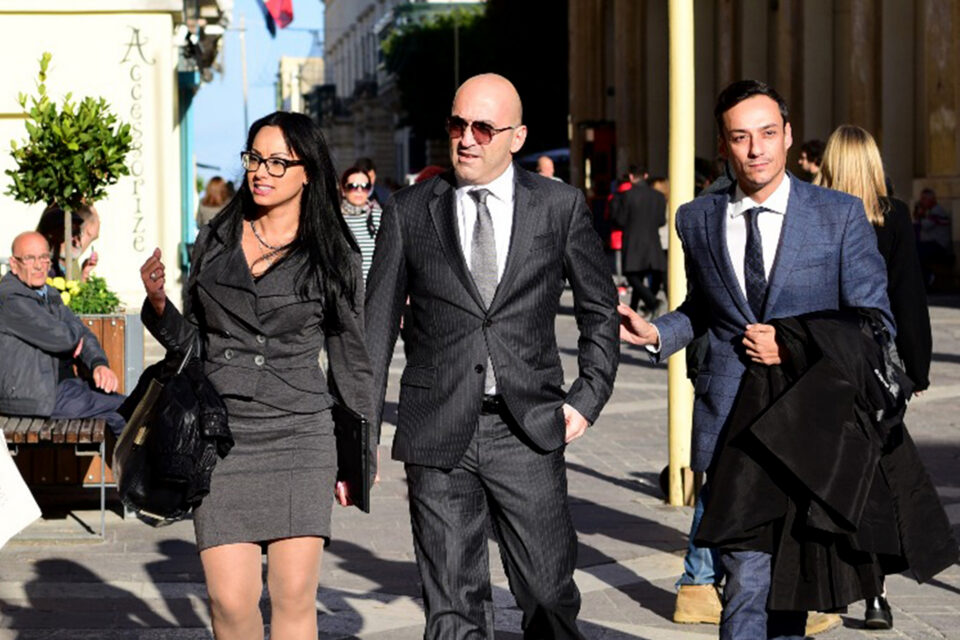
A businessman accused of ordering the murder of the Maltese journalist Daphne Caruana Galizia has gone on trial in the Maltese capital, Valletta.
Yorgen Fenech, the heir to a property empire, was arrested in 2019 by Malta’s armed forces on a yacht in connection with the car-bomb murder.
After years of delays due to legal challenges, he faces complicity and criminal association charges and is the last of seven men to face trial over the assassination that rocked the country. Fenech denies the charges.
The 2017 murder provoked outrage from journalists, civil society groups and governments around the world. Malta’s attorney general, Victor Buttigieg, has called for a life sentence for the murder charge and between 20 and 30 years for the criminal association charge.
Daphne Caruana Galizia’s husband, three sons and two sisters were in court for the commencement of the trial. Her son Matthew Caruana Galizia worked for the International Consortium of Investigative Journalists from 2014 to 2018.
In 2021, an inquiry singled out Malta’s former prime minister and his entire cabinet as bearing responsibility for Daphne Caruana Galizia’s murder.
In a 437-page report, the inquiry’s board, made up of former judges, accused the Maltese state of creating a pervasive “atmosphere of impunity” that allowed her killers to believe they’d face minimal consequences.
“The state should shoulder responsibility for the assassination,” the inquiry board wrote.
Caruana Galizia wrote extensively on corruption in Maltese politics and business.
She was killed, aged 53, in October 2017 just outside her home when her car was blown up by a remotely detonated bomb hidden under her seat in a shoebox.
She had been working on stories that built on revelations contained in the Panama Papers, among others.
In her final post on her website, published shortly before her death, Caruana Galizia wrote: “There are crooks everywhere you look now. The situation is desperate.”
Delayed justice
Five men have been convicted already in connection with Daphne Caruana Galizia’s murder. A sixth received a pardon in return for testimony.
In June 2025, Robert Agius and Jamie Vella were sentenced to life in prison for procuring and supplying the explosive device.
Two brothers, Alfred and George Degiorgio, are serving 40-year prison sentences for planting and detonating the bomb.
Another accomplice, Vincent Muscat, is serving 15 years over the killing that was allegedly masterminded by Fenech.
At the time of her death, Caruana Galizia was investigating a controversial power station deal involving Fenech.
Reporting Fenech’s trial, the Times of Malta said prosecutors alleged that Fenech had summoned a man named Melvin Theuma to a meeting at a Portomaso restaurant and asked him to find someone to kill Caruana Galizia.
The Times reported that prosecutors alleged Fenech had specifically suggested that Theuma approach George Degiorgio in April 2017.
Prosecutors had told the jury that Fenech had become increasingly anxious because Caruana Galizia was about to publish information about him, according to the Times.
Prosecutors also told the court that the agreed price for the killing was 150,000 euros, with 30,000 euros paid upfront and 120,000 euros paid after the murder.
Fenech was granted bail in February 2025 under strict conditions after agreeing to pay what is believed to be Malta’s largest ever bail, 80,000 euros with a 120,000 euro guarantee, according to the Guardian.
The scheduled trial date could not be disclosed in advance due to restrictive reporting conditions imposed by the court.
Sentinel — Human
The text is highly factual and detailed, demonstrating a structure typical of investigative journalistic reporting, with no clear stylistic or structural fingerprints pointing toward machine generation.